


Letztendlich stehen alle Projekte zur elektrischen Energieverteilung vor derselben grundlegenden ingenieurtechnischen Frage: Wo ist der geeignete Standort für Transformatoren? Dieses Versorgungsunternehmen fand eine Antwort in einem robusten Stahlgehäuse an der Ecke eines überfüllten Straßenparkplatzes auf den Philippinen. Das Transformatorengehäuse besteht aus einem 1.000 kVA Transformator, einer Ringhauptschaltanlage und einem Niederspannungsschaltfeld in einem wetterfesten Schrank. Diese Option ersetzte eine geplante Betonsubstation und schützte Hunderte von Tausenden von Dollar an Investitionen des Versorgungsunternehmens, während die Bauzeit um bis zu vier Monate verkürzt wurde. Die Entscheidung eines Versorgungsunternehmens zugunsten des boxförmigen Gehäuses anstelle des traditionellen Transformators machte die moderne kompakte Substation zu einem Erfolg.
Der Artikel beschreibt boxförmige Transformatorengehäuse, einschließlich ihrer Definition, Funktionalität, Konstruktion und Anwendungen in modernen elektrischen Energiesystemen.
Kurz gesagt, ein boxförmiges Transformatorengehäuse bezieht sich auf eine wetterfeste Abdeckung für boxförmige Umspannwerke, die das Umspannwerk, die Mittelspannungsschaltanlage und die Niederspannungsschaltanlage vor widrigen Wetterbedingungen, Schmutz, Tieren, physischen Schäden oder Störungen schützt. Das Gehäuse wird gemäß den Anforderungen der Norm IEC 62271-202 gebaut und ist nach IEC 60529 mit IP54/IP55 bewertet und bietet elektronischen Schutz, Schutz vor Hochwasserereignissen und ein manipulationssicheres Design.
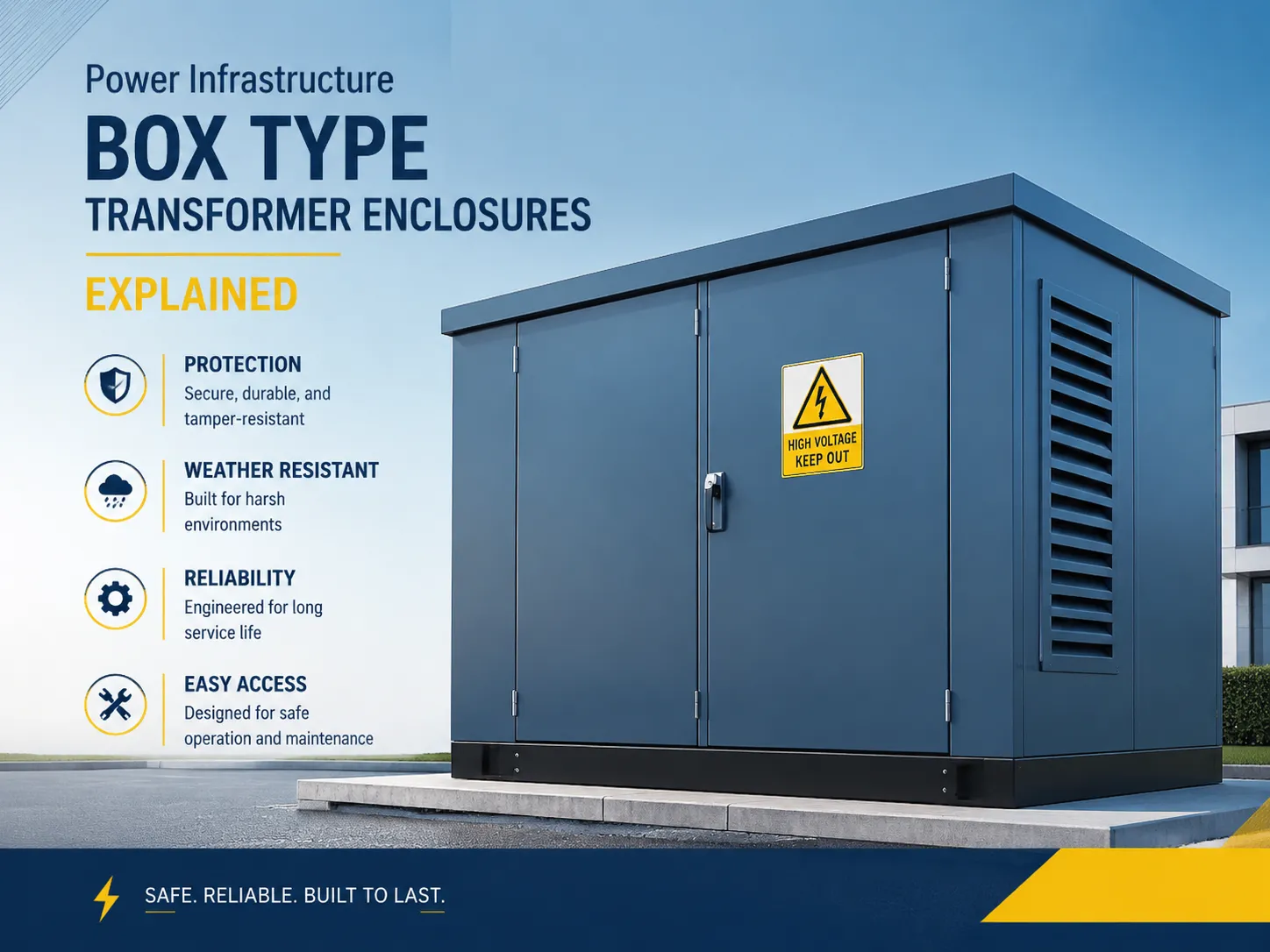
Was ist ein boxförmiges Transformatorengehäuse?
Ein boxförmiges Transformatorengehäuse ist eine Art Gehäuse, das eine kompakte, vormontierte Transformator-Umspannstation umfasst. Dieser Stahlkasten fungiert als der äußere Teil des Transformators, der im Inneren, in den meisten Designs, die Mittel- und Niederspannungsschaltanlagen, Mess- und Schutzgeräte sowie -ausrüstungen enthält. Es fungiert als Schutz zwischen dem Gerät und der Umgebung und erfüllt gleichzeitig eine Reihe von Funktionen, einschließlich Wetterschutz, Kontrolle des Kühlluftstroms, Schutz vor Manipulationen und Vandalismus, Überschwemmungen und Tieren sowie das Halten der Gefahr im Inneren im Falle eines Ausfalls innerhalb der Einheit.
Die Produktfamilie ist in IEC 62271-202 (Vorfabrizierte Transformatoren) festgelegt. Diese Position beschreibt die Anforderungen an die Gehäusekonstruktion, Abteile, Sicherheitsverriegelungen und Arten der vollständigen Prüfung des Gehäuses. Die IP-Bewertung, die von IEC 60529 festgelegt wird, bestimmt die Fähigkeit des Gehäuses, Wasser und Staub auszuschließen, und in der Regel ist seine Bezeichnung IP54 oder IP55. In Nordamerika gibt es eine vergleichbare Anforderung, die IEEE C57.12.20, die solche Gehäusetypen wie “dead front” berücksichtigt und auch die Tatsache, dass das Gehäuse gegen Manipulationen resistent sein sollte.
Das Verständnis des Gehäuses ist äußerst wichtig, da seine Effizienz Auswirkungen auf die Lebensdauer der Umspannstation, ihre Zuverlässigkeit und das Sicherheitsniveau hat, das sogar höher sein sollte als das des Transformators. Der schlechteste Transformator in einem guten Gehäuse wird jahrzehntelang gut funktionieren, während der beste Transformator innerhalb kurzer Zeit aufgrund des schlechten Gehäuses ausfallen wird.
Warum Gehäuse in der Energieinfrastruktur wichtig sind.
Die folgenden fünf Vorteile haben boxartige Transformatorengehäuse unverzichtbar gemacht:
- Reduzierte Fläche: Anstelle eines Gebäudes und eines eingezäunten Grundstücks benötigt ein Gehäuse nur 10-40 m² Fläche und spart mehr Land für eine Stadt.
- Schnelligkeit: In Fabriken gebaute Gehäuse helfen, monatelange Bauarbeiten zu vermeiden; der gesamte Installationsprozess dauert nur 2-5 Tage.
- Sicherheit der Installationsstandorte: Gehäuse sind widerstandsfähig, mit Schlössern ausgestattet, sodass sie in der Nähe von Fußgängerwegen, Schulen und Parkplätzen installiert werden können und dennoch alle Sicherheitsvorschriften erfüllen.
- Verhinderung des Einflusses externer Faktoren: Ein Gehäuse schützt vor Regen, Schmutz, Salz, Insekten usw., was zweifellos wichtig ist, damit Transformatoren nicht ausfallen.
- Niedrige Kosten: Die Kosten für ein Gehäuse sind viel niedriger als die eines Gebäudes, während der Endpreis eines Installationssystems 20-40% niedriger ist als der eines vor Ort gebauten Alternativsystems.
Das sind die Gründe für den Marktwechsel hin zur Verwendung von Gehäusen als Haupttyp von Transformatorstationen.
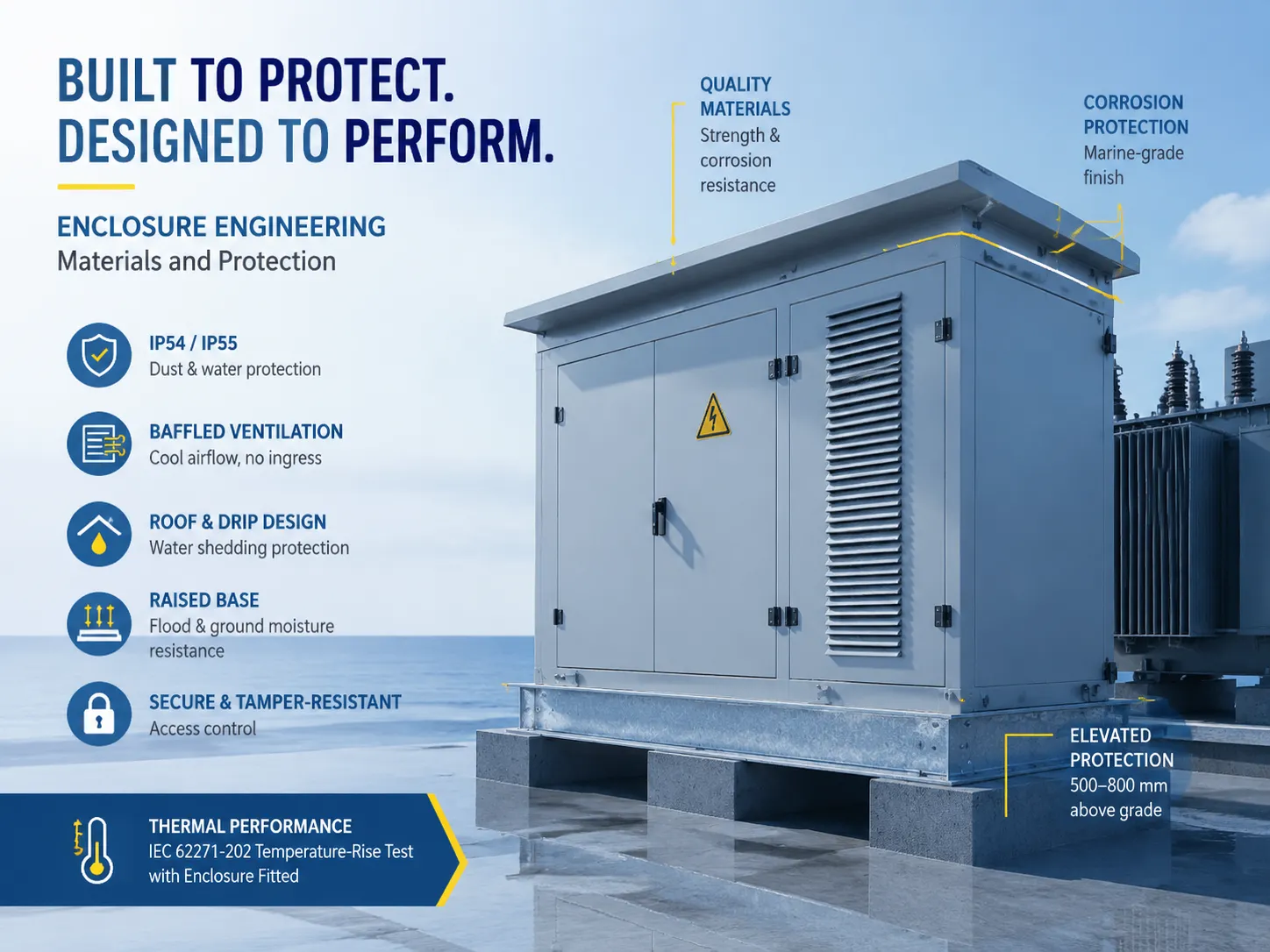
Gehäuseengineering: Materialien und Schutz
Die Qualität eines Gehäuses hängt von den verwendeten Materialien, den Konstruktionstechniken und der Umweltleistung ab.
| Element | Spezifikation | Gelieferter Schutz |
|---|---|---|
| Gehäusematerial | Lackierter Kohlenstoffstahl, Edelstahl, GRP/Verbundwerkstoff | Strukturelle Festigkeit und Korrosionsbeständigkeit |
| IP-Bewertung | IP54 (Staub + Spritzwasser), IP55 (Wasserstrahlen) | Ausschluss von Staub, Regen und Sprühwasser |
| Dach und Tropf | Überstehendes Dach, Tropfrinnen, Dichtungen | Wasserabführung von Türen und Nähten |
| Basis | Feuerverzinkt, 500–800 mm erhöht | Flut- und Bodenfeuchtigkeitsbeständigkeit |
| Belüftung | Abgedichtete, gefilterte Lüftungsschlitze mit IP-zugelassener Luftströmung | Transformatorenkühlung ohne Wettereintritt |
| Verriegelung und Manipulationsschutz | Vorhängeschlösser, interne Scharniere, Verriegelungen | Verhinderung unbefugten Zugriffs |
| Korrosionsschutz | Marinebeschichtung, anodisierte Beschläge | Salzsprüh- und UV-Beständigkeit an Küstenstandorten |
Engineering erfordert einen Kompromiss zwischen Belüftung und Schutz. Ein Gehäuse bietet somit Luftstrom zum Transformator für eine effektive Wärmeableitung, ist aber gleichzeitig anfällig für Regen, Staub und möglichen Tierzugang. Es ist jedoch möglich, effiziente Gehäuse zu entwerfen, die abgedichtete und gefilterte Lüftungsöffnungen haben und eine IP54-Bewertung erreichen, während sie die thermische Leistung gewährleisten, die durch den Temperaturanstiegstest gemäß IEC 62271-202 gefordert wird.
Interne Fächer
Es ist normalerweise mit Fächern der folgenden fünf Typen ausgestattet:
- MV-Fach: RMUs oder Vakuumschalter-Schaltanlagen mit Kabelkästen, Steuerungen, Verriegelungen und Anzeigen, die direkt zugänglich sind.
- Transformatorfach: Unterbringung des Transformators zusätzlich zum Öltank, Belüftungssystem und Temperaturwarnungen; die Tür ist mit der MV-Trennung verriegelt.
- LV-Fach: Unterbringung der Niederspannungsschaltanlage, Messgeräte, Ausgangsleitungen und optionaler Kondensatorbänke.
- Hilfszone: Unterbringung von Beleuchtung, Heizung, Antikondensationssteuerung und Verkabelung.
Die strukturelle Unterteilung, die zu den oben genannten Fächern führt, hat zwei Ziele: Sicherheit (ein interner Fehler in einem Fach erreicht nicht die Anschlüsse des Fachs, und der Bediener kann nicht sicher auf eine unter Spannung stehende MV-Schaltanlage zugreifen) und thermischen Schutz (alle Fächer mit heißen Abschnitten bleiben innerhalb normaler Grenzen).
Typen und Materialien im Vergleich
| Material | Kostenindex | Korrosionsbeständigkeit | Beste Umgebung |
|---|---|---|---|
| Lackierter Kohlenstoffstahl | 0 (Basislinie) | Gut mit maritimer Farbe | Binnenland, milde Klimazonen |
| Edelstahl (304/316) | 1.15–1.30 | Ausgezeichnet | Küstlich, salzhaltig, feucht |
| GRP / Verbundwerkstoff | 1.10–1.25 | Ausgezeichnet, nicht leitend | Küstlich, korrosiv, Überschwemmungsgebiete |
| Aluminium | 1.20–1.35 | Sehr gut | Leicht, küstliche Anwendungen |
Die Auswahl der Materialien wird mehr durch die Umgebung des Standorts als durch die anfallenden Kosten beeinflusst. Zum Beispiel wird eine Installation in einem Küstengebiet, die 20% durch die Verwendung von lackiertem Stahl spart, wahrscheinlich Verluste durch schnelle Korrosionsausfälle erleiden; unter solchen Bedingungen wird die Verwendung von Edelstahl oder Verbundwerkstoffen in ein paar Jahren zu Gewinnen führen.
Standards und Prüfungen
| Norm | Umfang | Schlüsselanforderung |
|---|---|---|
| IEC 62271-202 | Vorgefertigte Transformator-Umspannwerke | Gehäusekonstruktion, Verriegelungen, Typprüfungen für komplette Einheiten |
| IEC 60529 | IP-Gehäuseschutz | IP54/IP55 für Außenanwendungen |
| IEC 60076 | Leistungstransformatoren | Thermische und elektrische Leistung des Transformators |
| IEC 62271-200 | MV metallumhüllte Schaltanlagen | Sicherheit des Schaltanlagenraums |
| IEEE C57.12.27 (Nordamerika) | Integrität der Pad-Montagegeräte | Totfront, Manipulationssicherheit |
Der Temperaturanstiegstest gemäß IEC 62271-202 kann eindeutig nachweisen, ob die Belüftung des Gehäuses effizient ist. Kunden sollten immer den Prüfbericht zum Gehäuse und nicht zum Transformator selbst anfordern, da einige Anbieter möglicherweise nur Tests an nackten Transformatoren durchführen, was die Kühlungseigenschaften des Gehäuses nicht veranschaulicht.
Gehäuse vs. Traditionelles Gehäuse
| Faktor | Box-Typ Gehäuse | Traditionelles Gebäude |
|---|---|---|
| Bauzeit | Werkseitig gebaut; Installation 2–5 Tage | 4–12 Wochen vor Ort |
| Kosten | Bruchteil eines Gebäudes | Hohe Bau- und Arbeitskosten |
| Stellfläche | 10–40 m² | 100+ m² mit Zugang |
| Qualitätskontrolle | Werkseitig typgeprüft | Standortabhängig |
| Umzug | Ja | Nein |
| Überschwemmungsbeständigkeit | Erhöhte Sockeloptionen | Standortabhängig |
| Am besten für | Neue MV/LV-Verteilungspunkte | Übertragungsstationen |
Bei Spannungen über 40,5 kV bleiben konventionelle Strukturen und außenluftisolierte Designs der Standard. Für Spannungen unter diesem Niveau hingegen wird das Box-Typ-Gehäuse als führende Lösung anerkannt, da es kostengünstiger, schneller zu bauen ist und eine bessere Qualität als vor Ort gebaute Alternativen bietet.
Anwendungsbereiche
- Urbane Liefersysteme beinhalten die Einrichtung von Wohnblocks, Einkaufszentren und Büros, bis die Gebäude und Wege ein kompaktes und sicheres System darstellen.
- Industrieeinheiten bestehen aus einzelnen Fabriken, die durch 400-1600 kVA-Abschnitte erweitert werden können.
- Erneuerbare Energie besteht aus Solar- und Windinstallationen, die einzelne Einheiten integrieren, um als Umrichter von der spezifischen Solarenergie zum Netz zu fungieren.
- Die ländliche Elektrifizierung erfolgt durch Mini-Einheiten, die es Dörfern ermöglichen, mit minimalen Kosten an das Netz angeschlossen zu werden.
- Küsten- und Wüstenstandorte benötigen Edelstahl- und Verbundwerkstoffeinheiten zum Schutz vor Sand und Salzwassernebel.
- Bergbau und abgelegene Operationen können auf industrieller Basis durchgeführt werden, falls im Gebiet keine Baukapazitäten vorhanden sind.
Kosten und Preisspannen
Die Kosten für Gehäuse variieren je nach Materialien und Größe für eine komplette Box-Typ-Umspannstation. Die folgenden Zahlen sind ein Leitfaden für den Gehäuseteil einer kompletten Einheit:
| Nennleistung | Gehäusegröße (ca.) | Gehäusepreis (USD) | Vollständige Umspannstation (USD) |
|---|---|---|---|
| 100–315 kVA | 2,0 × 3,5 m | $800–$1.800 | $4.000–$12.000 |
| 400–630 kVA | 2,4 × 4,5 m | $1.500–$2.800 | $7.000–$20.000 |
| 800–1.250 kVA | 2,6 × 5,5 m | $2,200–$4,000 | $11.000–$33.000 |
| 600–2.500 kVA | 3,0 × 7,0 m | $3.500–$7.000 | $24.000–$60.000 |
Im Vergleich zu lackiertem Stahl fügt Edelstahl 15% bis 30% hinzu, Verbundmaterial 10-25%, und IP55/Antikondensations-Upgrades kosten $300-1.500. Alle angegebenen Preise sind immer FOB und variieren deutlich je nach Spezifikation, Marke und Region.
Top-Marken & Preisvergleich
| Marke | Land | Stärken von Gehäuse/kompakter Umspannstation | Richtpreis — 1.000 kVA (USD) |
|---|---|---|---|
| Schneider Electric | Optimierungsmaßnahmen in der Praxis | RMU-Integration, globales kompaktes Transformatorstationen-Sortiment | $22.000–$38.000 |
| Siemens | Deutschland | Digitale Optionen, integrierte Schutzsysteme | $23.000–$40.000 |
| ABB / Hitachi Energy | Schweiz | Breites Portfolio, starke Referenzen im Versorgungsbereich | $22.000–$39.000 |
| Eaton | USA | Pad-Montage und Stärke des nordamerikanischen Marktes | $20.000–$36.000 |
| ZPUE / AUSY (Spezialisten) | Europa | Dedizierte Planung für vorgefertigte Umspannwerke | $22.000–$45.000 |
| Jiangsu Subian Electric Power | China | IEC 62271-202 Gehäuse, Öl/trockene Optionen, OEM | $11.000–$33.000 |
Die großen globalen Unternehmen bieten Markenvertrauen, etablierte Produktlinien von RMU und erstklassigen Service – etwas, das für große Versorgungsangebote entscheidend ist. Jiangsu Subian Electric Power produziert Gehäuse für Transformatoren und vollständige kompakte Umspannstationen, die den Normen IEC 62271-202 aus lackiertem Stahl, Edelstahl oder Verbundmaterialien und isolierten Transformatoren entsprechen, zu etwa 40-55% der europäischen Preise. Für EPC-Unternehmen, Versorgungsunternehmen und Entwickler, die Umspannstationen an verschiedenen Standorten standardisieren, bietet Subian eine attraktive Kombination aus IEC-Zertifizierung, Werksprüfungen, Exporterfahrung und OEM-Anpassung, die es ermöglicht, in den Shortlists zusammen mit den großen globalen Akteuren zu erscheinen.
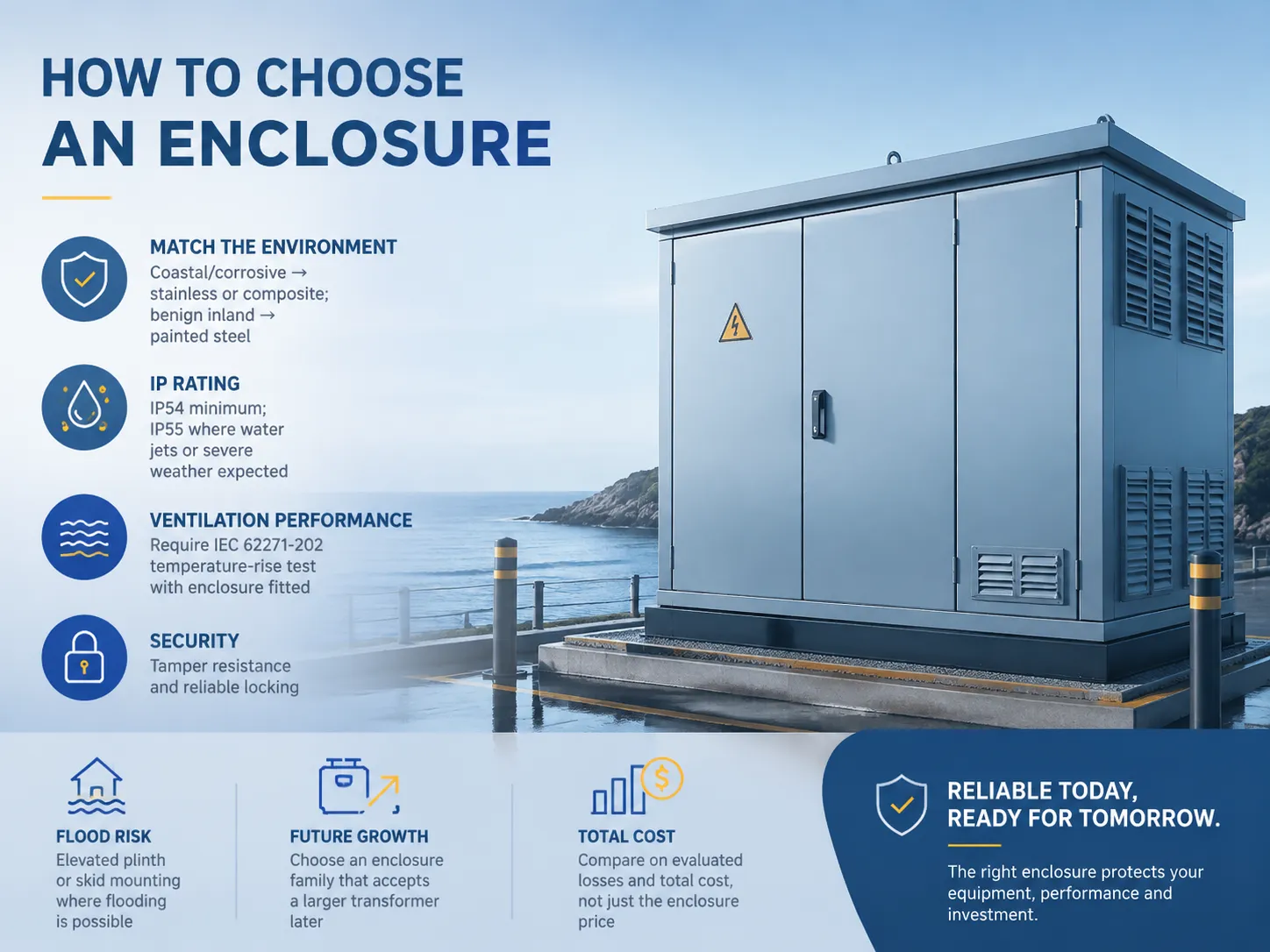
Wie man ein Gehäuse auswählt
- Zunächst müssen die geeigneten Umweltbedingungen übereinstimmen: für Küsten-/korrosive Umgebungen müssen Edelstahl oder Verbundmaterial verwendet werden, und der harmlose Standort im Inland erfordert lackierten Stahl mit maritimer Beschichtung.
- Die IP-Bewertung muss ebenfalls validiert werden: mindestens IP54; IP55, wo Wasserstrahlen oder schweres Wetter zu erwarten sind.
- Die Belüftungsleistung muss ebenfalls überprüft werden: Der Temperaturanstiegstest gemäß IEC 62271-202 muss mit installiertem Gehäuse durchgeführt werden.
- Die Widerstandsfähigkeit gegen Manipulation und das Verriegeln müssen für öffentliche Zugangsorte überprüft werden.
- Das Hochwasserrisiko muss ebenfalls bewertet werden: Wenn Überschwemmungen möglich sind, muss das Gehäuse durch die Verwendung von Skid-Montage erhöht werden.
- Dinge, die für zukünftiges Wachstum zu berücksichtigen sind, wären, nach einer Gehäuseserie für größere Transformatorinstallationen in der Zukunft zu suchen.
- Vergleichen Sie basierend auf Verlusten und Kosten, anstatt nur auf den Gehäusepreisen.
Häufig gestellte Fragen
Wie viel kostet ein Gehäuse für einen Transformator im Kastenformat?
Der Preis des Gehäuses eines vollständigen Umspannwerks liegt zwischen $800 und $7000, abhängig von Größe und Materialien. Die Kosten für das Gehäuse eines 400-630 kVA Transformators liegen zwischen $1500 und $2800 und für 1.600-2.500 kVA zwischen $3500 und $7000. Der Preis für Edelstahl und Verbundmaterial liegt etwa 15-30% und 10-25% über den Standardmaterialien. Der Gesamtpreis der Umspannstation im Kastenformat kann von $7000-$20000 für einen 400-1000 kVA Transformator bis zu $24000-$60000 für 1.600-2.500 kVA Transformatoren variieren.
Welche IP-Bewertung sollte ein Gehäuse für einen Transformator im Kastenformat haben?
Gemäß der IEC 60529-Norm beträgt die minimale IP-Bewertung für Freilufttransformatoren IP54, mit der Option, IP55 zu verwenden, wenn starke Regenfälle, Wasserstrahlen und extreme Wetterbedingungen zu erwarten sind. Die IP-Bewertung eines Gehäuses für einen boxförmigen Transformator muss auch für Türen und Lüftungsgitter gültig sein.
Wie lange hält ein Gehäuse für einen boxförmigen Transformator?
Eine gute Konfiguration eines Gehäuses für einen boxförmigen Transformator kann zwischen 25 und 40 Jahren halten. Wenn es mit standardmäßigem Kohlenstoffstahl und maritimer Beschichtung lackiert ist, kann es im Binnenland montiert werden; andernfalls muss es aus Edelstahl oder Verbundmaterial in Küstengebieten bestehen. Das bedeutet, dass die Hauptwartungsverfahren darin bestehen, Dichtungen zu überprüfen und alle drei bis fünf Jahre Nachlackierungen durchzuführen.
Beeinflusst das Gehäuse die Kühlung des Transformators?
Ja, das Gehäuse erlaubt keine Luftzirkulation, was zu einem Anstieg der Temperatur des Transformators führen kann. Gemäß der IEC 62271-202-Norm muss der Temperaturanstiegstest mit dem installierten Gehäuse durchgeführt werden, um die Einhaltung der IP-Bewertung des Transformators sicherzustellen.
Kann ein boxförmiges Gehäuse in einem überflutungsgefährdeten Gebiet installiert werden?
Ja, spezielle Lösungen wie erhöhte Fundamente (mit dem Gehäuse 500-800 mm über dem Boden) und IP55-Dichtungsoptionen können sicherstellen, dass ein Gehäuse für einen boxförmigen Transformator auch in überflutungsgefährdeten Gebieten angemessen verwendet werden kann.
Referenzen
- IEC 62271-202 — Hochspannungs-Schaltanlagen: Vorgefertigte Transformator-Umspannstationen — die maßgebliche Norm für das Design, die Sicherheit und die Typprüfung von Gehäusen für boxförmige Transformatoren.
- IEC 60529 — IP-Code — definiert die Schutzbewertungen IP54/IP55 für Gehäuse.
- IEC 60076-Serie — Leistungstransformatoren — die Basisnorm für die Transformatoren im Gehäuse.
- IEC 62271-200 — MV metallumhüllte Schaltanlagen — Anforderungen für das Schaltanlagenkompartiment.
- IEEE C57.12.27 — Integrität von Gehäusen für Fundamentmontierte Geräte — Anforderungen an die Gehäuseintegrität in Nordamerika.
- NEMA — Leitfaden für Verteilungsanlagen — Anwendungsleitfaden für eingekapselte Verteilungseinrichtungen.
- Jiangsu Subian Electric Power — offizielle Seite — Hersteller und Exporteur von Gehäusen für boxförmige Transformatoren gemäß IEC 62271-202.
Fazit
Gehäuse für boxförmige Transformatoren sind die stillen Helden der modernen Stromerzeugung – gefertigte Gehäuse, die es Versorgungsunternehmen, Entwicklern und Industriebetreibern ermöglichen, innerhalb weniger Tage eine komplette Umspannstation in engen Bereichen und ungünstigen Wetterbedingungen zusammenzustellen, während sie eine Qualität auf Fabrikniveau genießen. Aus organisatorischer Sicht bestimmt das Gehäuse mehr, wie lange und wie sicher die Einheit betrieben wird, als der Transformator im Inneren.
Hauptideen, die man sich merken sollte:
- Wählen Sie das Gehäusematerial und die IP-Klasse entsprechend den Umweltbedingungen – verwenden Sie Edelstahl/Verbundgehäuse und IP55 für Küsten- und feuchte Standorte.
- Stellen Sie sicher, dass der Test gemäß IEC 62271-202 für den gesamten Temperaturanstieg der Einheit durchgeführt wird.
- Überprüfen Sie das Gehäuse auf Widerstand gegen Manipulation, Schloss- und Überflutungsoptionen, wenn das Gehäuse in öffentlichen oder überflutungsgefährdeten Bereichen installiert werden soll.
- Vergleichen Sie die geschätzten Verluste und Gesamtkosten der Installation, nicht nur den Preis des Gehäuses.
- Nutzen Sie die Studie bekannter Marken wie Schneider, Siemens und ABB im Vergleich zu IEC-konformen Lieferanten wie Jiangsu Subian Electric Power.