


Si vous visitez la salle de commutation entre les deux extrémités d'un tunnel urbain en plein été et que vous voyez son état, vous obtiendrez la réponse. Le transformateur de 800 kVA, qui est la principale source d'alimentation du système de ventilation et d'éclairage du tunnel, est situé à l'intérieur d'une pièce avec un niveau d'humidité supérieur à 85% depuis des mois. Chaque nuit, de la condensation se forme sur la surface du réservoir. Les murs de la pièce montrent des taches causées par des dépôts de sel dus aux matériaux de déneigement déchargés de la chaussée. L'historique de maintenance indique trois cas de déconnexion des relais cette année en raison de problèmes qui provoquent la formation de courts-circuits sur les barres collectrices basse tension en raison de l'humidité. L'analyse de l'huile montre qu'elle contient 42 ppm d'eau, ce qui est supérieur au taux autorisé de 30 ppm et provoque une dégradation de l'isolation en papier.
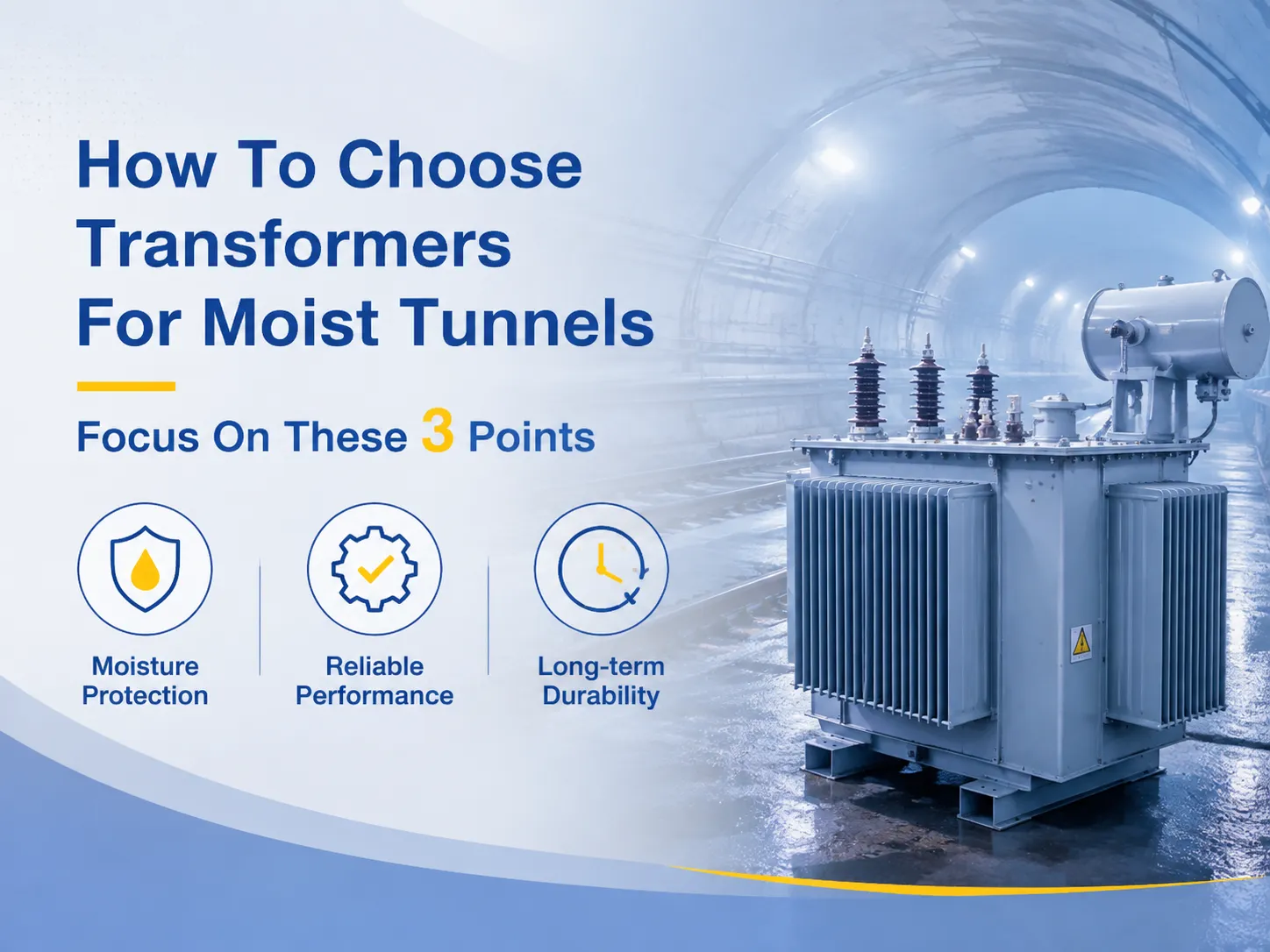
Les tunnels sont parmi les endroits les plus difficiles pour utiliser des transformateurs en raison de l'humidité qu'ils contiennent. Cet article vous présente 3 problèmes importants à garder à l'esprit lors de la sélection de transformateurs pour les tunnels : protection de l'isolation et de l'enveloppe, sélection des matériaux et protection contre la corrosion, et contrôle de la ventilation et de la condensation.
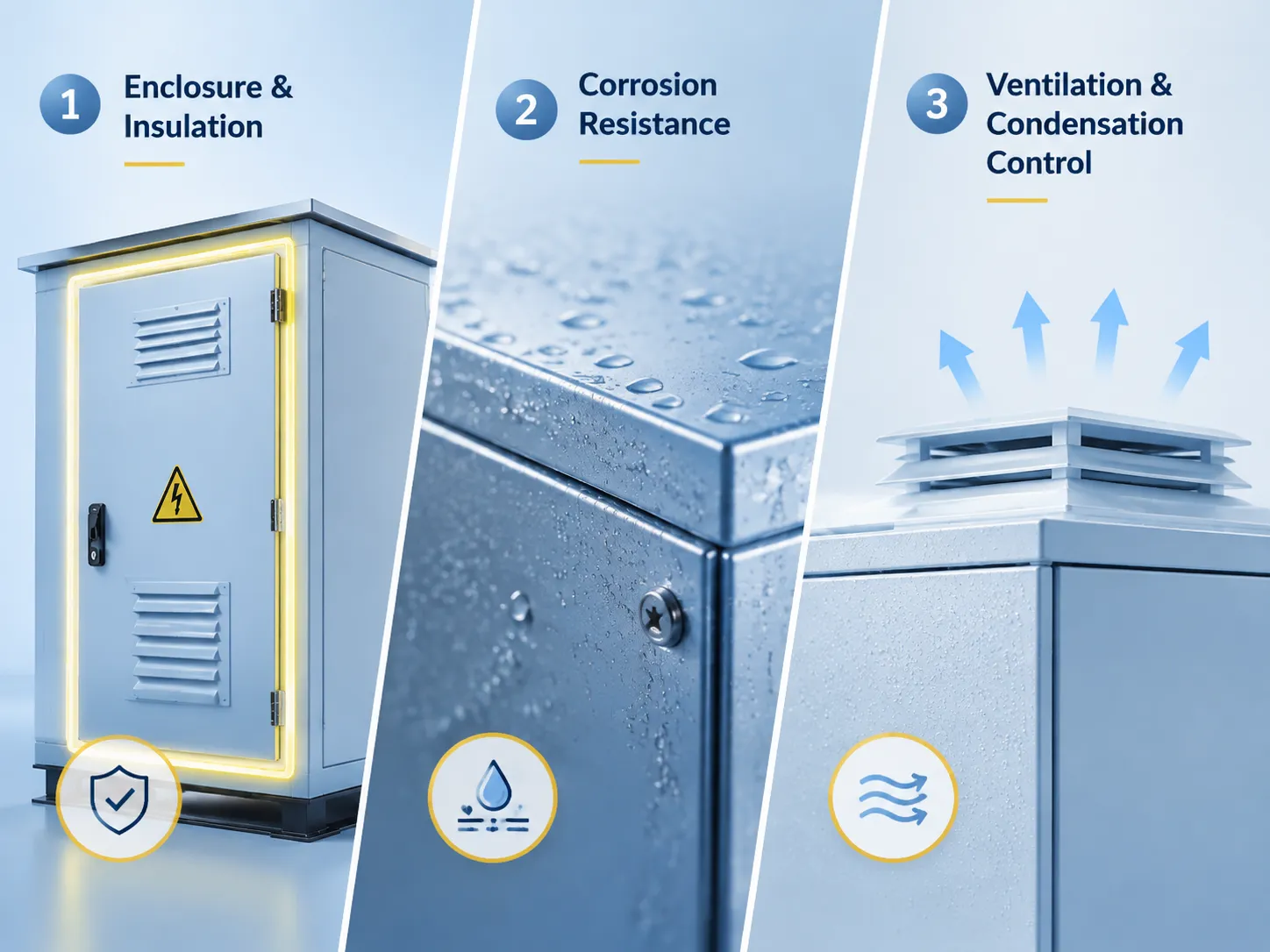
La réponse brève est la suivante : lors de la sélection d'un transformateur pour des tunnels humides, trois éléments doivent être pris en compte : (1) Protection par enveloppe et isolation – pour les types de transformateurs secs, des enveloppes classées IP54 et IP55 doivent être spécifiées. En cas de transformateurs immergés dans l'huile, des réservoirs scellés en matériaux résistants à la corrosion doivent être spécifiés ; (2) Matériaux résistants à la corrosion – enveloppes en acier inoxydable ou en matériaux revêtus de poudre de haute résistance, finitions classées pour la classe de corrosivité C3/C4 selon la norme ISO 12944, isolations tropicalisées avec des niveaux d'humidité élevés ; (3) Ventilation et prévention de la condensation – échange d'air contrôlé, chauffages anti-condensation ; contrôleurs d'humidité.
Pourquoi les tunnels humides détruisent les transformateurs
La défaillance d'un transformateur dans des environnements humides n'est généralement pas un accident électrique instantané — c'est plutôt un processus chimique et physique graduel. Voici les principales causes :
- Humidité dans l'isolation : Dans les transformateurs immergés dans l'huile, l'humidité pénètre par les respirateurs, les joints et la condensation. Des niveaux d'humidité supérieurs à 30 ppm dans l'huile du transformateur accélèrent le vieillissement de l'isolation en papier, réduisant sa durée de vie de moitié à chaque fois que l'humidité est deux fois supérieure à la normale. À 50–60 ppm, la formation de bulles peut se produire lors de la surcharge et entraîner une défaillance diélectrique.
- Suivi de surface et propagation : Sur les enroulements et les bushing de type sec, l'humidité associée à la poussière ou au sel crée des canaux conducteurs le long de la surface qui entraînent des décharges partielles et des arcs.
- Corrosion du réservoir, des accessoires et des connexions : Le condensat contenant du sel attaque les réservoirs, les ailettes de radiateur, les accessoires de câble et les connexions boulonnées, augmentant la résistance de contact et provoquant finalement des joints chauds.
- Condensation des compartiments de contrôle et basse tension : Les fluctuations de température font que l'eau se condense sur les barres omnibus et les modules électroniques, et un seul incident de condensation peut entraîner un arc entre phases.
Et les statistiques confirment la physique : les transformateurs situés sur des sites côtiers et dans des tunnels présentent un taux de défaillance 2 à 3 fois plus élevé par rapport aux unités dans des zones sèches à l'intérieur des terres, le vieillissement de l'isolation induit par l'humidité étant la principale cause de défaillance constatée lors des enquêtes judiciaires. La solution n'est pas l'entretien — c'est la spécification correcte lors de l'acquisition.
Point 1 : Protection de l'enceinte et de l'isolation
La question principale est de savoir comment empêcher l'humidité d'affecter l'isolation. En termes de langage de spécification, il est important d'être précis :
| Élément | Norme / Exigence | Spécification de qualité tunnel |
|---|---|---|
| Enceinte de type sec | Classe de protection IP selon IEC 60529 | IP54 minimum ; IP55 lorsque des projections d'eau sont possibles |
| Réservoir immergé dans l'huile | IEC 60529 + conception scellée | Réservoir scellé avec système de préservation de l'huile (couverture d'azote ou type adsorption de gaz) |
| Bagues et terminaisons | IEC 60529 / distance de creepage selon IEC 60076 | Distances de creepage étendues, sheds en silicone ou époxy, boîtes de câbles IP54 |
| Compartiments de contrôle / basse tension | IEC 60529 | Compartiments IP55 avec portes à joint et filtres à respirateur |
| Système d'isolation | IEC 60076-11 (sec), IEC 60076-1 (huile) | Isolation tropicalisée, limites de teneur en humidité indiquées dans la fiche technique |
L'erreur habituelle est de spécifier des enceintes IP23 ou IP31 — bien qu'elles puissent convenir à un usage industriel à l'intérieur, elles ne fonctionneront pas dans des cas exposés à des conditions d'humidité constante d'un tunnel. Chaque pourcentage d'amélioration IP coûte généralement entre 400 et 1 500 dollars par unité, et pourtant, c'est précisément la distinction entre IP31 et IP55 qui détermine si un transformateur de tunnel durera cinq ans.
Point 2 : Résistance à la corrosion et matériaux
Le deuxième point important dans la prise de décision est le choix des matériaux. Dans un environnement de tunnel humide, la finition de surface et la qualité du métal sont tout aussi essentielles que la conception des systèmes électriques. La norme applicable est ISO 12944 (peintures et revêtements pour constructions en acier) qui divise la corrosivité atmosphérique en catégories allant de C1 (intérieurs ventilés) à C5-X (très forte). Les tunnels avec des éclaboussures provenant des voitures sont généralement reconnus comme C3 ou C4, tandis que les tunnels riches en sel peuvent atteindre la catégorie C5-I.
| Composant | Spécification standard | Spécification de qualité tunnel |
|---|---|---|
| Revêtement du réservoir et de l'enceinte | ISO 12944 C2/C3, couche unique | Système de revêtement C4 ou C5, épaisseur minimale de film sec de 120 à 240 µm |
| Matériau de la coque de l'enceinte | Acier laminé à froid, peinture | Acier inoxydable (304/316) ou galvanisé à chaud + revêtement en poudre épais |
| Fixations et accessoires | Acier zingué | Fixations en acier inoxydable, passe-câbles en laiton ou en acier inoxydable |
| Radiateurs / ailettes de refroidissement | Acier au carbone standard | Ailettes revêtues ou marge de refroidissement augmentée pour compenser la perte de revêtement |
| Respirateurs en gel de silice | Norme | Gel de silice de qualité réactif avec indicateur de couleur, volume plus important |
L'impact sur le coût existe mais est limité ; passer d'un revêtement C2 à C4 entraîne généralement des coûts supplémentaires allant de $600 à $2,500 par unité. Ajouter une coque en acier inoxydable à une unité de type sec ayant une puissance de 1,000 kVA entraîne des coûts allant de $3,000 à $8,000. Lorsqu'il s'agit d'infrastructures de tunnel critiques qui ne peuvent pas être mises hors service pour être repeintes, ce coût est la forme d'assurance la moins chère disponible.
Point 3 : Contrôle de la ventilation et de la condensation
Le troisième critère est le contrôle environnemental dans la salle des transformateurs ou l'enceinte. Lorsque l'air environnant se condense, peu importe l'efficacité de l'enceinte IP55, cela ne sauvera pas le transformateur des dommages. Les solutions possibles à ce problème, classées par ordre d'efficacité, sont les suivantes :
- Chauffages anti-condensation : de 150 à 300 W par compartiment et régulés par thermostat, les chauffages anti-condensation permettent aux surfaces de rester 3 à 5 °C au-dessus du point de rosée. Le prix est compris entre $200 et $600 par compartiment.
- Ventilation contrôlée : dans un tunnel humide, même un système de ventilation naturelle n'est pas utile ; un système de ventilateur qui s'active uniquement lorsque l'air extérieur est plus sec est nécessaire. Cela coûte entre $1,500 et $5,000.
- Déshumidification : dans des salles critiques, un petit déshumidificateur garantit que le niveau d'humidité est inférieur à 60%. Dans ce cas, cela coûte entre $1,000 et $3,500.
- Évents chauffés et systèmes d'huile scellés : cette solution exclut le risque d'infiltration d'humidité pour les équipements immergés dans l'huile. Le prix est couvert par l'option mentionnée ci-dessus.
La tâche d'ingénierie est simple et directe : il faut maintenir le niveau d'humidité dans la zone de l'équipement au-dessus de 60% et les températures de surface au-dessus du point de rosée. Ces mesures doivent être incluses dans le paquet de spécifications du transformateur et ne doivent pas être considérées comme des travaux civils supplémentaires, car le fabricant de transformateurs doit être responsable de la prévention de l'humidité.
Types de transformateurs pour service en tunnel
Les deux grandes familles de transformateurs peuvent être rendues aptes aux tunnels, mais le choix affecte le coût, l'empreinte et la sécurité incendie :
| Taper | Forces dans les tunnels | Faiblesses | Prix typique, 1,000 kVA (USD) |
|---|---|---|---|
| Type sec (résine coulée) | Pas de risque de fuite d'huile, sûr contre les incendies, faible entretien, bonne performance contre l'humidité avec une enceinte appropriée | Coût plus élevé, sensible à une humidité élevée soutenue sans enceinte | $18,000–$32,000 |
| Immergé dans l'huile scellée | Coût inférieur, éprouvé, réservoir scellé résiste à l'infiltration | Considérations de confinement d'huile et de feu ; risque de corrosion du réservoir si le revêtement échoue | $12,000–$22,000 |
| Type sec en acier inoxydable | Résistance maximale à la corrosion, meilleur pour les tunnels salins | Coût le plus élevé | $25,000–$40,000 |
Dans le cas des tunnels ferroviaires et des tunnels autoroutiers, le transformateur sec est généralement la meilleure option dans les salles ignifuges car en cas d'incendie dans le tunnel, le transformateur peut représenter un danger et il n'y a pas beaucoup de possibilités pour les personnes de s'échapper. Dans le cas des conduits de services publics et des tunnels souterrains où le risque d'incendie est géré différemment, le meilleur choix sera des transformateurs remplis d'huile.
Type sec vs. Immergé dans l'huile pour les tunnels
La décision entre les deux familles dans un tunnel humide repose sur cinq facteurs, résumés ci-dessous :
| Facteur | Type sec (résine coulée) | Huile scellée immergée |
|---|---|---|
| Gestion de l'humidité | Bon avec un boîtier IP54+ ; l'humidité de l'isolation récupérable par séchage | Réservoir scellé résiste à l'intrusion ; l'humidité de l'huile doit être surveillée |
| Sécurité incendie | Auto-extinguible, minimal de fumée | Risque d'incendie d'huile ; nécessite une salle et un confinement résistant au feu |
| Entretien | Faible ; nettoyage périodique et thermographie | Plus élevé ; échantillonnage d'huile, DGA, service de respirateur |
| Coût (1 000 kVA) | $18,000–$32,000 | $12,000–$22,000 |
| Utilisation typique du tunnel | Salles d'équipement de route/rail et stations | Conduits de services publics, voûtes éloignées, sites miniers |
Il n'y a pas de vainqueur ultime. La sélection repose sur des critères de sécurité incendie et la capacité de réparation. Ce qui est important, c'est que quel que soit le système que vous choisissez, il satisfasse les trois critères mentionnés ci-dessus : bonne protection de l'enveloppe, propriétés résistantes à la corrosion et élimination de toute condensation qui pourrait se produire.
Liste de vérification des spécifications
- Confirmer les conditions du tunnel : niveaux d'humidité, quantités de sel, ventilation et produits chimiques appliqués.
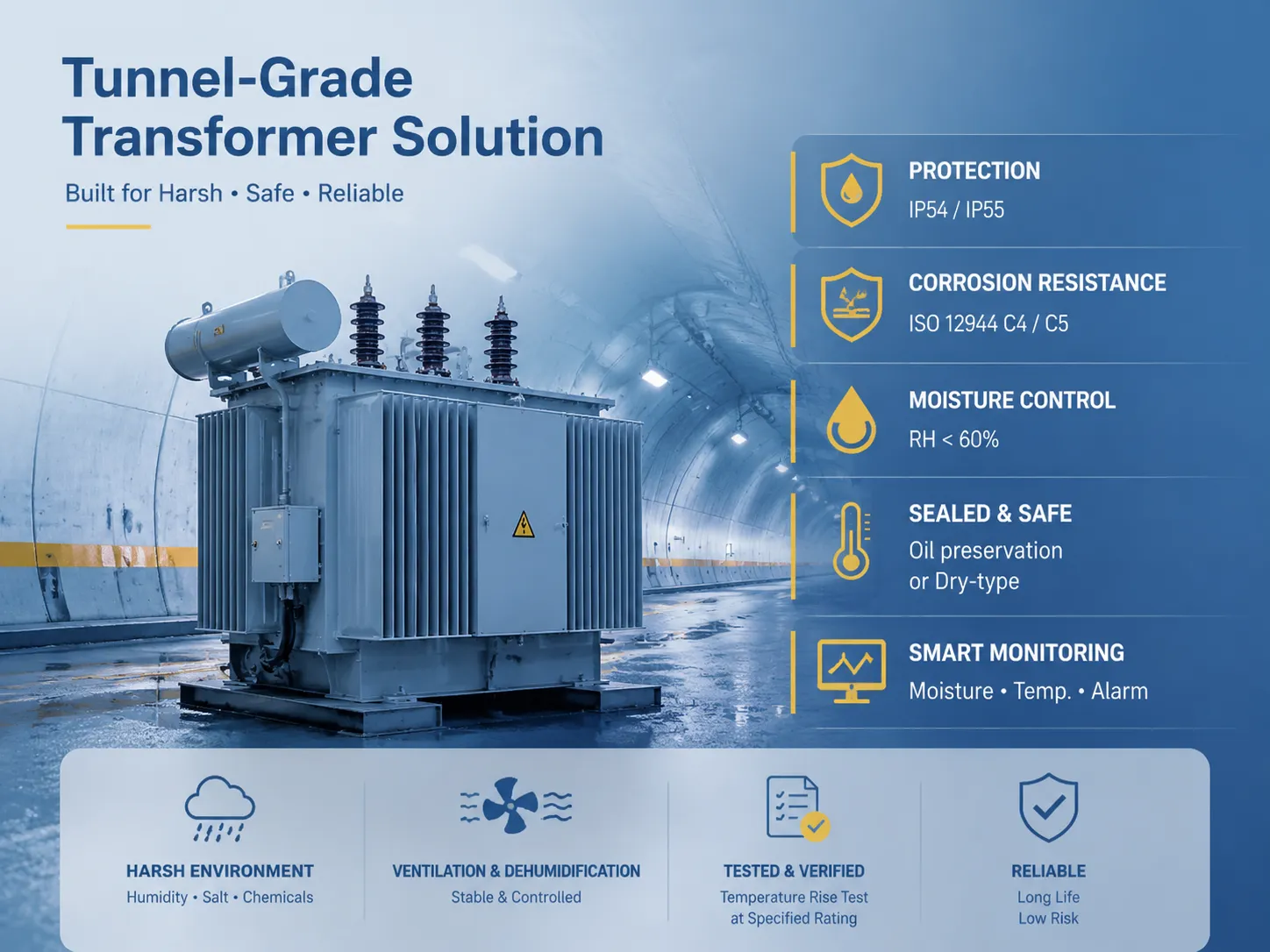
- Les enveloppes et compartiments doivent au moins être conformes à l'IP54 (il est recommandé de se conformer à l'IP55 si de l'eau est pulvérisée dans le tunnel).
- Le revêtement ISO 12944 C4 (ou C5 pour les tunnels salins) doit être spécifié avec une épaisseur de film sec dans le contrat.
- Des coques en acier inoxydable ou lourdement revêtues doivent être utilisées en cas de corrosion sévère.
- La préservation de l'huile scellée doit être appliquée aux équipements immergés dans l'huile tandis qu'une construction sèche doit être utilisée dans les zones à risque d'incendie.
- Des chauffages anti-condensation, une ventilation contrôlée par humidité avec des unités de déshumidification doivent être intégrés au projet.
- La teneur en humidité doit également être indiquée sur la fiche technique.
- Ajouter la surveillance : capteur d'humidité de l'huile, capteur de température des enroulements et capteur de fuite/condensation.
Meilleures marques et comparaison des prix
Les fabricants de transformateurs de qualité tunnel incluent à la fois des leaders internationaux et des producteurs dédiés. Le tableau fournit des prix pour des transformateurs secs de 1 000 kVA de 10/0,4 kV avec un boîtier de qualité tunnel IP54+ et un traitement C4 ; les transformateurs de type huile seront environ 35 à 45 pour cent moins chers.
| Marque | Pays | Forces pertinentes pour les tunnels | Prix indicatif (USD) |
|---|---|---|---|
| Schneider Electric | France | Portefeuille solide de types secs et d'enveloppes IP55 | $22,000–$34,000 |
| Siemens | Allemagne | Références d'infrastructure de tunnel, surveillance numérique | $23,000–$36,000 |
| ABB | Suisse | Gamme de résine coulée et de réservoir scellé | $22,000–$35,000 |
| Eaton | États-Unis | Profondeur de type sec industriel, enceintes sur mesure | $20 000–$32 000 |
| Hitachi Energy | Japon/Suisse | Expertise en transformateurs d'infrastructure de grande taille | $24,000–$38,000 |
| Jiangsu Subian Electric Power | Chine | Unités conformes à la norme IEC 60076 avec IP54/55, revêtement C4, options en acier inoxydable | $15 000–$26 000 |
Les fabricants internationaux offrent des pratiques de construction exceptionnelles et une expertise en documentation complète, qui sont des exigences clés pour les projets ayant des certifications et des exigences d'assurance strictes. Jiangsu Subian Electric Power est un participant actif dans ce domaine et fabrique des transformateurs de type sec et immergés dans l'huile conformes à la norme IEC 60076 qui répondent aux spécifications spécifiques de l'entreprise telles que l'enceinte IP55, le revêtement C4/C5, les options en acier inoxydable, les systèmes de chauffage anti-condensation et la surveillance de l'humidité, avec un prix 45-60% inférieur à celui de leurs homologues européens ou américains. En ce qui concerne l'évaluation des options pour la construction de plusieurs salles de transformateurs pour la ventilation, l'éclairage et le drainage, Subian se présente comme une alternative digne aux entreprises internationales en raison de sa flexibilité à produire des produits personnalisés et d'un excellent système de témoins d'essai en usine.
Questions Fréquemment Posées
Quel indice de protection ai-je besoin pour un transformateur dans un tunnel ?
L'indice de protection minimum acceptable pour un transformateur est IP54, mais IP55 est préférable si le transformateur sera exposé à l'eau en raison du nettoyage ou des fuites d'eau. La signification d'un indice IP54 est qu'il est étanche à la poussière et protège contre les éclaboussures d'eau venant de toutes les directions. En revanche, IP55 protège contre les jets d'eau utilisés pour le nettoyage. Installer un équipement qui fonctionne avec un indice de protection supérieur à IP23 coûte au moins $400–$1,500 de plus.
Combien coûte un transformateur de qualité tunnel par rapport à un standard ?
Le coût d'un transformateur de type sec standard de 1000 kVA peut atteindre $13,000–$18,000. Le coût d'un transformateur de qualité tunnel avec une enceinte IP54/55, un revêtement C4 et des contrôles de condensation est de $18,000–$32,000, ce qui signifie une prime de 15–30%. De plus, les coques en acier inoxydable ajoutent un supplément de $3,000–$8,000. Cependant, cela représente une petite prime lorsque les coûts totaux sont comparés aux coûts de son remplacement à mi-vie pour une infrastructure de tunnel critique.
Un transformateur de type sec ou immergé dans l'huile est-il meilleur dans un tunnel humide ?
Pour les tunnels routiers et ferroviaires où la protection contre l'incendie est sensible, le transformateur de type sec (résine coulée) est le choix préféré, car il est auto-extinguible et ne présente aucun risque de fuite d'huile. En revanche, les transformateurs immergés dans l'huile sont plus rentables pour les conduits de services publics, les travaux miniers et les voûtes non accessibles. Ainsi, il est important de comprendre que la protection contre l'incendie, l'accès pour l'entretien et les coûts sont les principales questions déterminantes dans le choix d'un type de transformateur.
Quel niveau d'humidité dans l'huile du transformateur est acceptable ?
On considère que la teneur en humidité dans l'huile de transformateur pendant la période de livraison ne doit pas dépasser 15-20 ppm. En fonctionnement, la teneur en humidité de l'huile est acceptable si elle ne dépasse pas 30 ppm. Si elle varie de 30 à 50 ppm, une surveillance supplémentaire est requise. Lorsque le niveau d'humidité dépasse 50 ppm, il existe un risque potentiel de formation de bulles d'air pendant le fonctionnement du transformateur.
Les chauffages anti-condensation empêchent-ils vraiment les pannes de transformateur ?
Oui, et ils figurent parmi les meilleures mesures de rentabilité mentionnées dans cet article. Ces chauffages fonctionnent à l'aide d'un thermostat et coûtent $200-$600.
Références
- IEC 60529 — Degrés de protection fournis par les enceintes (Code IP) — la norme définissant les classifications IP pour les enceintes et compartiments de transformateur.
- IEC 60076 série — Transformateurs de puissance — conception de base, tests et normes d'isolation pour toutes les spécifications de transformateurs de tunnel.
- ISO 12944 — Peintures et vernis : Protection contre la corrosion des structures en acier — la classification de corrosivité (C2–C5) utilisée pour les spécifications de revêtement de tunnel.
- IEEE C57.106 — Guide pour l'acceptation et l'entretien de l'huile minérale isolante — directives autorisées sur les limites d'humidité de l'huile et leur interprétation.
- IEC 60076-11 — Transformateurs de puissance à sec — exigences en matière d'humidité et d'enceinte pour les unités en résine coulée dans des environnements humides.
- Manuel AREMA pour l'ingénierie ferroviaire — directives sur l'infrastructure électrique et de ventilation des tunnels utilisées dans les projets ferroviaires nord-américains.
- Jiangsu Subian Electric Power — site officiel — fabricant de transformateurs de qualité tunnel IP54/55, revêtus C4 pour des projets d'infrastructure.
Conclusion
L'humidité peut endommager un transformateur, mais vous pouvez réduire les chances que ce problème se produise en suivant certaines recommandations. La première recommandation est d'installer le transformateur à l'intérieur d'une enceinte scellée (IP54 ou supérieur) avec une installation étanche. La deuxième suggestion est de revêtir les parties en acier du transformateur avec des matériaux capables de résister à la corrosion et à l'humidité (de préférence, un revêtement de classification ISO 12944 C4 sera approprié). La troisième recommandation est de fournir une ventilation, des systèmes de chauffage et un contrôle de l'humidité (déshumidificateurs).
Points clés :
- Les enceintes IP23/IP31 ne sont pas adaptées à l'exploitation dans les tunnels ; IP54/IP55 est indispensable.
- Assurez-vous d'utiliser un revêtement C4 (C5 pour les tunnels salins) pour protéger le transformateur de la corrosion conformément à l'ISO 12944.
- Vous devez encore payer un supplément de 15–30% pour un transformateur classé pour l'exploitation dans les tunnels lors de son achat ; de cette manière, vous serez assuré d'avoir un appareil fiable pendant 25 ans au lieu d'un appareil défectueux pendant seulement 5 ans.
- Fournissez au transformateur un chauffage et un contrôle de l'humidité : cela aidera à éviter les problèmes liés à l'humidité lors du fonctionnement du transformateur.