


Lorsque l'ingénieur de sous-station examine le document pour un appel d'offres concernant la mise à niveau de transmission de 132 kV, l'une des premières fiches de spécifications examinées est normalement le tableau de classification des transformateurs de puissance, car un mauvais choix peut coûter jusqu'à des centaines de milliers ainsi que provoquer des mois de retard dans le processus de mise en service. Chacun des types de classification des transformateurs de puissance est créé pour répondre à un problème particulier en termes de tension, de charge et de fiabilité, que ce soit une unité de distribution de 10 MVA fonctionnant dans un bloc d'usines ou un transformateur élévateur de générateur de 400 MVA installé dans une centrale à charbon.
L'article fourni décrit toutes les méthodes possibles pour classer les transformateurs de puissance, qui peuvent être par fonction de puissance, par niveau de tension, par configuration de bobinage, par type de refroidissement et par type de matériau d'isolation, etc.
En résumé, les transformateurs de puissance peuvent être catégorisés en fonction de leur fonction, tels que transformateur élévateur, transformateur abaisseur, transformateur de distribution, transformateur d'isolement et auto-transformateur ; en fonction de leur classe de tension, tels que transformateur de générateur, transformateur de transmission et transformateur de distribution ; en fonction de leur configuration de bobinage, tels que transformateur monophasé vs transformateur triphasé, transformateur à deux enroulements vs transformateur à trois enroulements ; en fonction de leur approche de refroidissement, tels que transformateur ONAN, transformateur ONAF, transformateur OFAF et transformateur ODAF ; et en fonction de leur méthode d'isolation, tels que transformateur immergé dans l'huile et transformateur à sec.
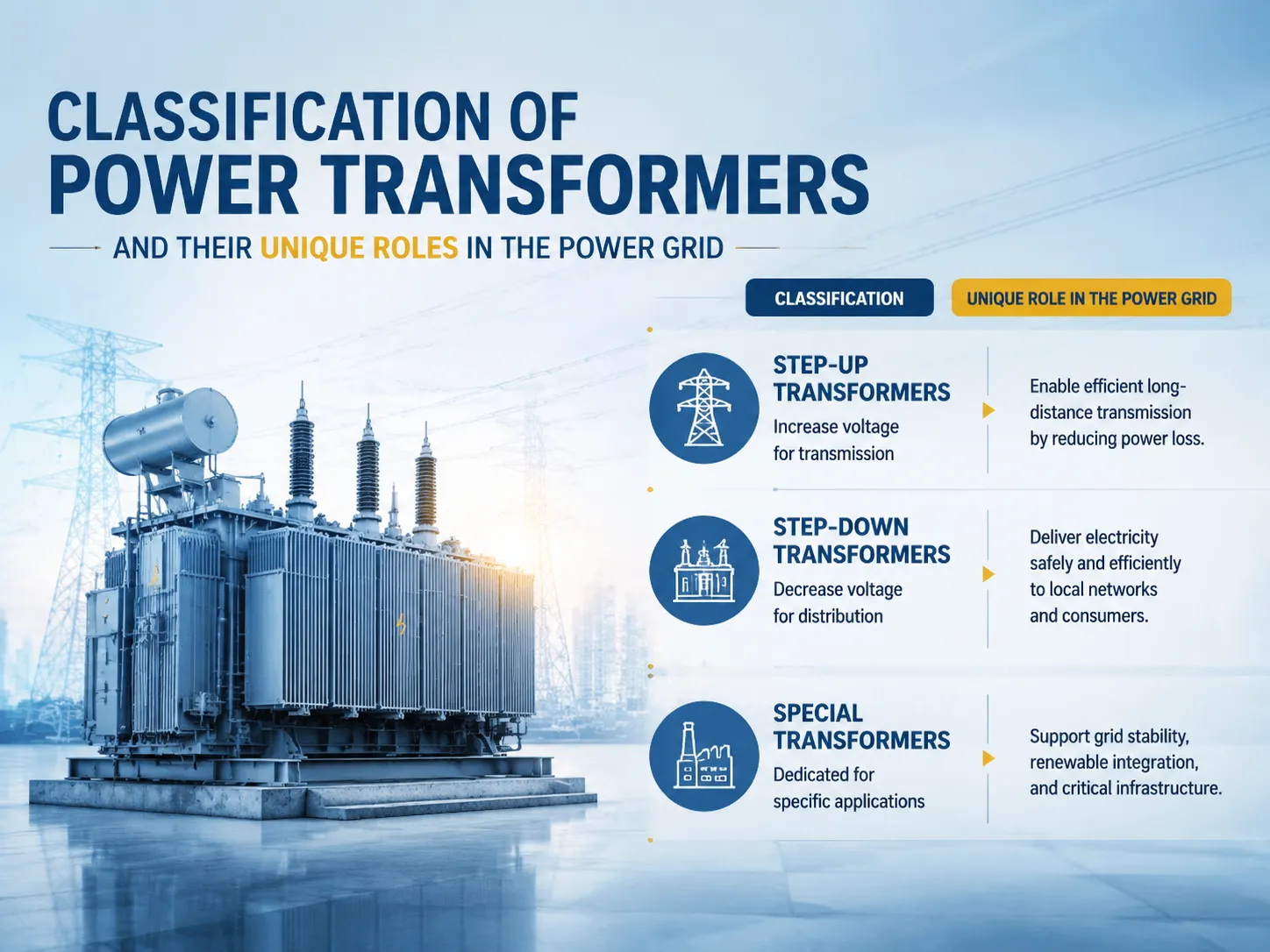
Qu'est-ce qu'un transformateur de puissance ? (Définition et fonction principale)
Un transformateur de puissance est un instrument électromagnétique statique qui transmet de l'énergie électrique à travers deux circuits ou plus via le processus d'induction électromagnétique avec une modification des niveaux de tension tout en maintenant la fréquence et la puissance apparente constantes (avec toutes pertes). Alors que les transformateurs de distribution effectuent principalement la chute de tension finale pour la consommation, les transformateurs de puissance se trouvent dans les sous-stations, les centrales de production et les grandes industries avec des puissances supérieures à 200 kVA et sont capables de traiter des tensions allant de 3,3 kV à 1 150 kV.
Un transformateur de puissance peut être caractérisé par trois valeurs : la puissance apparente nominale en kVA ou MVA, le rapport de tension nominal et l'impédance en cas de court-circuit (qui est généralement entre 5% et 15% selon la norme internationale IEC 60076-5). L'efficacité d'un transformateur à pleine capacité de fonctionnement est généralement entre 98% et 99,7%. C'est pourquoi les services publics sont prêts à dépenser beaucoup d'argent pour des conceptions à faible perte à cœur amorphe ainsi que pour de l'acier au silicium orienté grain de haute qualité afin de minimiser les pertes à vide.
Comment fonctionne un transformateur de puissance : le principe électromagnétique
Le principe de fonctionnement fondamental est basé sur la loi de Faraday de l'induction électromagnétique. Le courant alternatif dans l'enroulement primaire produit un flux magnétique fluctuant dans le noyau en acier au silicium, reliant l'enroulement secondaire et induisant une force électromotrice (fem) proportionnelle au nombre de tours selon la formule classique :
Vprimaire / Vsecondaire = Nprimaire / Nsecondaire (ceci est connu sous le nom de rapport de transformation), de sorte que Iprimaire × Vprimaire ≈ Isecondaire × Vsecondaire si d'autres conditions sont idéales.
Un transformateur fonctionnant en mode élévateur a plus de tours dans l'enroulement secondaire que dans le primaire. Un transformateur fonctionnant en mode abaisseur a plus de tours dans la bobine primaire. Cependant, les transformateurs de puissance réels fonctionnent avec des pertes d'environ 0,3% à 2%, dues aux pertes en cuivre (pertes I²R dans les fils en cuivre) et aux pertes en fer (en raison de l'hystérésis et des courants de Foucault). Par conséquent, les caractéristiques techniques de tout transformateur mentionnent le niveau d'efficacité, qu'il soit de 50%, 75% ou 100%.
Classification par Fonction : Élévateur, Abaisseur, Distribution, Auto
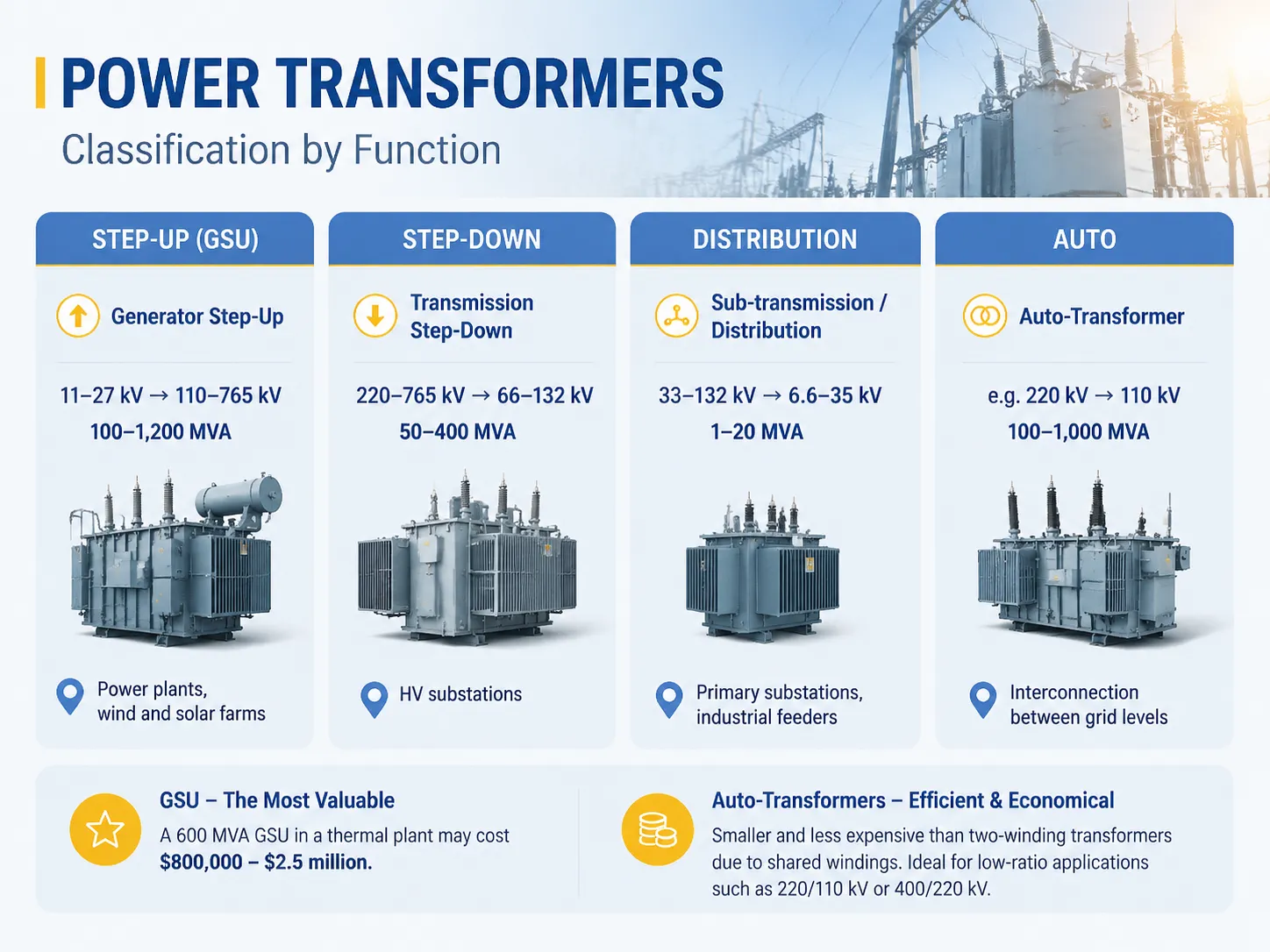
La fonction est le moyen le plus pragmatique de classer les transformateurs de puissance car elle indique l'emplacement de l'unité dans le transfert d'énergie. Le tableau qui suit résume quatre familles fonctionnelles différentes de transformateurs couramment utilisées par les ingénieurs dans le réseau.
| Fonction | Changement de Tension Typique | Évaluation typique | Où Vous Le Trouvez |
|---|---|---|---|
| Transformateur élévateur de générateur (GSU) | 11–27 kV → 110–765 kV | 100–1 200 MVA | Centrales électriques, parcs éoliens et solaires |
| Transformateur abaisseur de transmission | 220–765 kV → 66–132 kV | 50–400 MVA | Sous-stations HV |
| Sous-transmission / distribution | 33–132 kV → 6,6–35 kV | 1–20 MVA | Sous-stations primaires, alimentations industrielles |
| Auto-transformateur | par ex. 220 kV → 110 kV | 100–1 000 MVA | Interconnexion entre niveaux de réseau |
Le transformateur GSU (Transformateur Élévateur de Générateur) est situé à l'extrémité génératrice du spectre, ce qui en fait l'équipement le plus précieux au sein d'une centrale électrique. En fait, un transformateur GSU de 600 MVA dans une centrale thermique peut être évalué entre $800,000 et $2.5 millions. Bien que les auto-transformateurs tendent à être plus petits et moins chers que le transformateur à deux enroulements traditionnel, cela est possible puisque certaines de leurs enroulements sont partagés. Par conséquent, les entreprises de services publics d'interconnexion choisiraient d'utiliser des auto-transformateurs, en particulier pour des applications de tension à faible rapport telles que 220/110 kV ou 400/220 kV.
Classification par Niveau de Tension dans le Réseau
La classe de tension influence la conception de l'isolation et la conception des équipements énergétiques, y compris les techniques d'isolation. Le prix des équipements énergétiques est affecté par la classe de tension. Les normes IEC 60076-1 et IEEE C57.12.00 déterminent toutes deux les techniques d'isolation.
| Niveau de Réseau | Tension Nominale | BIL (Résistance à l'Impulsion de Foudre) | Rôle Typique |
|---|---|---|---|
| Tension de générateur | 3–33 kV | 40–200 kV | Côté d'entrée GSU, alimentations auxiliaires |
| Haute tension (HT) | 6–35 kV | 75–250 kV | Sous-stations de distribution, industrielles |
| Très haute tension (THT) | 66–220 kV | 325–950 kV | Transmission régionale |
| Très haute tension (THT) | 330–765 kV | 1 175–1 950 kV | Colonnes de transmission nationales |
Environ 70% de tous les transformateurs en place dans le monde sont au stade de distribution, mais ils ne représentent qu'environ 30% du coût. Une unité haute tension avec un système électrique de 500 kV et une valeur BIL de 1 550 remplit les exigences en matière d'isolation épaisse, de zones neutres larges et de procédures de test spéciales (tests de décharge partielle et tests d'impulsion selon la norme IEC 60076-3), donc l'installation d'un transformateur puissant peut nécessiter des dépenses de $1,5–$3 millions.
Classification par phase et configuration de bobinage
Les transformateurs de puissance peuvent être classés en fonction de leur construction en transformateurs monophasés ou triphasés. Cela repose non seulement sur leurs types mais aussi sur le nombre de leurs enroulements, c'est-à-dire en tant que transformateurs à deux enroulements, transformateurs à trois enroulements ou transformateurs auto-configurés. Les transformateurs monophasés sont largement acceptés car ils sont moins chers et plus faciles à transporter, ce qui est particulièrement utile en ce qui concerne les plus hautes classifications THT (par exemple, la formation d'une banque de 3×333 MVA composée de trois transformateurs monophasés fonctionnant à 500 kV), tandis que pour des variances de 300 MVA ou moins, les transformateurs triphasés seraient plus adaptés en raison de leur avantage par rapport aux variantes monophasées en termes de pertes, de solutions rentables et d'efficacité.
Les transformateurs à trois enroulements sont dotés d'un enroulement tertiaire et peuvent donc être utilisés non seulement pour des charges électriques standard mais aussi pour des filtres harmoniques, et pour dériver la troisième tension (par exemple 220/110/35 kV). Le groupe vectoriel peut être défini à l'aide de désignations spéciales, telles que Dyn11, YNyn0, YNd11, etc., qui montrent la configuration du transformateur et le point de la tension.
Classification par méthode de refroidissement (IEC 60076-2)
Le système de refroidissement est ce qui dicte la quantité maximale d'énergie électrique qu'un transformateur peut gérer en toute sécurité. L'acronyme utilisé conformément à la norme IEC 60076-2 fait référence au type de milieu de refroidissement et à la méthode de sa circulation.
| Code de refroidissement | Signification | Évaluation typique | Capacité de charge vs. ONAN |
|---|---|---|---|
| ONAN | Huile naturelle, air naturel | 50 kVA–60 MVA | Ligne de base (100%) |
| ONAF | Huile naturelle, air forcé (ventilateurs) | 1–150 MVA | ≈120–135% |
| OFAF | Huile forcée, air forcé | 10–300 MVA | ≈140–160% |
| ODAF | Huile dirigée, air forcé | 100–1 200 MVA | ≈150–170% |
Un transformateur conçu pour fonctionner en deux modes de refroidissement, ONAN et ONAF, signifie qu'une entreprise de services publics peut l'exploiter dans des conditions normales en mode de refroidissement naturel tout en utilisant des ventilateurs en cas de surcharges soudaines. Un transformateur d'une capacité de 40 MVA, indiquant son ratio comme “ 40/56 MVA ONAN/ONAF ” est un exemple viable. Les composants nécessaires tels que les ventilateurs ou les pompes à huile ne sont pas simples à entretenir, donc les plus petites sous-stations préfèrent uniquement les conceptions ONAN.
Transformateurs de puissance immergés dans l'huile vs. transformateurs de type sec
Le milieu d'isolation sépare le marché en deux catégories distinctes, avec des différences de prix, de sécurité et d'utilisation.
| Paramètre | Immergé dans l'huile | Type sec (résine coulée / VPI) |
|---|---|---|
| Milieu d'isolation | Huile minérale ou ester | Résine époxy / air |
| Puissance typique | 50 kVA–1 200 MVA | 100 VA–40 MVA |
| Prix (classe 1 MVA) | $18 000–$45 000 | $28,000–$70,000 |
| Risque d'incendie / environnemental | Plus élevé (conteneur d'huile nécessaire) | Faible, ignifuge |
| Meilleurs emplacements | Sous-stations extérieures | Intérieur, gratte-ciel, offshore |
Il existe des transformateurs immergés dans l'huile qui dominent dans la plage de zéro à 2 MVA en raison des propriétés diélectriques efficaces de l'huile. Les transformateurs secs fonctionnent mieux dans des endroits comme les bureaux, les hôpitaux et sur des plateformes et des installations pétrolières offshore où il existe des lois, telles que la NFPA 70, qui interdisent l'utilisation de transformateurs remplis d'huile en raison des dangers d'incendie. Les transformateurs en résine coulée coûtent généralement entre 40%-60% de plus que les modèles à huile comparables, mais ils ne nécessitent pas de fosses de récupération d'huile ni de systèmes d'extinction d'incendie.
Tableau des spécifications clés pour les classes de transformateurs courants
Afin de faire une comparaison équitable entre les modèles de transformateurs, les ingénieurs choisiront les paramètres fondamentaux nécessaires pour chacune des options en question. Un des graphiques ci-dessous montre les données de plaque signalétique de trois unités typiques.
| Paramètre | Unité de distribution | Unité de puissance de sous-station | Unité GSU |
|---|---|---|---|
| Puissance nominale | 1 000 kVA | 20 MVA | 250 MVA |
| Rapport de tension | 11/0,4 kV | 110/20 kV | 18/400 kV |
| Groupe vectoriel | Dyn11 | YNd11 | YNd11 |
| Tension d'impédance | 6% | 10% | 14% |
| Pertes à vide | ≈1 150 W | ≈14 kW | ≈90 kW |
| Pertes en charge | ≈10 500 W | ≈98 kW | ≈620 kW |
| Refroidissement | ONAN | ONAN/ONAF | ONAF/ODAF |
| Norme de référence | IEC 60076-1 | IEC 60076-1 | IEC 60076-1 |
L'assurance des pertes est importante pour les personnes traitant des affaires : la valeur de perte peut améliorer ou entraver le prix d'un transformateur et peut représenter une différence de 5%–10% concernant le prix d'un transformateur, car une différence de 1 kW dans les pertes à vide sur trente ans peut entraîner la perte de dizaines de milliers de dollars.
Le rôle unique de chaque classe de transformateur dans le réseau électrique
Chaque classe est placée à sa position dans la chaîne énergétique, et aucune ne peut être remplacée par une autre :
- Transformateurs GSU — changent la tension produite par les générateurs à la tension pour la transmission dans les centrales de production et les sites de sources alternatives.
- Les transformateurs de réduction de tension fonctionnent pour interconnecter les niveaux de haute tension et de basse tension dans les grandes sous-stations où ils régulent également la tension à l'aide de changeurs de prises sous tension.
- Transformateurs de distribution — sont le dernier transformateur qui fixe la tension pour la consommation à 400/230 V et constituent donc le plus grand nombre de transformateurs dans le monde.
- Auto-transformateur — interconnecte les niveaux de tension voisins comme 220 kV et 110 kV mais doit être installé uniquement lorsque la mise à la terre est disponible en raison de sa conception.
- Transformateur à décalage de phase — un outil important pour traiter la question du flux d'énergie dans des corridors parallèles et utilisé de plus en plus dans les réseaux de haute tension maillés.
Les concepteurs de réseaux de distribution affirment que jusqu'à 90 % des pertes d'énergie dues aux transformateurs se produisent dans les réseaux de distribution, ce qui pousse de nombreux pays (par exemple, la Chine et l'UE en vertu de la norme GB 20052) à promouvoir l'utilisation de transformateurs à cœur amorphe avec des pertes d'énergie plus faibles parmi les transformateurs de distribution.
Marques de premier plan et fourchettes de prix réalistes
Choisir une marque de transformateur de puissance revient à équilibrer le prix d'achat initial, l'efficacité, le délai de livraison et les services après-vente fournis par les fabricants. Les marques bien connues dans l'industrie définissent la norme, tandis que les plus anciens acteurs chinois proposent des produits à peu près identiques conformes aux normes IEC 60076, mais à des prix inférieurs de 30%–50%.
| Marque | Siège social | Force | Prix indicatif (20 MVA, 110 kV) |
|---|---|---|---|
| ABB / Hitachi Energy | Suisse / Japon | Expertise HVDC, EHV | $450,000–$700,000 |
| Siemens Energy | Allemagne | Sous-stations EHV et numériques | $430,000–$680,000 |
| Schneider Electric | France | Distribution, EcoStruxure | $280,000–$450,000 |
| GE Vernova / Prolec GE | États-Unis / Mexique | GSU à l'échelle des services publics | $420,000–$650,000 |
| TBEA | Chine | Grands MVA, projets EPC mondiaux | $180,000–$320,000 |
| Jiangsu Subian Electric Power | Chine | Classe personnalisée 50 kVA–220 kV, OEM/ODM | $160,000–$300,000 |
Les prix ne sont pas exacts ; ils vont être variables en fonction des spécifications, des niveaux de perte et de l'emplacement. Ainsi, toutes ces valeurs données ci-dessous doivent être comprises comme des guides plutôt que comme des prix fixes. Jiangsu Subian Electric Power propose des transformateurs allant de 50 kVA à la classe 220 kV avec plusieurs options, y compris des transformateurs à sec et remplis d'huile. L'entreprise offre de nombreux avantages supplémentaires ; tout d'abord, elle propose des prix qui sont 30-50% inférieurs par rapport à l'Europe ; deuxièmement, ses distributeurs respectent les délais et livrent dans plus de 60 pays du monde.
Comment choisir la bonne classe de transformateur pour votre projet
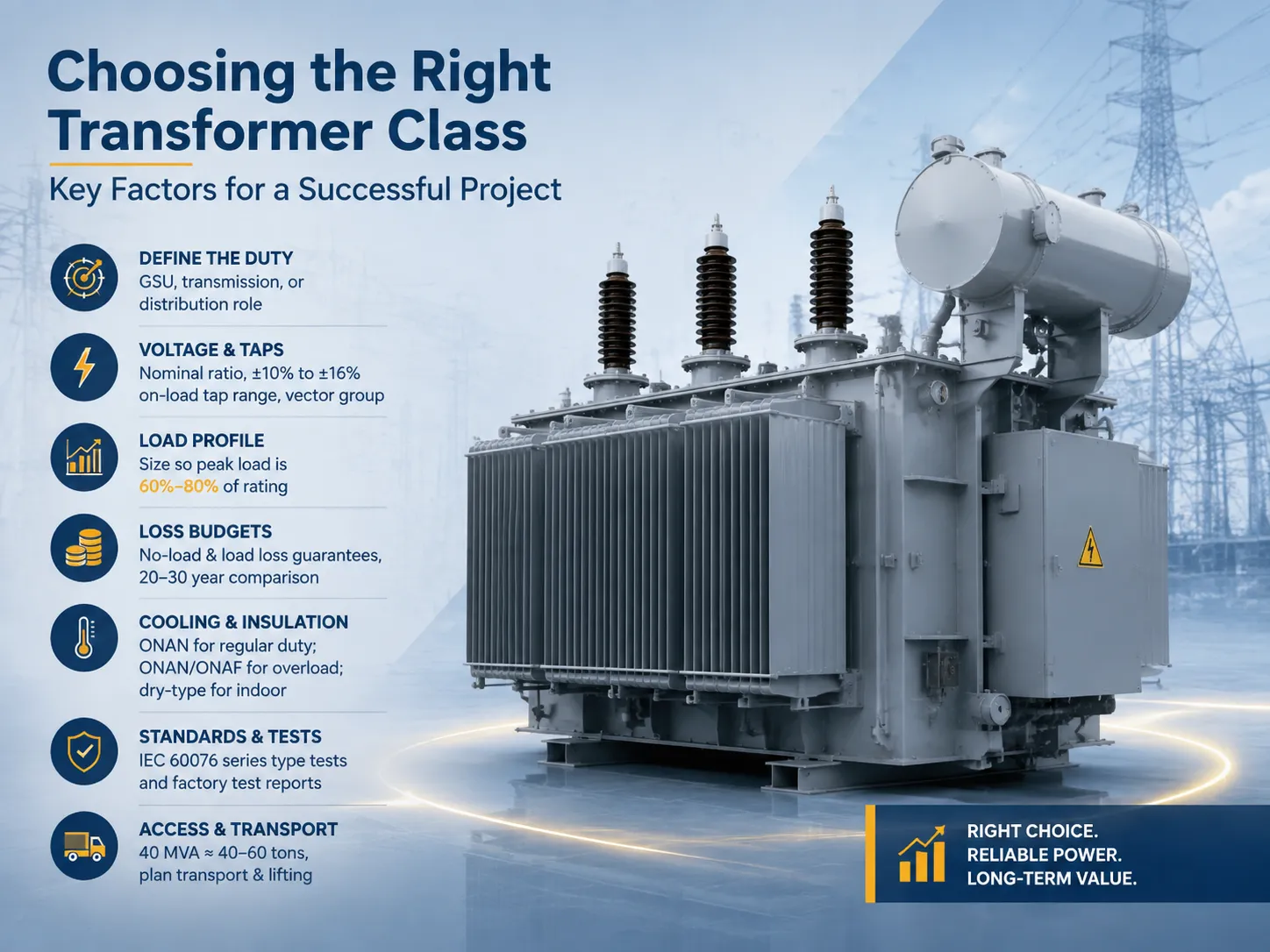
- Définir la fonction — un GSU, un rôle de transmission ou de distribution résout l'ensemble de l'enveloppe de conception.
- Vérifiez les niveaux de tension et la plage de prises — établissez le rapport nominal, ±10% à ±16% sur la plage de prises sous charge, et le groupe vectoriel par rapport à votre réseau.
- Calculez le profil de charge — déterminez la taille en kVA/MVA afin que la charge de pointe se situe entre 60%–80% de la capacité pour une efficacité et une marge maximales.
- Établissez des budgets de pertes — demandez des garanties de pertes à vide et sous charge et effectuez une comparaison des pertes capitalisées sur une période de 20 à 30 ans.
- Sélectionnez le refroidissement et l'isolation — ONAN pour un usage extérieur régulier ; ONAN/ONAF pour une flexibilité de surcharge ; type sec à l'intérieur du bâtiment.
- Vérifiez les normes — obtenez des essais de type de la série IEC 60076 (dielectrique, élévation de température, court-circuit) et des documents de test en usine.
- Considérez l'accès et le transport — une unité de 40 MVA a un poids de 40 à 60 tonnes et peut nécessiter des transports spéciaux et une étude de main-d'œuvre.
Questions Fréquemment Posées
Quelle est la différence entre un transformateur de puissance et un transformateur de distribution ?
Les transformateurs de puissance gèrent des capacités élevées (généralement supérieures à 200 kVA) au niveau de la transmission ou de la sous-transmission et sont conçus pour un fonctionnement à pleine charge avec régulation de tension ; un transformateur de distribution est le dernier transformateur abaisseur (normalement 5 kVA–2 500 kVA) qui atteint les utilisateurs finaux et fonctionne principalement à charge partielle. Les transformateurs de distribution sont beaucoup plus nombreux que les transformateurs de puissance ; il y en a des millions dans le monde tandis que les transformateurs de puissance constituent la partie la plus précieuse de la sous-station.
Que signifie le rapport de transformation d'un transformateur dans la classification ?
Le rapport de transformation N1/N2 est égal au rapport de tension primaire à secondaire en conditions à vide, ce qui fournit une indication réelle de savoir si le transformateur est un transformateur élévateur (c'est-à-dire N2 > N1), un transformateur abaisseur (c'est-à-dire N1 > N2) ou s'il s'agit d'un transformateur d'isolement fonctionnant à un rapport de 1:1. Par exemple, le transformateur ayant une capacité de 110 kV/20 kV aura un rapport de 5,5:1 tandis que le transformateur GSU abaissant la tension de 18 kV à 400 kV aura un rapport d'environ 22:1.
Quelle classe de refroidissement est la meilleure pour un transformateur de sous-station de 20 MVA ?
La majorité des fournisseurs d'électricité optent pour des modèles ONAN/ONAF, car sa charge normale est soutenue par un refroidissement naturel et un refroidissement par air forcé (généralement dans la plage de 120%-135% de la capacité ONAN) qui accommodent les charges de pointe et les surcharges temporaires. Les conceptions complètes OFAF/ODAF incluent une pompe et la direction du mouvement de l'huile, augmentant à la fois l'efficacité et ses coûts de maintenance.
Combien coûte un transformateur de puissance en 2025 ?
La majorité des fournisseurs d'électricité optent pour des modèles ONAN/ONAF, car sa charge normale est soutenue par un refroidissement naturel et un refroidissement par air forcé (généralement dans la plage de 120%-135% de la capacité ONAN) qui accommodent les charges de pointe et les surcharges temporaires. Les conceptions complètes OFAF/ODAF incluent une pompe et la direction du mouvement de l'huile, augmentant à la fois l'efficacité et ses coûts de maintenance.
Ai-je besoin d'un transformateur immergé dans l'huile ou d'un transformateur de type sec ?
En ce qui concerne les sous-stations extérieures avec des capacités supérieures à 2 MVA, l'option la plus rentable est le type immergé dans l'huile. Cependant, dans les applications intérieures ou en hauteur telles que les lieux sensibles au feu et les bâtiments offshore, des variétés de type sec doivent être utilisées car la rétention d'huile et la suppression des incendies sont donc difficiles à réaliser. Ainsi, bien qu'une unité en résine coulé de 1 MVA puisse coûter $28,000–$70,000, les unités immergées dans l'huile sont généralement vendues dans une fourchette de $ 18,000 à $45,000.
Références
- IEC 60076-1 : Transformateurs de puissance — Général — La norme internationale définissant les classifications, les tolérances et les procédures d'essai pour les transformateurs de puissance.
- IEC 60076-2 : Élévation de température — Spécifie les limites d'élévation de température et les classes de refroidissement utilisées dans la classification des transformateurs.
- IEC 60076-3 : Niveaux d'isolation et tests diélectriques — Définit les exigences de BIL et de test diélectrique par classe de tension.
- IEEE C57.12.00 : Exigences générales pour les transformateurs de distribution, de puissance et de régulation immergés dans un liquide — La norme compagnon nord-américaine de la norme IEC 60076.
- NFPA 70 : Code national de l'électricité — Régit l'installation des transformateurs, les dégagements et la protection aux États-Unis.
- Portefeuille de transformateurs Hitachi Energy — Référence pour la technologie moderne des transformateurs EHV, HVDC et de générateur.
Conclusion
Il est crucial de comprendre l'importance de la classification des transformateurs de puissance. C'est le facteur le plus important qui déterminera si l'on achète le bon équipement. La fonction du transformateur, la classe de tension, la configuration des enroulements, la méthode de refroidissement et le type d'isolation indiqueront la présence du transformateur dans le réseau, la quantité de charge et son prix — commençant à $1 500 pour les transformateurs de distribution et se terminant à $2,5 millions pour les transformateurs EHV.
- Tout d'abord, il est important de catégoriser l'équipement selon sa fonction (GSU, transformateur de transmission, transformateur de distribution et transformateur auto), puis selon sa tension, sa méthode de refroidissement et son type d'isolation.
- La classe de refroidissement doit être alignée au profil de charge du transformateur. Le meilleur rapport flexibilité-coût pour un transformateur allant jusqu'à 150 MVA est ONAN/ONAF.
- Il est nécessaire de suivre la norme IEC 60076 dans le contrat pour les réserves de pertes, les tests diélectriques et les tests de court-circuit.
- Il devrait y avoir au moins trois fournisseurs comparés selon le prix pour le MVA, l'estimation des pertes en capital et le délai de livraison.
Si votre projet nécessite des transformateurs de distribution ou de puissance de 50 kVA à 220 kV avec des rapports personnalisés et une documentation de type-test IEC, contactez Jiangsu Subian Electric Power pour un devis direct d'usine et une consultation technique.