


変圧器のリードタイムは2023年から2024年初頭にピークに達しましたが、2025年末以降改善しています。ただし、2019年の標準配電用変圧器の従来の2~4か月のリードタイムにはまだ戻っていません。変圧器市場は大きく2つに分かれています。1) 数か月で入手可能な標準配電ユニット、2) 数年のリードタイムが必要な大型またはカスタムユニットです。.
簡単な回答: 標準配電用変圧器のリードタイムは一般的に 16~30週間 50 kVAから2,500 kVAのユニットの注文から納品までの期間であり、2023年のピーク時の50~80週間から大幅に短縮されています。通常、中電圧の乾式ユニットは12~24週間のリードタイムです。一方で、100 MVAを超える大型電力変圧器は依然として18~30か月のリードタイムが一般的であり、発電機昇圧変圧器は30か月以上のリードタイムがかかる場合もあります。さらに、大型ユニットのカスタム仕様では設計承認や型式試験に8~16週間が追加されることが一般的です。変圧器の価格は2020年以降60~90%上昇していますが、価格は横ばいとなり、現在は4年前とほぼ同水準です。.
以下のセクションでは、現在入手可能な変圧器の範囲、市場における変圧器不足の継続理由、製品別の変圧器リードタイムの内訳、リードタイムに影響を与える要因、標準品とカスタム品の比較、各メーカー(当社を含む)が提供可能な機能、スケジュールを守るための戦略、見積もりリードタイムの構成方法、注文前に確認すべき質問リストについて説明します。.
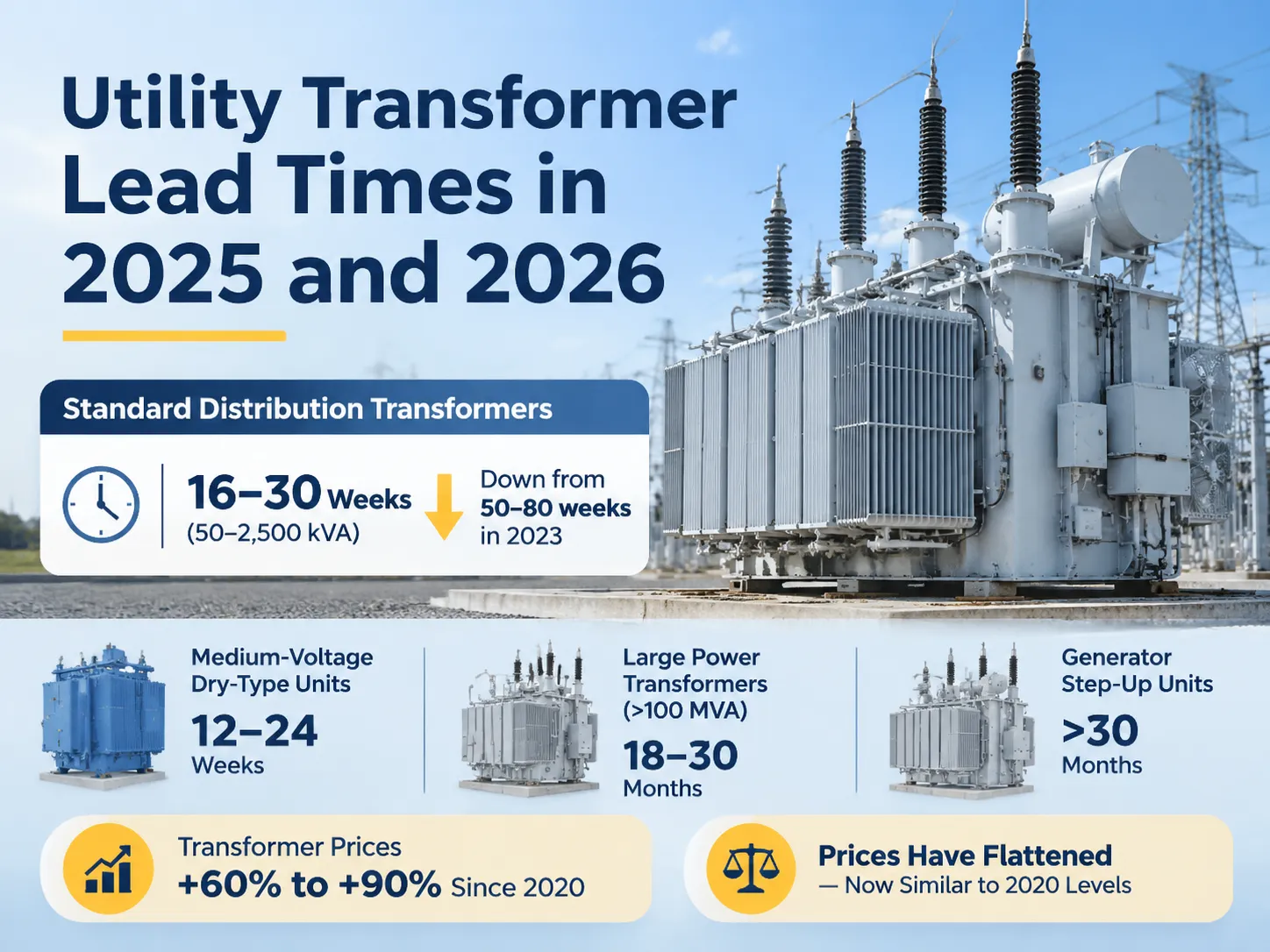
2025年および2026年の変圧器リードタイムのまとめ
ピークのボトルネック:2023年から2024年初頭およびその後. 電力会社は負荷増加に先行して発注し、再生可能エネルギープロジェクトを稼働させ始めましたが、結晶方向性電気鋼板を製造する工場は同じペースで拡張できませんでした。2023年には500 kVAのパッドマウントユニットの見積もりが70週間でしたが、現在は20~26週間となっています。.
回復は均一ではありません。回復は製品の種類によって異なります。標準的なコアとコイル設計に基づくカタログ配電ユニットは数か月で製造可能です。しかし、新しいタンク設計、非標準インピーダンス、型式試験が必要な場合、生産スケジュールは工場の製造ラインおよび設計部門の両方で遅延が発生し異なります。.
大型電力変圧器セクターの回復は他の変圧器カテゴリーと比較して最も遅れています。この場合、ボトルネックは鋼材ではなく試験場と熟練巻線工です。これらの能力は1年以内に増強できません。2026年に注文された200 MVAユニットは2028年の納期と予測する必要があります。.
業界が遅れを取っている理由
業界の回復には3つの障害があります。これらのいずれも受注残に起因するものではありません。.
世界中でごく少数の製鉄所が結晶方位電気鋼板を製造しており、新たな焼鈍およびコーティングラインを迅速に稼働させて結晶方位電気鋼板を生産することはできません。新しい生産ラインの建設は数年にわたる資本支出であり、需要ショックを吸収するには数年かかります。. これが、銅や労働力ではなく、コア材料が供給不足の主因となっている理由です。.
熟練巻線工の育成には時間がかかります。配電用変圧器の巻線は繰り返し可能な工程であり誰でも容易に行えますが、100 MVAユニットは全く異なるものであり、この作業を行うことができる労働力が縮小し高齢化しているため、市場ごとに資格を持つ人材はごくわずかしか残っていません。.
施設内で組み立てられるユニット数にかかわらず、大型電力変圧器の試験ベイ容量が工場全体のスループットを制限します。大型電力変圧器は試験ベイで数日間を過ごすことがあり、そのため製造施設内の試験ベイの床面積は圧倒的に最もコストの高い平方メートルとなります。過去10年間、世界的に試験ベイ容量にほとんど変化はありません。.
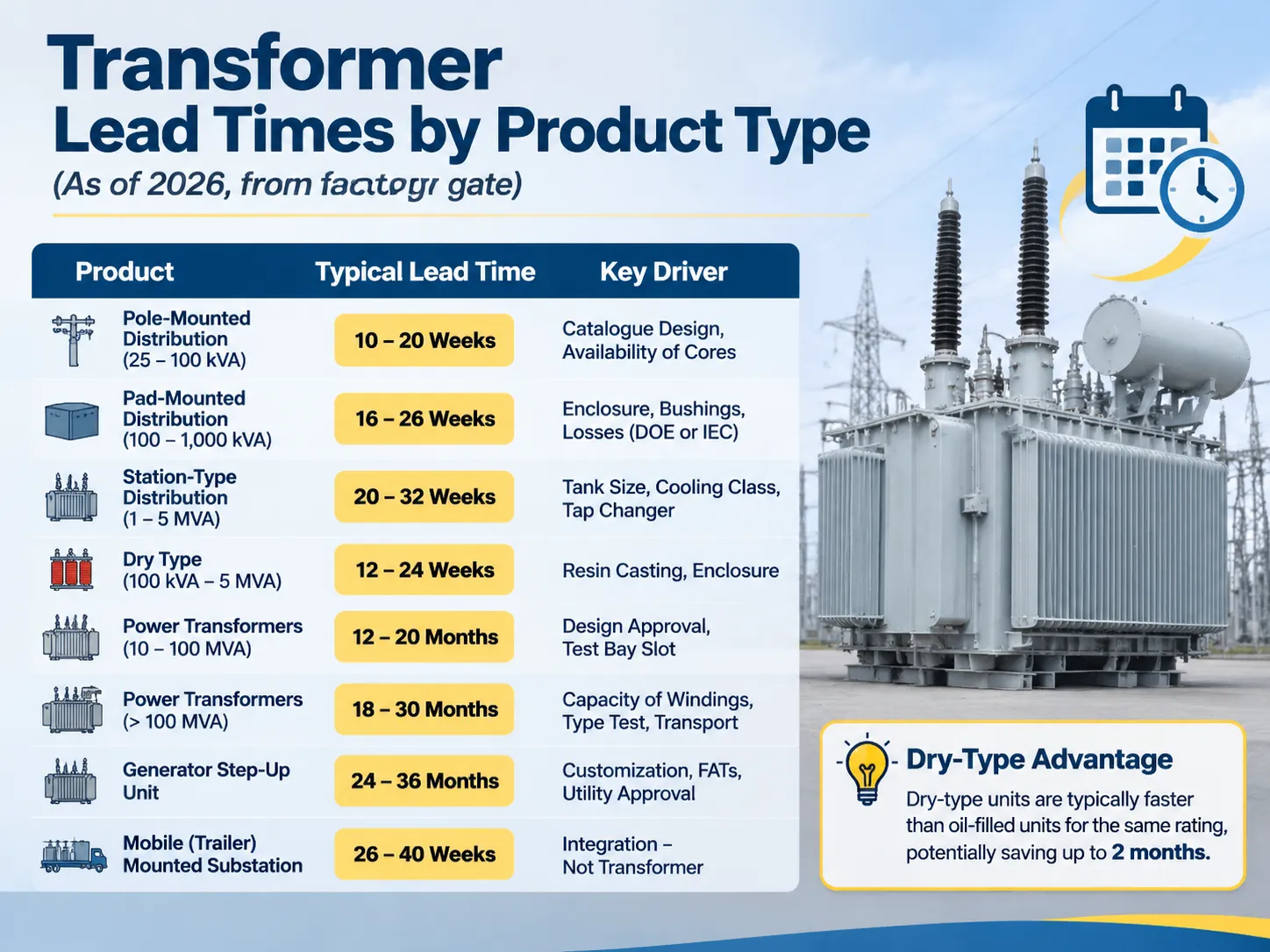
製品タイプ別リードタイム
以下の表は、2026年時点での新規変圧器注文の工場出荷までの納期範囲を示しています。さらに、輸送および現場作業がこの合計に加わることにご留意ください。.
| 製品 | 一般的なリードタイム | 主要要因 |
|---|---|---|
| 電柱設置型配電用(25~100 kVA) | 10~20週間 | カタログ設計、コアの入手可能性 |
| パッド設置型配電用(100~1,000 kVA) | 16~26週間 | エンクロージャーの種類、ブッシング、損失(DOEまたはIEC) |
| 変電所型配電用(1~5 MVA) | 20~32週間 | タンクサイズ、冷却クラス、タップチェンジャー |
| ドライタイプ(100 kVA~5 MVA) | 12~24週間 | 樹脂の鋳造能力、エンクロージャー |
| 電力変圧器(10~100 MVA) | 12~20ヶ月 | 設計承認、試験ベイスロット |
| 電力変圧器(100 MVA超) | 18~30ヶ月 | 巻線容量、型式試験、輸送 |
| 発電機昇圧ユニット | 24~36ヶ月 | カスタマイズ、工場受入試験(FAT)、電力会社承認 |
| 移動式(トレーラー)設置変電所 | 26~40週間 | 統合 – 変圧器ではない |
注:ドライタイプユニットは、同じ定格の油入ユニットよりも通常納期が短いため注目されています。キャスト樹脂ユニットはタンクや油処理を必要としないため生産工程が短く、屋内用ドライタイプが受け入れられればプロジェクトで最大2ヶ月の短縮が可能です。.
100 kVAユニットの価格と納期は ボリューム市場のサイズであり、リードタイム回復の大部分がここで起きているため、良いベンチマークとなります。.
変化をもたらす要因:サイズ、電圧、仕様
サイズは最も明白な変数であり、線形的な進行ではありません。トランスの定格を倍にすると、必要な材料の量がほぼ倍増し、冷却クラスの移行点、絶縁が設計上の問題となる電圧レベル、および通常の輸送手配の範囲外となる全体のサイズにおいて、複雑さが大幅に増加します。.
絶縁は設置されるトランスの電圧と直接的な関係があります。例えば、33 kV(設計および製造の観点から)は一般的な電圧定格です。132 kVのユニットは、ブッシング、クリアランス、インパルステストが必要となり、異なる工場でトランスを製造・保管し、異なる完成ラインに投入する必要があります。.
As the voltage of the transformer continues to increase, the number of companies that produce transformers above approximately 145 kV (as a guide) decreases significantly. For this reason, it can be expected that the lead times for these types of products will grow faster than the electrical rating of the product.
Thirdly, specification: an example of a compliant distribution transformer from the DOE (Department of Energy) with a standard impedance would be considered a catalogue product. However, the same rating but with non-standard impedance for parallel, a specific tap range, an assured low level of noise, or a specific vector group would constitute as an engineered order and, because of the requirement for engineering approval, could take up to six weeks.
The oil-immersed distribution transformer in the 20 kV voltage class serves as a good example. The factory builds the units to the various ratings of the product based on the catalogue of standard builds for each of those ratings, while the 20 kV insulation class establishes the design family to which the transformer belongs.
Custom vs. Standard – Two Timing Clocks
As mentioned before, a standard unit runs by means of a production clock, where the processes of receipt of material, winding, assembling, testing, painting, and shipping overlap; therefore, the factory will be able to forecast the lead time of all of these steps because the design for the standard unit will always be available.
A custom transformer may have the same structure as a standard transformer but have 2 timing clocks operating on the same order. The design clock will start with the day the customer orders and will conclude when the engineering and the utility approve the drawing. Once a project starts producing, the production clock begins counting down. So, estimating 10 weeks of production time (from the manufacturer) + 20 weeks for the project delivery to arrive = 30 weeks total time frame from “start to finish.” This is why projects that are anticipating using catalogue estimates fall behind schedule.
By removing the specification approval process for early-stage design and accepting a generic design early on, it is possible to compress the length of time required for the production process. Most non-standard impedances have a standard because the study that was conducted assumed a value of the impedance; there is no specific reason why that impedance type is needed for a particular project.
A Manufacturer’s Review of Expectations
Grid-scale manufacturers, including both Hitachi Energy and Siemens Energy, cite longer quotes than their competitors and typically hold to their dates more closely than others. A manufacturer that provides a 24 month quote for large power transformer manufacturing facilities has a more reliable delivery date than one that provides a 14 month quote for smaller power transformer manufacturing facilities. Large manufacturers have their own testing bays and have greater control over winding capacity than do smaller manufacturers.
The European Mid-Market, (represented by SGB-SMIT), is in the middle of the pack: they manufacture distribution and medium power units with delivery times ranging from 16 weeks to 30 weeks, with an advantage over non-European manufacturers due to access to European documentation and shorter shipping distances.
North American distribution manufacturers, including Prolec GE and ERCO, represent an expedited route for North American projects; they estimate 16-30 weeks for delivery, build to meet the project specifications (there is no adaptation of the IEC design to meet project specifications), therefore they are able to provide faster turnaround than overseas manufacturers.
The Chinese manufacturers, such as TBEA and China XD, are price competitive and can provide a completed distribution unit in a very short time frame of between 12 and 20 weeks, plus delivery time, and are frequently the quickest source of power transformer units for African and Southeast Asian regions. The only thing limiting the production of transformers is the documentation and approvals at the receiving end; however at SUBIAN we have complete control over the time it takes to manufacture both cores and windings for all of our transformers.
Timeframe Expectations
The construction lead times for our oil-filled and dry-type distribution transformers are based on the size of the transformer you would like to order, but also on whether the transformer involves a configuration with unique impedances, enclosures, substation packages, etc. The standard timeframe for ordering an oil-filled distribution transformer is generally between 12 and 20 weeks, and between 10 and 16 weeks for the dry-type distribution transformers. If you have a standard rated transformer in stock, it will qualify for the shortest quoted timeframe (12 to 20 weeks) for manufacturing & delivery. Any timeframes given that exceed those for the least costly method to manufacture & deliver the transformer (12 to 20 weeks), are based on unique specifications.
Unlike other manufacturing facilities that manufacture their own winding, our facility builds all of our own tanks and windings in-house. This offers SUBIAN a manufacturer lead-time advantage compared with those manufacturers who must purchase their windings or tanks and have limited control over their speedy production.
SUBIAN will always provide you with an ordered slot for your order rather than just an estimated time frame. For us, when we have our own winding department, tank building facility and testing bay; we will be able to guarantee your ordered lead-time. Whenever we quote transformer or substation prices, we will always list the lead-times for the ordering slot in the quotation.
The only limiting factor in the overall manufacture of your requested transformer is the length of time required to obtain Utility Approval. While the Utility Approval process is an integral part of our construction timeframe, the Utility Approval timelines fall outside of SUBIAN’s manufacturing construction timetable. Therefore, if your order requires an industry witness acceptance test, approved third-party type test, or Utility specification review, those timelines must be accounted for.
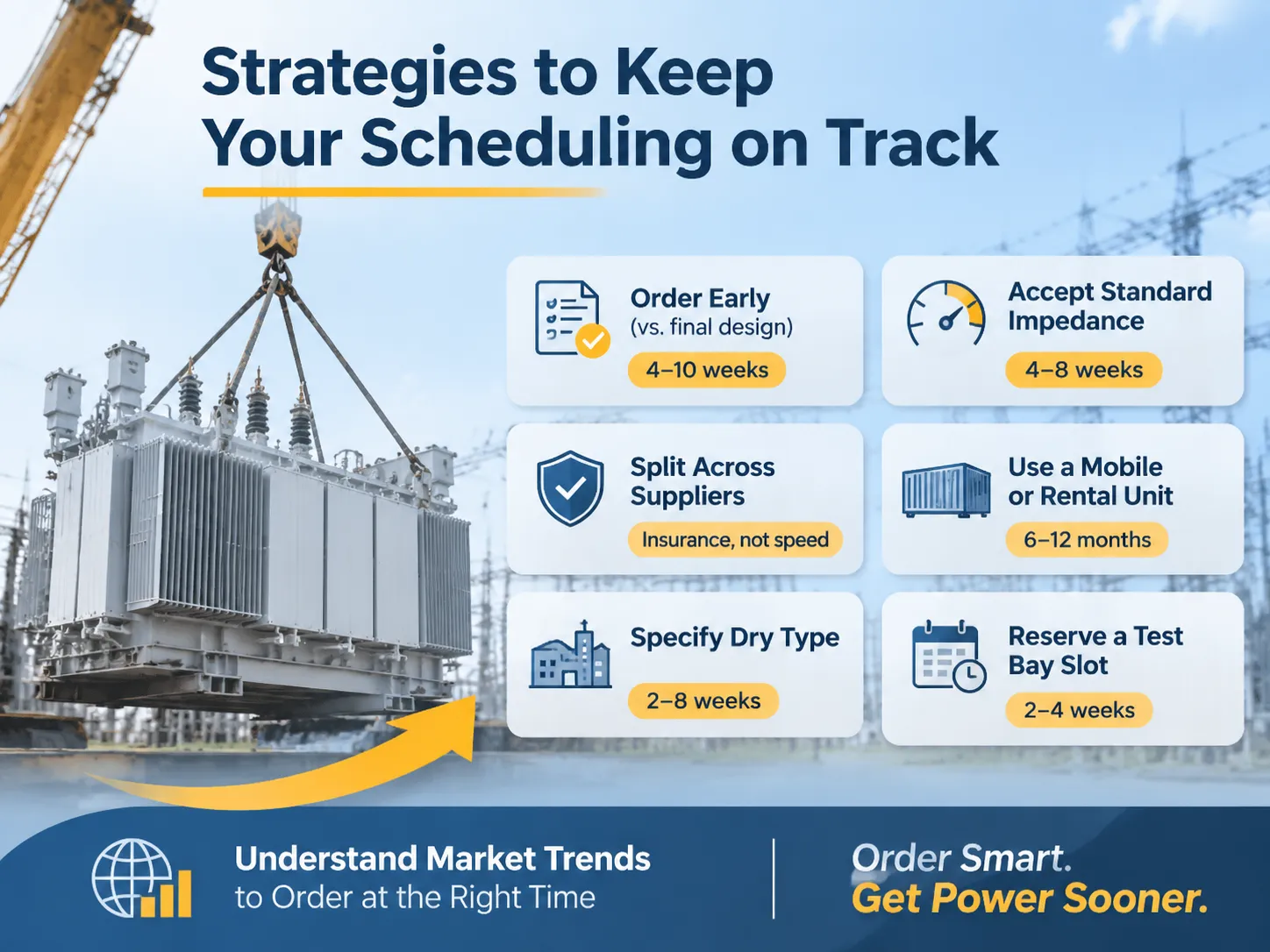
Strategies to Keep Your Scheduling on Track
| Tactic | What it buys | When to use it |
|---|---|---|
| Order before the design is frozen, against a performance spec | 4 to 10 weeks | Any project with a hard energisation date |
| Accept a standard impedance and tap range | 4 to 8 weeks | Where the study allows it |
| Split the order across two suppliers | Insurance, not speed | Multi-unit projects |
| Use a mobile or rental unit as an interim | Bridges 6 to 12 months | Replacements and emergency capacity |
| Specify dry type where the building allows | 2 to 8 weeks | Indoor commercial and industrial |
| Pay for a reserved test bay slot | 2 to 4 weeks | Large power units with a fixed date |
Thanks to that row, the entire project can occur much faster than it would normally. By ordering a transformer based on the performance specification prior to finalizing the single line diagram, it allows for a transformer to go to production sooner and to be changed later in the event that the calculated impedance changes; while a project that waits for the fully approved drawing will have already spent approval time twice.
When analyzing the global transformer market, it provides the backdrop for understanding the reasons for ordering in a certain time frame, thus making ordering today to take advantage of the seasonal demand.
Definition of “Lead Time”
A lead time is the amount of time between a signed order with a deposit and notice of dispatch readiness. The lead time does not count freight shipping time, customs clearance time, site delivery time, installation time, or commissioning time; there are variations that can add anywhere from four to sixteen weeks depending on routing.
Typically, three factors are excluded and frequently overlooked. Most large manufacturers usually count the approval of the order separately from the approval of the drawings and some don’t even include the approval of material for production until all approvals are received, at which point it will have to be produced on a scheduled basis.
Factory acceptance tests often require a witness and a slot of time to conduct. Spare part delivery is commonly shipped after the main unit.
The best way to determine the lead time for your product is to request a schedule rather than just a single number. The schedule should list all of the important milestones in the order fulfillment process, such as the date the order was placed, the date all drawings were approved, the date all materials were released, the date all windings began, the date the unit was test conducted, and the date the unit was shipped.
If a supplier can provide you with a detailed schedule, it is likely he/she has planned to complete the order and the supplier who only provides a single date has not.

Some Questions to Ask Your Supplier
- Is the quoted lead time based on the date the order was placed or the date the drawings were approved?
- If you need to approve the drawings, what is the average number of weeks required to get approval?
- Does the supplier include factory acceptance testing as part of the above lead time?
- Are any of the components for the transformer purchased from third-party vendors, and what are their respective lead times?
- What is the current lead time to manufacture a transformer of the same rating for another customer (note: this question differs from the previously requested standard lead time)?
- If the specifications change after the drawing release, what will be the additional number of weeks and cost to produce the revised product?
- Does the factory have a reserved production slot for the order, and is there a provision in the contract for its use?
- What is the penalty/credit to the vendor if the equipment is not delivered on time?
- What will be included with the shipped unit, and does this include routine test reports and material certificates?
- What is the lead time for ordering spare bushings, tap changers and oil? A transformer that has a two-year lead time for a spare bushing presents a potential two-year outage risk. Typically, spare parts for substations fall under the category of substation components, as they are included in the same package with the main unit (i.e., when ordered together, not separately later).
よくある質問
What is the 80 percent rule on transformers?
This is an industry standard and not a requirement of the National Electrical Code (NEC). It is common for transformers to be designed to carry continuous loads at no more than about 80 percent of their nameplate rating, because prolonged operation with loads exceeding that shortens the life of the insulation and does not allow for future load growth. For example, NEC requires that overcurrent protective devices are sized at 125 percent to provide an equivalent margin from the opposite side.
Once the transformer is finally ordered, how long does it take to get a new one?
The timeframe for receiving a transformer can vary greatly based on size and design from a few weeks (12 weeks or more) for smaller dry-type standard models, three years for a custom generator step-up transformer, up to and including also having to wait for a type test. The main factors that determine delivery time are rating, voltage class, existing design, and the type of test required to complete the transformer.
Why does it still take so long to get a lead time for a transformer?
There are three major factors that contribute to this: The availability of grain-oriented electrical steel is highly limited to a small number of mills, skilled winders need years of training, and the available test bay capacity limits the number of large units that can be completed by a factory at any given time; therefore, none of these factors can be easily increased.
Will I be able to get a transformer in a shorter time frame if I pay more?
This depends; it may be possible to purchase a reserved slot on the production schedule for a large transformer or purchase air freight to expedite delivery for a smaller transformer. However, it would not be possible to purchase steel that is not ready for rolling or to procure winding skills not available in the workforce.
参考文献
- Hitachi Energy: Transformer Delivery and Project Capability
- Siemens Energy: Power Transformer Manufacturing
- SGB-SMIT Group: Distribution and Power Transformer Range
- U.S. Energy Information Administration: Grid and Capacity Data
- Electrical Engineering Portal: Transformer Procurement and Specification
結論
The question of lead time has been split into two sections. Distribution-type transformers will be available again in months, while large power transformers will continue to take at least two years from order to delivery. If a project is planning on purchasing a distribution transformer, yet attempts to place an order for a large power transformer, they will most likely miss their required delivery date.
To protect a project schedule, it is recommended to order against a performance specification before the drawing has been finalised. Always ask the supplier for a confirmed schedule, rather than a specific date. Suppliers that are able to confirm their estimated approved order date, estimated winding date, and estimated test date have planned their order, and their plan is worth far more than the commitment of weeks from that date.