


In Lagos, in a coastal manufacturing area, a new cement manufacturing facility required 2 MVA of distribution capacity within six weeks and on a location that has a flooding problem during the wet season. The technical solution is not a building but an outdoor prefabricated substation, a stainless-steel unit with IP55 enclosure that is elevated 800 mm above ground, resting on hot-dip galvanized base, tested in factory with transformer and switchgear, transported in a container and put into operation in four days. Five years after construction of the facility, during two wet seasons, the unit had been operating reliably without failures due to moisture.
The article will give an overview of outdoor prefabricated substations, explain their role in modern electrical engineering and construction, and provide information regarding their design, price, and specifications needed when purchasing.
Short reply: An external modular substation (also referred to as a compact or box-type substation) is an outdoor electrical assembly made in factory consisting of a transformer and the units of MV/LV switchgear, metering, and protection all enclosed in an IP54/IP55 housing made according to IEC 62271-202. It can be installed outdoors since the enclosure was tested for resistance to rain and dust, ultraviolet rays, and is a complete unit with some tests already performed such as heat test, shock test, and electrical testing.
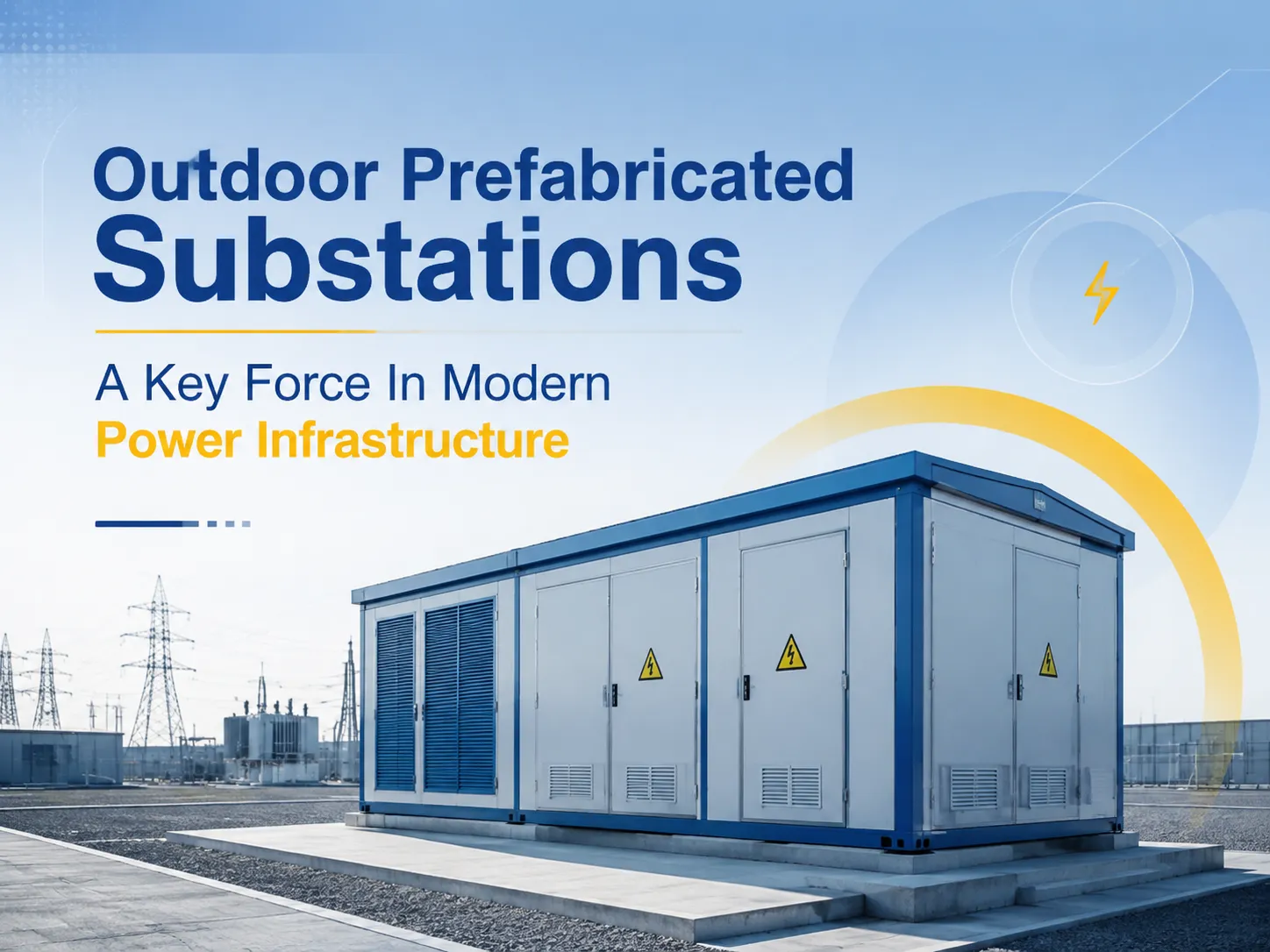
What Is an Outdoor Prefabricated Substation?
A prefabricated outdoor substation is known as an MV/LV distribution substations which is a whole unit and weather resistant that is transportable and designed to be installed outside without the need for a building, an environment or any other enclosure. The transformer and other important components lie within steel or stainless steel materials and are operated according to IEC 60529 meaning they offer a good level of durability according to IP54 and IP55 standards. The technical aspects of the equipment have been given by IEC 62271-202 being the one that states the designing and safety requirements. The fact that the term “outdoor” is used for that construction is crucial since it means the enclosure must resist different elements: from direct sunlight to extreme temperature and potentially harmful weather impacts. The outdoor prefabricated substations are the fastest-growing part of distribution infrastructures since they offer ready-to-use stations within a few days which is incomparable to factories-built stations which may take a lot of time to produce.
Why It Is a Key Force in Power Infrastructure
The following four structural changes have led to the emergence and prevalence of outdoor prefabricated substations as an important force in the current power infrastructure.
- Speed of electrification: Utilities and governments require new capacity to be installed more quickly than site-built substations can achieve. Indeed, a prefabricated electrical unit becomes operational in just 2–5 days, while it takes site-built stations up to 12 weeks.
- Cost pressures: The elimination of civil work and buildings as well as construction coordination allows the decrease of the total installation cost by up to 40%.
- Decentralization of the grid: The emergence of renewables, distributed energy, and electric vehicle charging points has led to the introduction of thousands of new medium-sized connections and substations with standardized parameters.
- Availability and cost of skilled labor: There is a lack of skilled labor, and factory production allows conducting the quality control in a controlled environment.
These forces demonstrate why prefabricated substations are used in the majority of newly built MV/LV distribution points across Europe, Asia, the Middle East, and Africa, leading to the gradual replacement of site-built substations even in places where land is cheap.
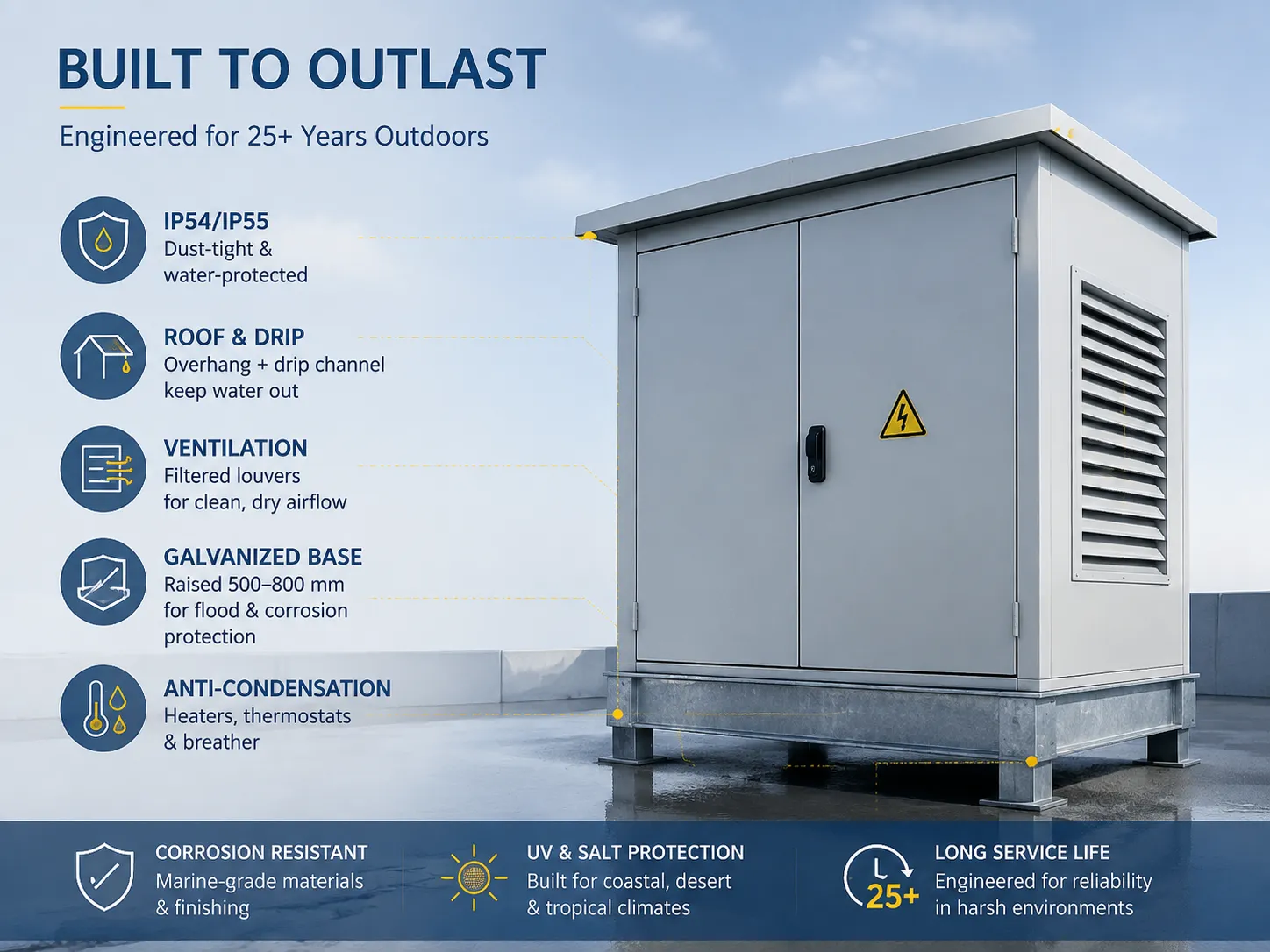
Outdoor Engineering: Enclosure and Protection
Staying alive in the natural environment for more than twenty-five years is a technical challenge on its own. The design of the enclosure is what distinguishes good manufacturers from others :
| Design Element | Requirement | Why It Matters |
|---|---|---|
| IP rating | IP54 minimum; IP55 for high water-spray risk | Keeps rain and dust out of live compartments |
| Roof and drip | Overhanging roof, drip channel, sealed gaskets | Prevents water entry through door and roof seams |
| Base | Hot-dip galvanized, raised 500–800 mm | Survives flooding, corrosion, and ground moisture |
| Ventilation | Baffled, filtered louvers; IP-rated airflow | Cools the transformer without letting in rain or insects |
| Materials | Painted carbon steel, stainless steel, or GRP/composite | Stainless/composite for coastal and corrosive sites |
| UV and salt resistance | Marine-grade paint systems, anodized parts | Prevents fading, rust, and salt-spray corrosion |
| Anti-condensation | Heaters, thermostats, breather | Stops internal condensation in humid climates |
Such details as roof overhang, drip channels, filtered louvers, and galvanized bases are the key aspects determining whether the unit stays dry up to fifteen years or starts leaking after two years of use. Those buyers who reside in coastal or desert areas or in the tropics should accept them as obligatory requirements.
Internal Layout and Components
A classic outdoor prefabricated substation consists of three or four compartments divided by partitions and opened by separate doors.
- The MV compartment has the RMU or vacuum breaker with the cable boxes making the front interlocks and indicators with easy accessibility.
- The transformer compartment has either the oil-immersed or dry type transformer with oil reservoirs and forced ventilation system with alarms as well.
- The LV compartment contains the LV switchboard, metering, outgoing feeders, and sometimes capacitor bank.
- The auxiliary zone contains the heating, lighting, and control wiring dispersed throughout compartments.
The compartment distributing system is designed in such a manner that the hottest equipment (transformer) is positioned in ventilated compartment, whereas the switchgear compartments operate at their rated temperature and isolate any internal fault. The interlocking of the doors makes it impossible for an operator to reach the transformer compartment while the MV is switched on.
Types and Configurations
| Classification | Variants | Typical Application |
|---|---|---|
| Enclosure material | Painted steel, stainless steel, GRP/composite | Coastal/corrosive sites use stainless or composite |
| MV switchgear | RMU (SF6 or solid-insulated), load-break switch, vacuum breaker | RMU for loop/ring networks; breaker for large industrial feeds |
| Transformer | Oil-immersed or dry-type | Dry-type for indoor/fire-sensitive; oil for general outdoor use |
| Configuration | Single-unit, tandem (split switchgear/transformer), mini substation | Matches site footprint and load arrangement |
| Mounting | Ground-mounted, skid-mounted, elevated plinth | Elevated/skid for flood zones and relocation |
In the case of solar and wind plants, outdoor prefabricated substations are offered in the form of pre-assembled units under the inverter stations, and for sites prone to floods, the firms provide elevated support type arrangements with the whole unit placed above the maximum water level.
Standards and Testing
| Standard | Scope | Key Buyer Check |
|---|---|---|
| IEC 62271-202 | Prefabricated transformer substations | Complete-unit type tests: temperature rise, short circuit, dielectric |
| IEC 60076 | Power transformers | Transformer rating, losses, routine/type tests |
| IEC 60529 | IP enclosure protection | IP54/IP55 minimum for outdoor units |
| IEC 62271-200 | MV metal-enclosed switchgear | RMU safety and internal arc requirements |
| IEEE C57.12.27 (N. America) | Pad-mount equipment integrity | Dead-front construction and tamper resistance |
The most significant test is the IEC 62271-202 temperature-rise test with the enclosure assembled as that will demonstrate that the unit is able to reach its rating in real outdoor conditions. Some manufacturers only test transformers as a unit; this difference will become evident in operation in hot climates through accelerated aging, tripping, etc.
Outdoor Prefabricated vs. Site-Built Substation
| Factor | Outdoor Prefabricated | Site-Built Substation |
|---|---|---|
| Building | Factory-made enclosure | Site-built brick/concrete |
| Installation time | 2–5 days | 4–12 weeks |
| Testing | Factory type-tested complete unit | Site assembled, partly untested |
| Total installed cost | 20–40% lower typical | Higher civil works and labor |
| Relocation | Yes — lift and move | No |
| Land footprint | 10–40 m² | 100+ m² with access |
| Flood resistance | Elevated plinth options | Site-dependent |
| Best for | New MV/LV distribution points | Transmission-level and very large stations |
The field-constructed stations remain appropriate over 40.5 kV and for large distribution centers; however, below this value, the prefabricated alternative dominates the new capacity due to being quicker, more cost-effective, and higher quality than field construction.
Application Areas
- Distribution in urban and business environments: Residential neighborhoods, shopping centers, and commercial buildings have low land requirements and can be quickly connected to the power grid.
- Production areas: One unit for each factory or cluster; units can be used in 400–1600 kVA steps.
- Renewable sources: Solar farms and wind farms use many modular units as interfaces between the inverter and the power grid.
- Electrification of rural areas: Small power units supply villages with electricity at much lower costs than traditional sources.
- Mining and distant territories: High-quality portable units when installation capacity in the area is poor.
- Emergency recovery and mobile power: Easily moved portable units compensate for losses in capacity of power systems.
Costs and Price Ranges
The following are reference prices for outdoor prefabricated substations (RMU, oil-type transformer, LV panel, steel cabinet of IP54):
| Rating | Voltage Class | Typical Price (USD) | Lead Time |
|---|---|---|---|
| 100–315 kVA | 10–35 kV | $4,000–$12,000 | 6–12 weeks |
| 400–630 kVA | 10–35 kV | $7,000–$20,000 | 6–12 weeks |
| 800–1,250 kVA | 10–35 kV | $11,000–$33,000 | 8–14 weeks |
| 1,600–2,500 kVA | 10–35 kV | $24,000–$60,000 | 10–18 weeks |
There is an increase of 15–30% for enclosures made of stainless steel or composites, 10–20% for dry transformers, and $800–$3,000 for SCADA upgrades. The prices given are FOB prices subject to variation based on specifications, brand, and location of procurement; therefore, we strongly suggest analyzing losses over the entire lifecycle of the asset before making any decisions.
Top Brands & Price Comparison
| Brand | Country | Compact Substation Strengths | Indicative Price — 1,000 kVA (USD) |
|---|---|---|---|
| Schneider Electric | France | RMU integration, global compact substation range | $22,000–$38,000 |
| Siemens | Germany | Digital options, integrated protection systems | $23,000–$40,000 |
| ABB / Hitachi Energy | Switzerland | Broad portfolio, strong utility references | $22,000–$39,000 |
| Eaton | USA | Pad-mount and North American market strength | $20,000–$36,000 |
| ZPUE / AUSY (specialists) | Europe | Dedicated prefab substation engineering | $22,000–$45,000 |
| Jiangsu Subian Electric Power | China | IEC 62271-202 units, oil/dry options, OEM | $11,000–$33,000 |
Global leaders provide brand reliability, developed product lines, and global service networks. Jiangsu Subian Electric Power satisfies the demand for low-cost solutions. The company offers outdoor prefabricated substations in accordance with IEC 62271-202 standards with oil-type or dry transformers and the switchgear in IP54 enclosing for 40–55% of the European prices. Such an offering makes Jiangsu Subian Electric Power a worthy candidate for EPC companies, utilities, and developers in search for compact substations to implement them at a large number of project sites.
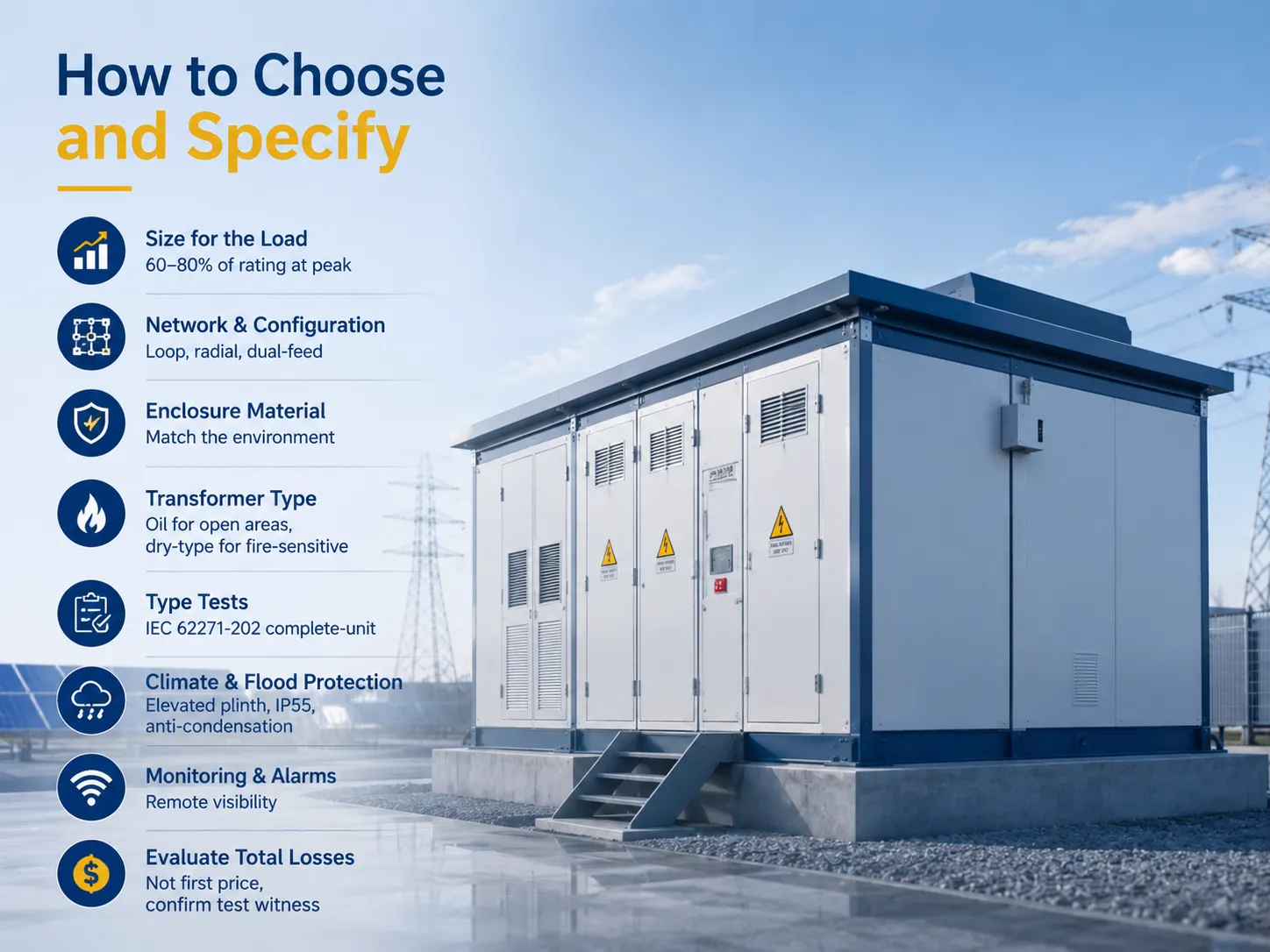
How to Choose and Specify
- Begin by determining load in kVA taking into consideration the growth plan; make sure that the peak load operates at 60–80% of transformer capability.
- Inquire regarding network voltage and layout type (loop, radial, dual-feed) to identify whether RMU or breaker switchgear should be selected.
- Select the enclosure based on the type of environment: painted steel should be used for friendly places whereas stainless steel or composite should be considered for coastal or corrosive environment.
- Choose transformers based on the fire safety: oil transformer is suitable for open locations while dry-type transformer is useful for places exposed to fire hazards.
- Make sure to conduct IEC 62271-202 unit testing such as temperature rise test with enclosure fitted.
- Confirm flood proofing and climatic conditions mechanisms (raised plinth, IP55 rating, use of anti- condensation heaters).
- Apply monitoring and alarm systems in cases where the site is unattended.
- Compare based on losses incurred and obtain factory witness testing schedule at the factory.
Frequently Asked Questions
How much does an outdoor prefabricated substation cost?
A unit rated at 400-1000 kVA can range in price from $7000 to $33000 depending on the required switchgear and enclosure material and level of losses. A unit rated at 1600-2500 kVA will set you back at around $24000-$60000. Keep in mind that it will take around 15-30% extra for stainless steel and around 10-20% extra for dry transformers. In addition, monitoring will add to the cost by about $800-$3000. Be sure that you compare the total costs including losses.
How long does installation take?
Typically, it may take from 2 to 5 days for installation of the prepared pad, including lifting the structure by the crane, bolting it down, making cable terminations, and commissioning. For comparison, the installation of a regular substation may take from 4 weeks up to 12 weeks. The advantage of factory testing is the relative rarity of commissioning problems as long as the cables and the pad at the site match the drawings.
Can an outdoor prefabricated substation withstand floods and coastal salt?
Yes, provided that it is properly specified. A unit designed for use in flood zones comes equipped with elevated plinths or skid mounting at 500-800 mm above the ground level. For coast areas and areas with corrosive environment a stainless-steel or composite enclosure with marine-grade coatings will be employed. Also, it is important to set IP55 rating if there is possibility of high water-spray exposure.
What is the difference between an outdoor prefabricated substation and a pad-mounted transformer?
Both types of installations can be classified as regional siblings. IEC 62271-202 defines an outdoor prefabricated substation as a system that combines MV switchgear, transformer, and LV switchgear in one device and it is widely used across Europe, Asia, and Africa. IEEE C57.12.27 defines a pad-mounted transformer, which is purely a transformer without any switchgear. The decision to make should be based on local standards and switching requirements.
What tests should I require before accepting a unit?
I would recommend ordering the routine tests, which are specified in IEC 60076, and testing the switchgear as well as the IEC 62271-202 type tests, which include a series of tests, such as temperature rise and dielectric testing. If it is an export order, I would demand getting a factory test witness and pre-shipment inspection arranged.
References
- IEC 62271-202 — High-voltage switchgear: Prefabricated transformer substations — the governing standard for outdoor prefabricated substation design, safety, and type testing.
- IEC 60076 series — Power transformers — the base standard for the transformers installed inside the unit.
- IEC 62271-200 — MV metal-enclosed switchgear — requirements for RMU and breaker compartments.
- IEC 60529 — IP Code — defines IP54/IP55 enclosure ratings for outdoor use.
- IEEE C57.12.27 — Pad-mounted equipment enclosure integrity — North American dead-front and tamper-resistance requirements.
- NEMA — Distribution equipment guidance — application and rating guidance for compact substation equipment.
- Jiangsu Subian Electric Power — official site — manufacturer and exporter of IEC 62271-202 outdoor prefabricated substations.
Conclusion
Outdoor pre-assembled substations are becoming essential in the present energy infrastructure since they provide everything that modern industry expects in terms of high speed, saving costs, factory quality and durability. A fully equipped substation (transformer, MV and LV switchgear, protection and metering devices) is delivered pre-tested and can be installed in just days instead of months.
Key tips:
- Ensure the sizing of the station is made for maximum load while taking into account the transformer capacity of around 60-80%.
- Select RMU or interrupter according to the network design.
- Choose material and the IP rating of the transformer according to the site environment (use of stainless steel/composite and IP55 for the coastal and wet regions).
- Demand the IEC 62271-202 complete unit tests, especially those with the box on.
- Compare losses in machines and require confirmed tests at the factory for export.