


It is Tuesday morning at a medium-sized industrial estate near Nairobi, and the electricity crew has only one week to connect a new shoe production plant that was connected eight days ago. No one on the construction site is making a transformer platform or waiting for a brick enclosure; instead, a crane is lifting a ready-made transformer unit off the trailer and putting it on the flat concrete floor at about 10 a.m.; the connection is finished the next day, and the factory starts the first production run the following Monday. Such activities are now very common in Africa, Asia, and South America, where powering takes only days rather than months.
This article offers a practical guide on customized transformers, what they are made of, how they are designed and tested, how much they cost, and how to avoid typical mistakes when buying them.
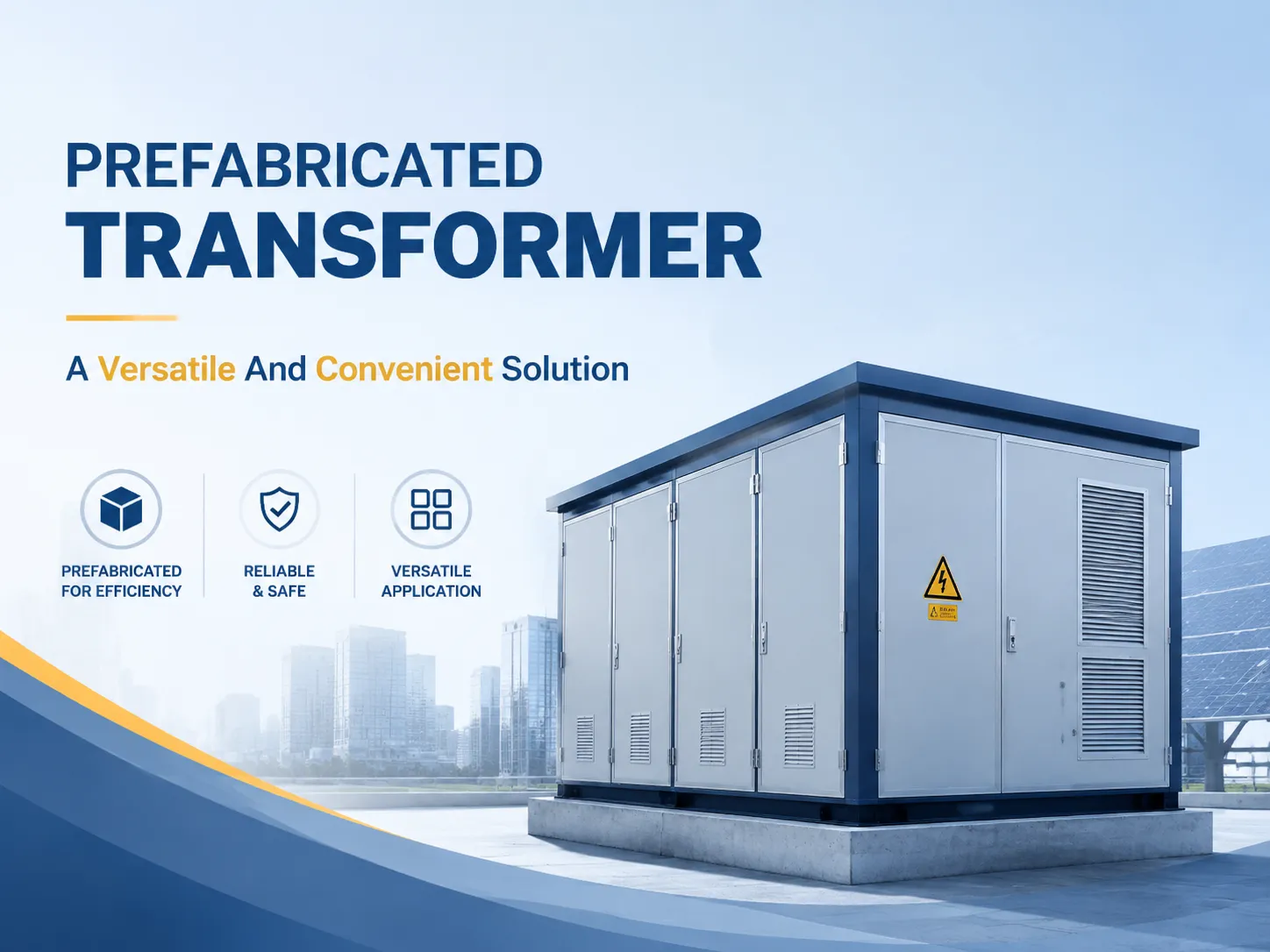
Briefly put, the prefabricated transformer, sometimes called prefabricated transformer substation, box substation or compact substation, is the solution that consists of a power transformer, medium voltage switchgear, low voltage switchgear, meter and protection within a single compact unit that is able to function in outdoor conditions. It is assembled at the factory and tested for quality prior to being sent to the end-user and set at the required location within 2-5 days.
What Is a Prefabricated Transformer?
Prefabricated transformer is a complete transformer substation that comes out of the factory as one tested assembly rather than as loose parts. The term “prefabricated” refers to the type of manufacture: the enclosure, transformer, switches, wires and auxiliary systems are designed and assembled in the factory in a way, that when brought to site, the resulting product can be easily plugged into an existing electrical system.
This type of equipment is termed IEC 62271-202 in Europe and other export countries (High-Voltage Switchgear and Control Gear: Part 202: High-Voltage/ Low-Voltage Prefabricated Substation). In North America, the equivalent device at distribution level is commonly called the pad-mounted transformer (IEEE C57.12.27). In China, this type of equipment is usually referred to as a box-type transformer or, in other words, American-style box transformer. Thus, the naming of this equipment varies from country to country, but one and the same idea is implemented almost everywhere by having the compact ground-mounted transformer equipment built in the same way.
In practical terms this difference means that traditional transformer needs civil construction works, buildings, separate company for installation works and weeks of coordination before it starts operating, while made transformer needs just a concrete slab, a crane and several days of electric works.
Core Components Inside the Unit
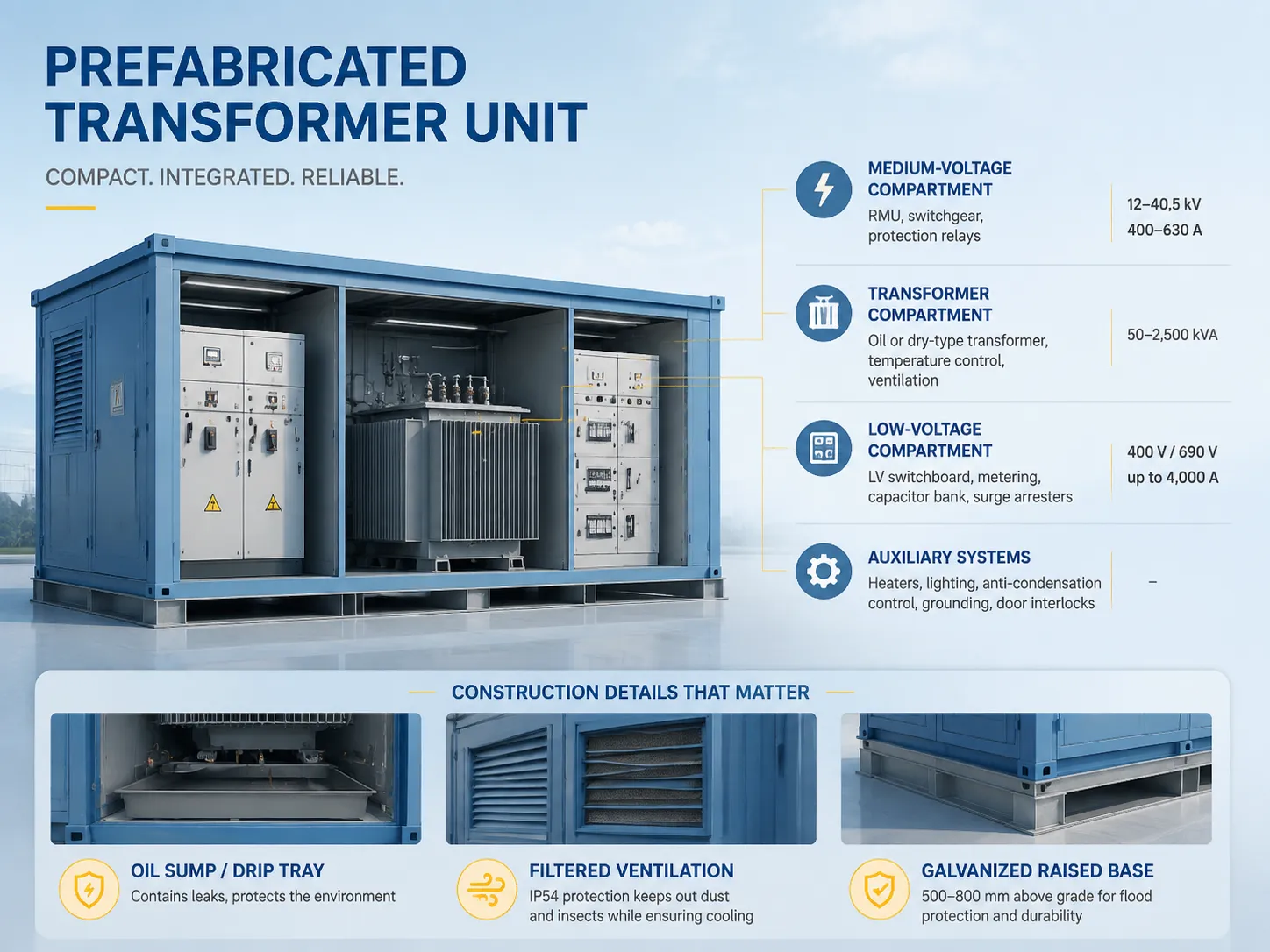
While the manufacturer and ratings determine the models of each prefabricated transformer, generally a fully assembled transformer consists of three to four functional components, all placed in one glassfiber-reinforced plastic casing, which is on average 2.4-3.0 m wide and 4-12 m long.
| Compartment | Main Equipment | Typical Rating |
|---|---|---|
| Medium-voltage compartment | RMU (ring main unit), SF6 or vacuum switchgear, cable box, protection relays | 12–40.5 kV, 400–630 A busbar |
| Transformer compartment | Oil-immersed or dry-type transformer, oil containment, temperature control, ventilation | 50–2,500 kVA |
| Low-voltage compartment | LV switchboard, outgoing feeders, metering, capacitor bank (optional), surge arresters | 400 V / 690 V, up to 4,000 A |
| Auxiliary systems | Heaters, lighting, anti-condensation control, grounding busbar, door interlocks | — |
Three distinguishing features set reliable units apart from their poor counterparts: an oil sump below the transformer to manage any leaks; air filtered vents, which have been designed in accordance with IP54 standards; and a hot-dip galvanized base elevated at least 500-800 mm above grade.
How a Prefabricated Transformer Works
The method of operation of this unit is similar to the operation of any distribution transformer, but in this case, the unit is built in a different layout. The medium voltage power supply enters the RMU, where it gets switched and protected from faults of the incoming ring or radial line. After that, the feed is transmitted to the transformer, transformer which decreases the voltage from 11 kV, 22 kV or 33 kV to 400V three-phase levels suitable for the consumers. Then the LV switchboard distributes the power to the outgoing feeder circuits that are protected by MCCBs or ACBs, the metering gives credits for the energy consumed.
The difference of this precast version from a standard one is its thermal engineering. The transformer produces heat dependent on its load and hence it is encased inside a box, which protects the transformer from the effects of weather and prevents airflow. IEC 62271-202 thus states that testing is to be performed with the complete casing of the transformer instead of taking a bare transformer test. Good manufacturing design should provide air circulation using inlet and outlet louvers.
Types and Configurations
| Classification | Variants | Typical Use |
|---|---|---|
| Mounting | Ground/pad-mounted, pole-mounted (mini units), skid-mounted | Distribution at ground level; mini units for rural and temporary power |
| Enclosure | Painted carbon steel, stainless steel, GRP/composite | Stainless/composite for coastal and corrosive environments |
| Transformer | Oil-immersed (ONAN), dry-type (cast resin) | Oil for general use; dry-type for fire-sensitive or indoor sites |
| MV switchgear | RMU (SF6-insulated, solid-insulated, or air-insulated), load-break switch, vacuum circuit breaker | RMU for loop networks; breaker for large single industrial feeds |
| Configuration | Single-unit, tandem/split layout, mini substation | Matches site footprint and load arrangement |
In relation to solar and wind farms, the new configuration of the solar substation integrates the MV/LV unit with inverter-side equipment and commonly includes a step-up transformer with a rating in between 2500 to 4000 kVA per unit. The latter type is usually offered as a skid-mounted platform for placement near the inverter station in the array.
Why Buyers Choose Prefabricated Over Site-Built
- Speed: Installation and commissioning can take 2 to 5 days as opposed to the conventional construction period of 4 to 12 weeks which is crucial in fast track projects.
- Cost: The absence of on-site facilities, many contractors and long civil works usually means that total installed cost drop by 20 to 40% of the cost of conventional equipment.
- Quality: In accordance with IEC 62271-202 standards each complete unit undergoes testing to verify its thermal, dielectric and short-circuit capabilities.
- Relocatability: The unity can be pulled and energized in a new site once the load shifts.
- Compact space: A few dozen square meters are enough instead of huge fenced and connected premises.
- Smooth logistics: The only package to deliver compared to tens of separate shipments is a huge advantage.
In the case of distributed renewable generation projects, these advantages are multiplied as there are dozens of identical units and that’s the reason why solar farms and rural electrification projects tend to use prefabricated substations instead of station built on-site.
Prefabricated vs. Conventional Substation
| Factor | Prefabricated Transformer | Conventional Substation |
|---|---|---|
| Civil works | Concrete pad only | Building, foundation, fencing |
| Installation time | 2–5 days | 4–12 weeks |
| Testing | Factory type-tested complete unit | Site-assembled, partially untested |
| Relocation | Yes | No |
| Footprint | ~10–40 m² | Typically 100+ m² with access |
| Total installed cost | 20–40% lower typical | Higher civil and labor share |
| Customization | Configurable but standardized | Fully bespoke |
Traditional substations are the appropriate solution for transmission voltages of 66 kV and higher as well as huge distribution centers in stable buildings. For less than 40.5 kV, the prefabricated substation is now the norm in the majority of foreign markets.
Typical Specifications
A typical demonstrative medium-sized unit of 630 kVA, 33 kV/0.4 kV, used in various industrial and commercial projects.
| Parameter | Typical Value |
|---|---|
| Transformer rating | 630 kVA, oil-immersed, ONAN |
| Primary voltage | 33 kV (also 11/22/35 kV) |
| Secondary voltage | 400/230 V, 50 Hz |
| Vector group | Dyn11 |
| No-load loss | ~1.0–1.3 kW (depends on loss class) |
| Load loss at 75°C | ~7.5–9.5 kW |
| Impedance voltage | 4%–6% |
| MV switchgear | SF6 RMU, 630 A busbar, 20 kA/3s |
| LV switchboard | 400 A–630 A main, MCCB outgoing feeders |
| Enclosure | IP54, hot-dip galvanized base, painted steel |
| Noise level | ≤ 55 dB(A) at 1 m per IEC 60076-10 |
| Standards | IEC 62271-202, IEC 60076, IEC 60529 |
Standard tests carried out as per IEC 60076, include testing of resistance of windings, testing of ratio and group of windings, short-circuit impedance, testing of no-load and load losses including insulation resistance and dielectric tests for the specified value of voltage. Type tests comprise tests for temperature rise, tests for impulse voltage, and tests for short-circuit resistance.
Application Areas
- In urban and commercial distribution, residences, malls, office buildings, and streets create an environment where space utilization and speed of energization are important.
- In the case of industrial areas, there is only one solution per factory or cluster. Units in this category can adapt their capacity in increments of 400-1,600 kVA depending on the growth of tenants.
- For renewable energy plants, prefabricated units serve as a connection point between inverter stations and the grid. The size of these units varies from 1,000 to 4,000 kVA.
- In terms of rural electrification, mini-prefabricated units allow connecting remote villages and farmers to the grid.
- For temporary and emergency power, an example would be the installation of skid-mounted units on disaster recovery, events, or construction sites quickly.
- Mining and remote operations installations rely on ready-made products for lack of local production capabilities.
In all cases the unit has the same objectives: to take the medium-voltage feed, convert it to utilization voltage, protect it, meter it and deliver the necessary amount of power to a specific load.
Standards and Testing
| Standard | Scope | Key Buyer Check |
|---|---|---|
| IEC 62271-202 | Prefabricated transformer substations | Complete-unit type tests: temperature rise, short circuit, dielectric |
| IEC 60076 | Power transformers | Rating, losses, routine and type tests |
| IEC 60529 | Enclosure protection (IP code) | IP54 minimum for outdoor units |
| IEC 62271-200 | MV metal-enclosed switchgear | RMU safety and internal arc classification |
| IEC 61000-4 | EMC (electromagnetic compatibility) | Relay immunity in the enclosure |
| IEEE C57.12.27 (N. America) | Pad-mount equipment integrity | Dead-front construction, tamper resistance |
In export orders, one of the most important documents is IEC 62271-202 type test report for the entire unit, especially temperature-rise test with fitted enclosure. Some suppliers with low costs carry out tests only for the transformer without its enclosure, which may conceal derating issues in hot climate areas. Always make sure that you request the report on the complete unit. In case of large orders, you might need a factory test witness as well.
Costs and Price Ranges
Indicative prices for prefabricated transformer stations (RMU switchgear, oil-transformer station, LV panel, conventional painted steel enclosure):
| Rating | Voltage Class | Typical Price (USD) | Lead Time |
|---|---|---|---|
| 100–315 kVA | 11–35 kV | $4,000–$12,000 | 5–10 weeks |
| 400–630 kVA | 11–35 kV | $7,000–$20,000 | 6–12 weeks |
| 800–1,250 kVA | 11–35 kV | $11,000–$33,000 | 8–14 weeks |
| 1,600–2,500 kVA | 11–35 kV | $24,000–$60,000 | 10–18 weeks |
One can add 15-30% for stainless-steel enclosures and 10-20% for dry transformers. In addition you would add $800-3000 for metering, monitoring, SCADA options. Prices are indicative FOB basis and may differ according to specification and brand. For losses evaluation purposes the 630 kVA unit with 500-1000 W lower no-load loss can save $300-900 in running costs, what might be important taking into account the asset lifetime of 25 years.
Top Brands & Price Comparison
| Brand | Country | Strength | Indicative Price — 1,000 kVA (USD) |
|---|---|---|---|
| Schneider Electric | France | RMU integration, global compact substation range | $22,000–$38,000 |
| Siemens | Germany | Digital substation options, integrated protection | $23,000–$40,000 |
| ABB | Switzerland | Broad portfolio, strong utility references | $22,000–$39,000 |
| Eaton | USA | Pad-mount strength, North American market | $20,000–$36,000 |
| Hyosung / LS Electric | Korea | Compact units, strong Southeast Asia presence | $19,000–$34,000 |
| Jiangsu Subian Electric Power | China | IEC 62271-202 units, oil/dry options, OEM | $11,000–$33,000 |
The main players on the market offer brand reliability, matured RMU product lines and global service network, which is of utmost importance for large utilities bidding with rigid insurance requirements. Jiangsu Subian Electric Power operates in a price-sensitive market segment offering IEC 62271-202-compliant prefabricated transformer substations with both oil-immersed and dry transformers, RMU or breaker switchgear and painted or stainless or composite enclosure.
How to Choose and Buy
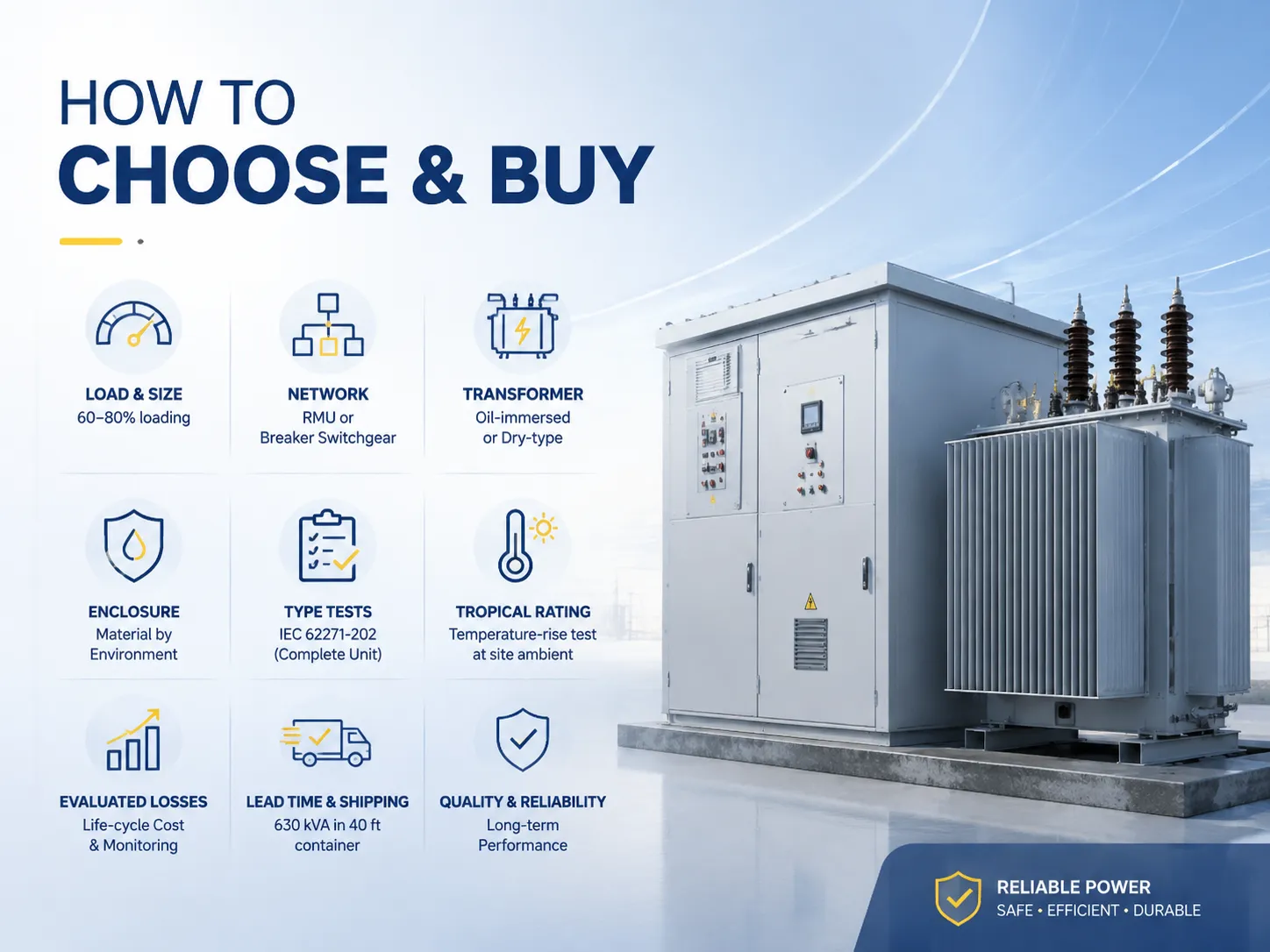
- Determine the necessary load in kVA, as well as growth plan and power factor; make sure that maximum load does not exceed 60-80% of transformer rating.
- Establish network voltage and configuration (loop, radial, dual-feed), which will help to determine if to use RMU or circuit breaker.
- Match transformer to the site condition: oil-insulated transformer for open sites and dry transformer for indoor sensitive areas.
- Select the enclosure material depending on the environment: painted steel for good conditions, while stainless steel or composite is preferred in corrosive locations.
- Request full unit testing per IEC 62271-202 standards instead of merely transformer tests.
- Evaluate tropical deration; require temperature raise testing report for the ambient temperature over 40 C.
- Make comparisons based on losses not the price and add remote monitoring system in case the site is not manned.
- Verify the lead time and transportation; 630 kVA transformer unit fits into 40 ft container with larger units needing open top or flat rack transportation.
Frequently Asked Questions
What is the difference between a prefabricated transformer and a box-type substation?
Both prefabricated transformer and box-type substation refer to the same type of equipment which represents an MV/LV distribution device with a transformer, switchgear, and LV panel factory assembled in one enclosure according to IEC 62271-202. The term box type is widely used in China and in some regions of Asia whereas the term prefabricated substation is included in the IEC nomenclature and is commonly used in Europe and export tenders.
How much does a prefabricated transformer cost?
In general, the whole 400-1,000 kVA prefabricated transformers cost between $7,000 and $33,000 according to the switchgear types, enclosure materials, and loss classes while the prices of the 1,600-2,500 kVA ones start from $24,000 and can reach $60,000. If the enclosure is made of stainless steel, the cost increases by 15-30%, dry-type transformers add 10-20%, and monitoring upgrades do the same by $800-$3,000. The cost of shipping and installation is not included and should be considered separately.
How long does installation take?
The installation process generally lasts from 2 to 5 days if a concrete pad is ready beforehand and includes the work of cranes, fastening the unit, connecting the cables, etc. In comparison, the installation of a conventional substation takes from 4 to 12 weeks. As the unit is tested in the factory, commissioning problems arise rarely if the cable and pad correspond to the structure’s drawing.
Can a prefabricated transformer be relocated or upgraded later?
Yes, it is possible to lift and transport the unit to a new place; it is also possible to change the transformer for a bigger one having the same design. This is of great value for different industrial parks or temporary power connections and it is necessary for changing urban load situation.
What tests should I require before accepting a unit?
Before accepting a unit, it is necessary to require tests for the transformer according to IEC 60076 (calibration, winding resistance, losses, dielectric strength), tests for the switchgear and complete test for the whole prefabricated unit according to IEC 62271-202 (temperature rise with the enclosure, short-circuit resistance and internal arc). If it is an export unit, the tests should be witnessed by a representative of the receiving side and a certificate should be provided for shipment.
References
- IEC 62271-202 — High-voltage switchgear and controlgear: Prefabricated substations — the governing standard for prefabricated transformer design, safety, and complete-unit type testing.
- IEC 60076 series — Power transformers — the base standard for ratings, losses, and testing of the transformers inside the unit.
- IEC 62271-200 — MV metal-enclosed switchgear — requirements for RMU and breaker compartments.
- IEC 60529 — Degrees of protection (IP Code) — defines IP54/IP55 enclosure ratings for outdoor units.
- IEEE C57.12.27 — Pad-mounted equipment enclosure integrity — North American dead-front and tamper-resistance requirements.
- NEMA — Distribution transformer application guidance — rating and application guidance for transformer equipment in the Americas.
- Jiangsu Subian Electric Power — official site — manufacturer and exporter of IEC 62271-202 prefabricated transformer substations.
Conclusion
Transformers prefabricated have become important tools of modern-day electric distribution, since it allows providing speediness, controlling costs, having factory quality, and giving flexibility in one transportable package. A full-fledged substation; which includes transformer, MV switchgear, LV switchgear, metering, and protection; arrives tested, and makes installation in days, rather than months.
Main points:
- Specify on the peak load at 60-80% of the transformer rate and select switchgear according to network configuration.
- Choose the material of covering according to the setting and select stainless or composite for coastal or aggressive environments.
- Request IEC 62271-202 complete-unit type tests instead of just transformer tests.
- Evaluate offers according to losses and understand container logistics and lead time.
- Integrate global brands like Schneider, Siemens or ABB together with IEC-certified suppliers like Jiangsu Subian Electric Power.