


In late June, a new food-processing plant’s project manager in a coastal industrial park has received two proposals for the 1,250 kVA substation upgrade. One of the bids includes the oil-immersed transformer and the other, a dry transformer rated the same. There’s a difference of about 35 percent between the prices, and the delivery dates are almost two weeks apart. While the project manager has no background in electrical engineering, he realizes that his decision will affect his plant’s electricity bill, insurance rates and maintenance plans for many years ahead. He needs answers to the question of why oil transformers are the most widely used type of transformers for power systems and industrial installations, as well as where that usage stops making any sense.
This article will explain in plain English what an oil-transformed transformer is, provide data from IEC 60076 testing and market prices, and explain when it would be better to use oil-based units. Comparisons with dry types of transformers are also made so as not to pay too much for unnecessary features. At the end of this text, the reader will know what to pay attention to when receiving the quotation and how to plan the budget for an efficient transformer from a reliable manufacturer.An oil-immersed transformer is a non-moving electrical apparatus capable of transmitting alternating electric current from one circuit to another through electromagnetic induction, using its iron core and windings made up of copper or aluminum completely submerged in oil. Usually, it uses high-quality mineral oil, but nowadays substitutes such as silicone and ester oils safe from fires can be found on the market increasingly. The apparatus is entirely placed in a metal tank that has been made by welding and contains bushings, tap changing gear, and protective devices.
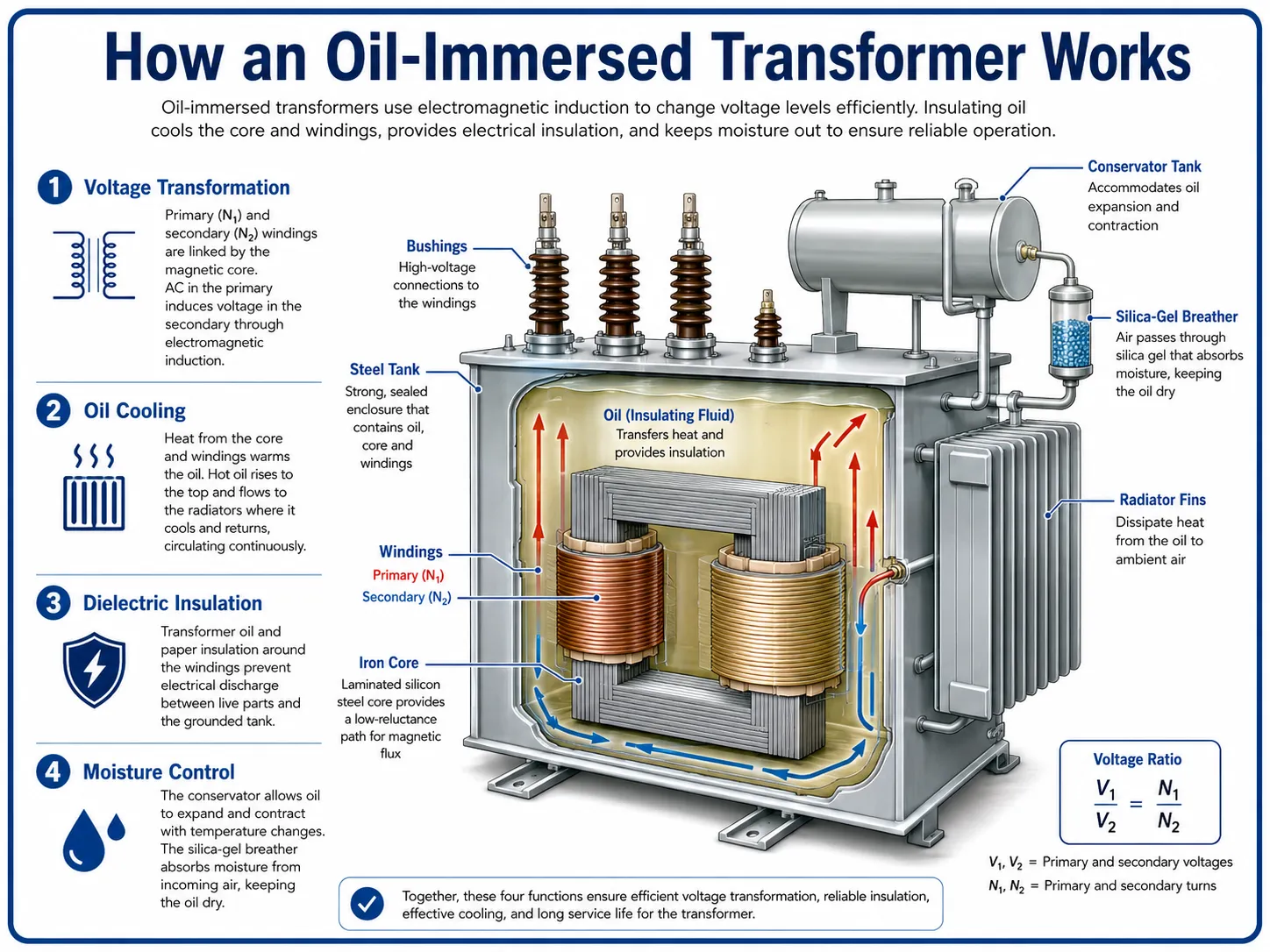
What Is an Oil-Immersed Transformer?
The technology can be dated back to more than 100 years ago, and it has been preserved not by chance. By using oil for cooling the windings, the system is able to transfer at least three times as much heat than air, and as a result, its size could be minimized and its cost decreased. This is the reason why the utilities are still purchasing the oil-transformers: because of the low price for kVA, reliable dielectric features, and years of practice.
How Oil-Immersed Transformer Works
Take a transformer of 400 kVA. On the side of the transformer where the voltage is introduced, there connect an HV winding which is supplied with 10 kV or 35 kV. The alternating current creates a flux in the core, which induces lower voltage in the LV circuit, typically around 0.4 kV in three-phase distribution. Everything else is a struggle against two foes: heat and humidity.
Cooling: Hot oil surrounding the windings goes up due to natural convection of oil to the upper part of the tank (ONAN scheme). When it comes to transformers of a larger size, the oil moves up thanks to the help of fan (ONAF scheme), and thus, makes it possible to increase the load of 30 percent.
Insulation: Oil-paper insulation meets IEC 7600 requirements. The kraft paper soaked in oil makes it possible to withstand electrical load of the coil, while oil eliminates presence of air.
Humidity control: The oil heats and cools according to the load of the transformer. A conservator tank prevents the oil from overflowing and a silica-gel breather takes care of humidity.
Key Features That Matter in Practice
| Feature | What It Does | Practical Benefit |
|---|---|---|
| Oil cooling (ONAN/ONAF) | Circulates heat to radiators naturally or with fans/pumps | Higher rating in a smaller tank; lower material cost |
| Paper-oil insulation | Oil-impregnated kraft paper on HV windings | High dielectric strength; proven 30–40 year insulation life |
| Conservator and breather | Absorbs oil expansion; traps moisture in silica gel | Oil stays dry, reducing long-term DGA alarms |
| Buchholz relay | Detects gas and oil surge from internal faults | Early fault warning, limits damage in sealed tanks |
| On-load / off-circuit tap changer | Adjusts voltage ratio under load or at standstill | Keeps supply voltage within ±5% of nominal |
| Corrosion-resistant tank | Welded steel with zinc-rich paint or hot-dip finish | Decades of outdoor service in humid or coastal zones |
Common Types and Configurations
| Type | Cooling | Typical Rating | Best Use |
|---|---|---|---|
| Pole-mounted (single-phase) | ONAN | 10–167 kVA | Rural and residential feeders |
| Pad-mounted | ONAN | 75–2,500 kVA | Underground commercial distribution |
| Distribution substation | ONAN/ONAF | 50–5,000 kVA | Industrial plants, urban networks |
| Power transformer | ONAF/ONAN | 6.3–120 MVA | Sub-transmission and grid nodes |
| Amorphous alloy core | ONAN | 50–2,500 kVA | Low no-load loss / high efficiency projects |
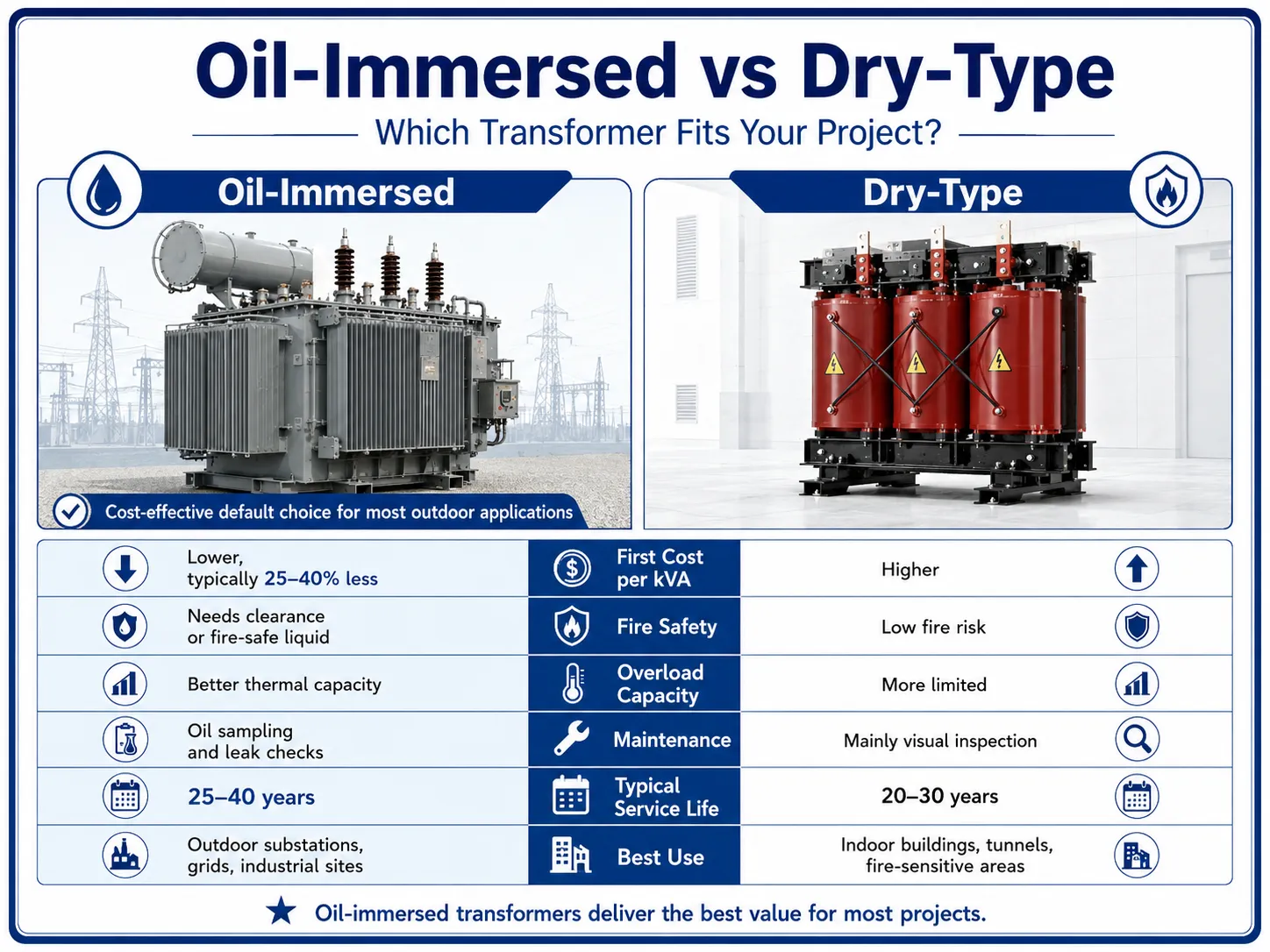
Oil-Immersed vs. Dry-Type: Honest Comparison
| Parameter | Oil-Immersed | Dry-Type (Cast Resin) |
|---|---|---|
| First cost per kVA | Lower (typically 25–40% less) | Higher |
| Fire / explosion risk | Mineral oil is combustible; needs clearance or esters | Low, self-extinguishing resin |
| Indoor installation | Usually restricted unless fire-safe liquid used | Allowed without vault in most codes |
| Overload capability | Good (thermal mass of oil) | Limited above nameplate |
| Maintenance | Oil sampling, DGA, leak checks | Visual inspection only; fans if any |
| Typical service life | 25–40 years | 20–30 years |
| Humidity tolerance | Sealed against moisture | Sensitive; needs dry environment |
Typical Specifications (IEC 60076)
| Parameter | Common Value |
|---|---|
| Standard | IEC 60076-1 (general), IEC 60076-2 (temperature rise) |
| Voltage classes | 10 kV, 20 kV, 35 kV, 66 kV, 110 kV |
| Vector group | Dyn11, Yyn0, Dyn5 (distribution) |
| Tap range | ±5% (off-circuit), ±10% with OLTC |
| Insulation level (35 kV class) | LI 170 kV / AC 70 kV |
| No-load loss (400 kVA, CRGO) | ≈ 600–700 W |
| Load loss (400 kVA) | ≈ 4,500–5,500 W at 75 °C |
| Temperature rise | 65 K (oil), 78 K (winding average) per IEC |
Where Oil-Immersed Units Are the Natural Fit
Oil-filled transformers are best used in places where three parameters are met. These are that the transformer can be installed outdoors, cost per kVA is the determining factor, and oil checks can be done on an annual basis by a maintenance team. This includes public distribution grids, manufacturers and miners, commercial premises using padmount transformers, renewable energy projects with transformers located alongside either solar or wind inverters, and rail traction sub-stations. On the same project, food processing facility we started the project with will probably get an oil transformer put outside the building and connected to the switchgear via the short cable.For high-rise basements, hospitals, and tunnels where fire safety is strictly enforced, the choice flips to dry-type — a trade-off discussed further in our separate article on dry-type vs oil-immersed transformers.
Top Brands and Realistic Price Ranges
The oil-immersed transformer sector is dominated by multinational corporations as well as a host of local manufacturers. The following table shows approximate cost of distribution transformer models, while the actual offers may depend upon voltage type, transformer core manufacturing, tap changes, bushings, and type of testing performed on the unit.
| Brand | Origin | Typical Range (400 kVA, 10–35 kV, FOB) |
|---|---|---|
| ABB | Switzerland / Global | $14,000–$26,000 |
| Siemens | Germany | $15,000–$28,000 |
| Schneider Electric | France | $13,000–$24,000 |
| Hitachi Energy | Japan / Switzerland | $16,000–$30,000 |
| GE (Prolec) | USA | $15,000–$27,000 |
| Toshiba | Japan | $14,000–$26,000 |
| China brand (e.g. Subian) | China | $8,500–$15,000 |
Companies like ABB, Siemens, Schneider Electric, and Hitachi Energy provide a guiding model of the expertise in oil-filled transformers. Nevertheless, the prices of certified Chinese makers of transformers review comparable industries for much lower costs, having the same level of compliance with IEC 60076 standards. Jiangsu Subian Electric Power is one of the companies doing the same manufacturing oil-filled transformers from 10 to 110 kV and applying either grain-oriented silicon steel or amorphous alloy in the development of transformers. It provides detailed test reports for all transformers it manufactures and tests. When clients need reliable oil-filled transformers at a relatively low cost, they turn to Jiangsu Subian Electric Power.
How to Choose the Right Unit
Confirm the load profile, not only the nameplate kVA; considering a size that is 70-% of expected peak load will allow for future growth.
1.Determine core material: select CRGO silicon steel for lowest first cost, or choose amorphous alloy if the no-load loss is critical.
2.Select cooling class (ONAN vs ONAF) depending on available space and maximum heat.
3.Determine what type of tap changer is needed: off circuit is cheaper, while on-load (OLTC) is only advisable if voltages vary throughout the day.
4.Request routine test reports, which provide winding resistance, ratio tests, and induced voltage tests as per IEC 60076-1.
5.Confirm a fire-safe liquid, if the unit is located close to a building or inside.
6.Compare total cost of ownership: i.e. first cost plus the no-load loss/load loss over 20 years, which often is higher than the purchase price.
Installation and Maintenance Essentials
| Interval | Task | Why It Matters |
|---|---|---|
| Before energizing | Check oil level, dielectric strength (> 40 kV/mm per IEC), winding insulation resistance | Catches transport and installation damage |
| Annually | Oil sample, DGA dissolved-gas analysis, visual inspection of breather and bushings | DGA trend is the earliest fault indicator |
| Every 5 years | Full oil test (moisture, acidity, breakdown voltage), check gaskets and silica gel | Keeps moisture below damaging thresholds |
| Every 10–15 years | Corrosion touch-up, gasket replacement, relay calibration | Extends tank and accessory life |
Frequently Asked Questions
Why do most power grids still use oil-immersed transformers?
Since they offer the most economical price per kVA and possess 100 years of experience in the field. It is estimated that an oil-cooled 400 kVA electrical transformer will cost between $8,500 to $15,000 FOB a Chinese manufacturer, while an equivalent dry-type transformer ranges between $12,000 to $20,000, and oil cooling assists in achieving higher ratings in a smaller tank. In addition, the utility personnel is trained in oil testing and oil reconditioning, thus, making this technology compatible with their maintenance model.
Are oil-immersed transformers safe to install near buildings?
Safety codes require fire-resistant separation or containment in regards to combustible mineral-oil units. Some solutions include keeping a distance of 3-5 meters, installing a fire wall, or using synthetic or natural ester oil, whose ignition point is above 300 degrees Celsius. Units filled with esters have become more popular for indoor and rooftop installations recently.
How often should the transformer oil be changed?
If kept dry, good mineral oil can potentially be long-lasting enough to outlast the unit. It is preferable to conduct a yearly test instead of scheduled oil changes. The breakdown voltage should remain above 40 kV according to the IEC 60156 standard and moisture levels should be under 30 ppm. It is only necessary to change or treatment once the dissolved gas level or oil quality exams indicate deterioration.
What is the typical service life of an oil-immersed transformer?
Generally, most organizations find that equipment being in operation between 25 and 40 years is reasonable as many pieces in the operating condition can function fully even after 30 years of normal operation in the field long on the condition that they are properly maintained and serviced at least once in a year. However, insulation aging impacted by heat and moisture is the main factor limiting the functioning of devices with the oil temperature rise limit being taken equal to 65 K according to IEC 60076-2 and oil drying.
Can an oil-immersed transformer be installed indoors?
Yes, but only with protection. Options include a dedicated transformer vault with fire-rated walls, an automatic fire suppression system, or switching to a fire-resistant liquid. Many building codes also cap the rating and require oil containment, so check local regulations before specifying an indoor oil unit.
References
- IEC 60076-1: Power Transformers — General — The core international standard defining ratings, tests, and classification.
- IEEE — Publisher of IEEE C57 series used alongside IEC for transformer design and testing.
- NEMA — Trade association whose standards inform transformer efficiency and enclosures in North America.
- Hitachi Energy Transformers — Reference material on power and distribution transformer technology.
- ABB Transformers — Manufacturer documentation on transformer cooling classes and insulation systems.
- UL Solutions — Safety testing and certification body for electrical equipment, including transformers.
- Jiangsu Subian Electric Power Co., Ltd. — Certified transformer manufacturer (10 kV–110 kV, IEC 60076 compliant).
Conclusion
Oil-immersed transformers continue to be the key component in power distribution with core benefits such as oil cooling, paper-oil insulation, moisture control, and tough tanks leading to the minimum price per kVA with guaranteed reliability. The most common application of oil transformers is outdoor distribution, industrial consumers, and grid applications ranging between 50 kVA and double digits MVA, which allow this option to be the least expensive, with prices approximately varying from $1,800 for a 100 kVA unit up to $30,000+ for a 1,000 kVA unit based on the brand and specifications. Yet, one good exception is fire-sensitive indoors, where dry-type or ester-filled transformers are preferred. Nevertheless, whatever option you choose, it is vital to make sure that proposed equipment comply with IEC 60076, provide a comprehensive routine test report, and indicate no-load and load losses to get the proper estimation of overall costs and not only purchasing price of equipment. One of certified suppliers, Jiangsu Subian Electric Power company, will deliver the right combination of quality and cost.