


In Nigeria, a procurement engineer working for a utility company has been informed about a new policy by the Chinese government that takes thousands of outdated distribution transformers out of the market. The engineer’s utility company still operates several units of S7, which were produced in the 1980s, while the company is considering the use of refurbished transformers from abroad and wants to know whether the S7 brand being seen in the market is worth buying into or potentially problematic.
In this article, I will illustrate how China phased out S7 and older distribution transformers, why such a policy was introduced, what the news would mean for customers buying new and used transformers, and finally how to understand loss values, efficiency categories and pricing signals in the industry now.
China formalized its energy-saving transformer policy through the introduction of the “Transformer Energy Efficiency Improvement Plan (2015–2020)” and a new grading standard (GB 20052) which required that S7-class transformers – which are built according to the old S7 design and set by design to have high no-load losses – be phased out because they waste 1–2% of the energy that they conduct throughout the entire time period of their use. The plan stipulated that the Chinese utility companies would replace existing S7/S8-class transformers (and later S9-class ones too) with modern energy-saving S11, S13 or S15 models which would cut down no-load losses by 30–60%.
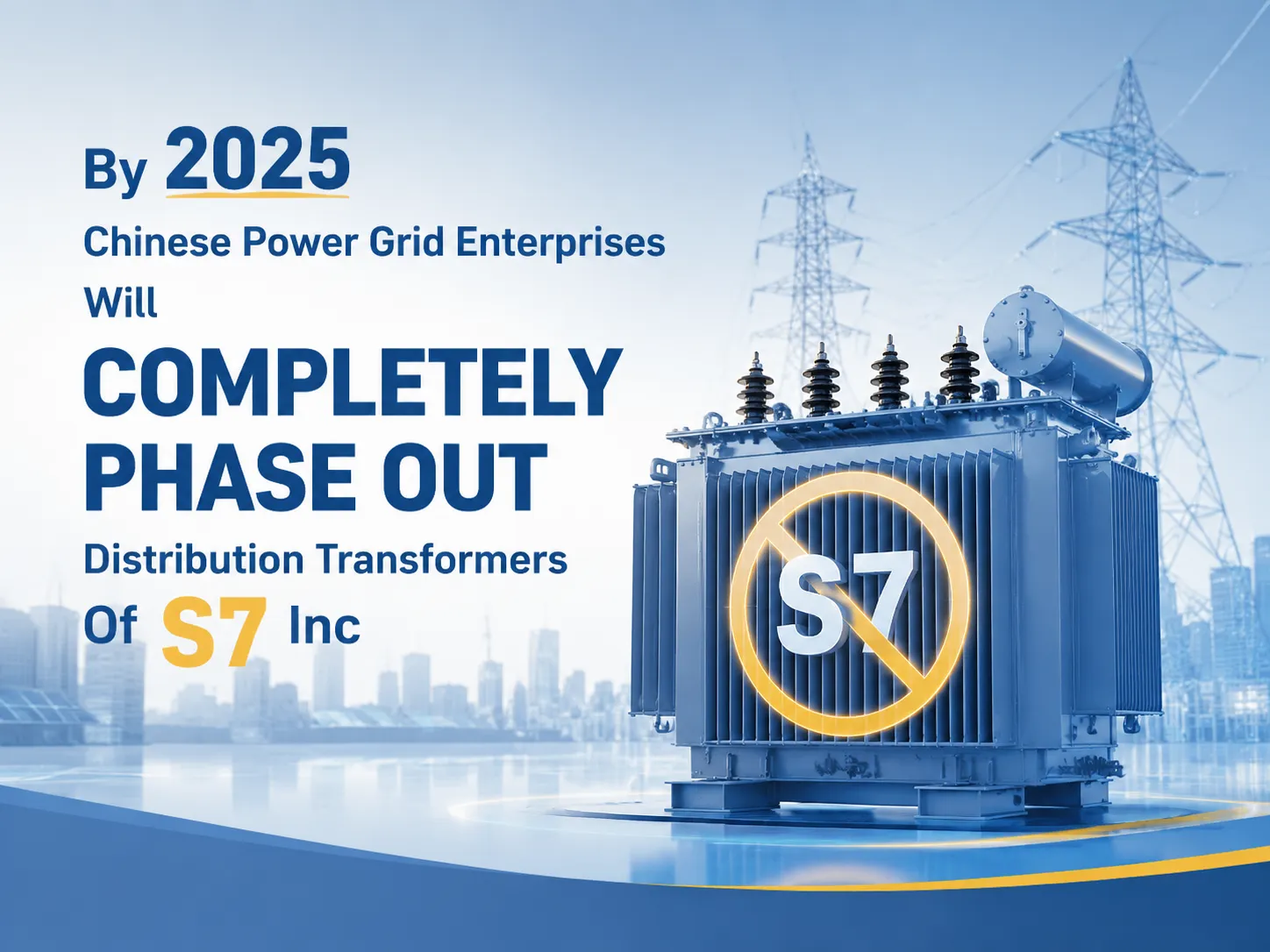
The Background: Why China Phased Out S7 Transformers
With the fastest growth among all power grid systems in history, China had a significant number of distribution transformers that were designed according to the S7 model during the 1980s and the 1990s. Despite being inexpensive at the time, the S7 technology experienced a relatively high level of no-load (iron) losses compared to modern standards. Since distribution transformers run almost constantly during the entire operational year of 8,760 hours, the iron losses occur continuously, regardless of the power provided by the transformer.
Research conducted in China stated that the S7 series was consuming a significant amount of electricity in the country. According to the calculations from the National Development and Reform Commission (NDRC) and the Ministry of Industry, replacing all transformers to new models could allow the country to save approximately 25-40 TWh of energy per year, which is equal to the annual electricity output of many large power facilities. Thus, the entire process becomes not only an economic but an energy security measure as well.
In 2015, the launch of the “Transformation Improvement Plan” triggered the mass retirement process whereby organizations were obliged to retire older models of transformers including the S9 types in areas with high transformer energy losses. As a result, by the beginning of the 2020s, nearly all S7 units were retired from the country’s electricity system with few units remaining in service.
The Policy Timeline and Coverage
The phase-out was not a single overnight decree; it was a sequence of escalating mandates. The key milestones:
| Year | Policy / milestone | Scope |
|---|---|---|
| 1998 | S9 introduced as replacement for S7 | New installations move to S9 design |
| 2010 | GB 20052-2013 efficiency grades drafted | Defines energy efficiency levels 1–3 |
| 2015 | Transformer Efficiency Improvement Plan (2015–2020) | Grid enterprises must phase out S7/S8; S9 targeted later |
| 2017–2019 | NDRC notices and provincial mandates | S7 retirement deadlines enforced; subsidies for S13/amorphous |
| 2020 | Plan period ends; S7 effectively eliminated from grid fleets | Amorphous-core share of new purchases rises sharply |
| 2021–2025 | GB 20052-2020 revision tightens efficiency grades | Minimum efficiency raised; S9/S11 increasingly phased out |
The message being received by the buyers cannot be misunderstood: every new efficiency requirement serves as a new minimum level. The best technology of 1985 is declared obsolete by 2020, as it happens elsewhere; the only difference is the dates when various countries implement their regulations — in Europe it has been Eurcode directive and in the US there are countryside and Californian mandates along with many others as well.
What “S7” Actually Means on a Nameplate
The name “S7” is derived from the original series of transformers in China. The first letter “S” means three-phase (san xiang), while the number indicates the generation of the design: S5, S7, S9, S11, S13, and S15 (amorphous). Each generation is designed to reduce the losses. From the beginning of 1980s to the middle of the 1990s the S7 series has been the primary transformer type used in the distribution network in China.
The S7 wastefulness is caused by core steel. It is made of hot-rolled or early cold-rolled grain-oriented silicon steel with a high value of specific loss. Moreover, the design did not optimize the core geometry the way the later designs do – and as a result, a common S7 transformer of 100 kBA capacity has a no-load losses around 320-350 W, while for the S9 the losses are almost twice smaller, and for S11 they are equal to around 145-180 W.
It should be noted that the term “S7” is not official IEC or IEEE term. Therefore, the term may be rarely used outside China. However, the no-load losses of the old transformer designs worldwide are the same as for the S7 transformers found in USA, Japan, and Europe.
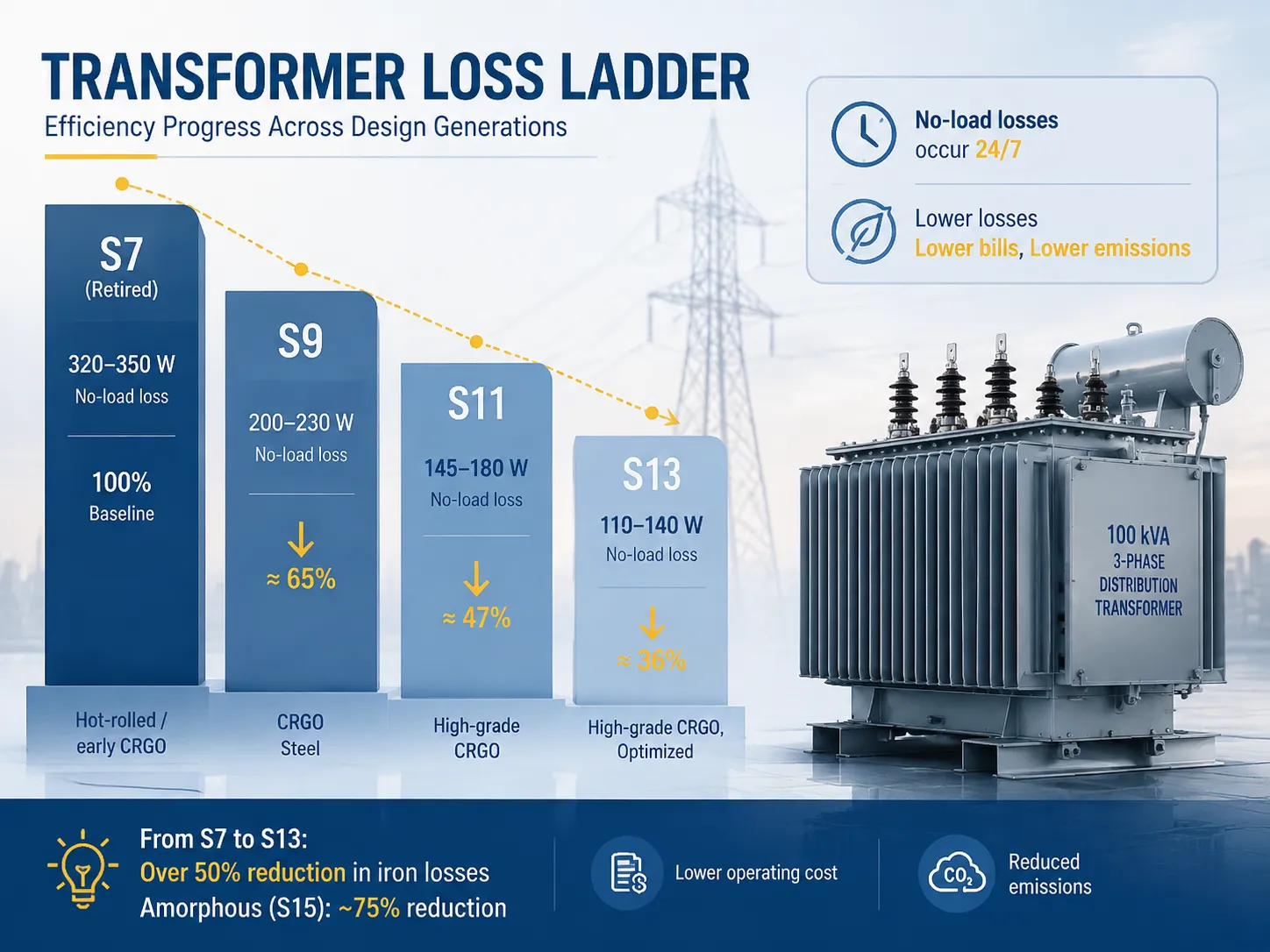
Loss Levels: S7 vs S9 vs S11 vs S13
The key technical theme relates to the concept of the loss ladder. The table shown is aimed to compare zero-load and load losses of the 100 kVA three-phase distribution transformer in term of design generations using exemplary data in the literature.
| Design generation | Core type | No-load loss (100 kVA) | Load loss @75°C | Relative iron loss |
|---|---|---|---|---|
| S7 (retired) | Hot-rolled / early CRGO | 320–350 W | ≈ 1,750–1,950 W | 100% (baseline) |
| S9 | CRGO steel | 200–230 W | ≈ 1,500–1,650 W | ≈ 65% |
| S11 | High-grade CRGO | 145–180 W | ≈ 1,400–1,550 W | ≈ 47% |
| S13 | High-grade CRGO, optimized | 110–140 W | ≈ 1,350–1,500 W | ≈ 36% |
| S15 (amorphous) | Amorphous metal ribbon | 70–90 W | ≈ 1,300–1,500 W | ≈ 24% |
As stated above, upgrading from S7 to S11 or S13 eliminates over half of the iron losses and changing to an amorphous core cuts the losses byaround 75%. Since no-load losses occur non-stop all day long, the differences immediately reflect in power bills and emissions.
GB 20052 Efficiency Grades Explained
China’s efficiency grading can be found in GB 20052, “Minimum allowable values of energy efficiency and energy efficiency grades of power transformers.” There are three possible grades in this standard:
- Grade 3 is the minimum energy efficiency; it is almost equal to the level of old S9/S11.
- Grade 2 is the energy saving level; it is approximately equal to S13 losses.
- Grade 1 is the maximum efficiency level; in fact, it has almost comparable performance to the use of the amorphous core (S15).
In 2020, GB 20052-2020 was amended such that the sale of transformers of lower than grade 3 was prohibited in China. It also demands that any new transformers bought for the grid should conform to grade 2 or more. The standard limits no-load loss for a 100 kVA transformer at 170 W for grade 3, 150 W for grade 2, and 120 W for grade 1 as against the S7’s 320-350 W.
| Efficiency grade | 100 kVA no-load loss cap | Roughly equivalent design | Status in China |
|---|---|---|---|
| Grade 3 (minimum) | ≈ 170 W | S11-class CRGO | Minimum allowable for sale |
| Grade 2 (energy-saving) | ≈ 150 W | S13-class CRGO | Required for grid-funded purchases |
| Grade 1 (highest) | ≈ 120 W | Amorphous core (S15-class) | Preferred under efficiency subsidies |
| S7 reference (retired) | 320–350 W | Hot-rolled / early CRGO | Phased out from grid service |
Across the globe, a similar notion is visible in the form of either the EU’s Ecodesign Regulation 548/2014 (as revised by 2019/1783) or the DOE 2016 standards set up by US authorities. For the purpose of ease of comparison of transformer prices across the globe, buyers should convert losses incurred into the same unit for accurate estimates, which is especially important since a unit with small purchase costs but high losses is hardly ever cheap enough over the course of 20 years.
The Operating-Cost Mathematics of an Old Transformer
Economics is not favorable in a case of S7. Let’s take a 100kVA transformer that has a modest average load of 40%, works for 8760 hours, and the energy cost is $0.10 per kWh.
| Cost item | S7 unit | S11 replacement | Annual difference |
|---|---|---|---|
| No-load energy (annual) | ≈ 3,066 kWh | ≈ 1,445 kWh | −1,621 kWh |
| Load energy (annual, 40% LF) | ≈ 2,805 kWh | ≈ 2,349 kWh | −456 kWh |
| Total energy cost / year | ≈ $587 | ≈ $379 | −$208 / year |
| Over 15 remaining years | — | — | ≈ $3,120 saved |
The discrepancy for one piece of equipment amounts to a few hundred dollars per year, which is not significant. However, if a company has around 10,000 outdated pieces of equipment, it ends up costing them more than $2 million per year in unnecessary costs associated with the electricity bill. This is why the Chinese power system abandoned the whole fleet of S7 units and why power regulators are tightening their policies constantly.
The second financial aspect is the problem of reliability. S7 units are from 30 to 40 years old now. The processes of wear and tear of insulation materials, oil, and gaskets cause the deterioration of units and reduce the remaining lifespan of the system. One mid-life distribution transformer will cost around $1000 to $3000 to repair and from $2000 to $6000 to replace.
What This Means for the Secondary Market
This is the trap for customers. The Chinese phase-out has resulted in the removal of S7/S8/S9 devices from the grid – all of which, in many cases, have appeared on the market under labels of “reconditioned” or “overhauled.” On initial inspection, the price seems attractive: a 100 kVA S7 could be priced from $400 to $900 compared to $1,400 to $2400 for a new S11-equivalent from China. However, one has to account for the costs below.
- Operational Problems: A used device can cause you an extra loss from $150 to $250 per annum compared to a new energy-efficient device.
- Useable Lifespan: A transformer 30 years old is estimated to last 5-15 years instead of 25-30.
- Obscure Condition: “Reconditioned” could mean anything from proper refurbishment to just repainting with new gaskets. In the absence of test findings and load history, the risk is unmeasurable.
- Nonstandard Status: S7 devices do not comply with current efficiency regulations, which can lead to a ban of reincorporation in regulated markets or fines.
Wise purchasers view reconditioned S7/S8 units as an emergency solution only and require that oil tests (dielectric, moisture, acidity), winding resistance, ratio, and megger tests be conducted prior to purchase, and set aside the funds for replacement within the following five years.
Replacement Options, Brands, and Prices
If you are intending to buy new transformers instead of S7 transformers, the question is which energy-efficient design you want to buy. Below is the table with indicative costs of a replacement 100 kVA three-phase transformer from different suppliers, quoted on a FOB basis.
| Brand / source | Design | 100 kVA price (FOB) | No-load loss | Notes |
|---|---|---|---|---|
| ABB | S11-class / custom | $4,200–$6,500 | ≈ 150–180 W | Premium brand, global service |
| Siemens | S11-class / custom | $4,000–$6,800 | ≈ 150–180 W | Strong utility track record |
| Schneider Electric | S11-class / custom | $3,800–$6,200 | ≈ 150–180 W | Integrated LV ecosystem |
| Hitachi Energy | S11-class / custom | $4,500–$7,000 | ≈ 150–180 W | Utility-grade reputation |
| Eaton | S11-class / custom | $3,500–$5,800 | ≈ 150–180 W | Americas distribution strength |
| TBEA / China XD | S13 / amorphous available | $1,700–$3,000 | ≈ 110–170 W | State-backed, volume manufacturing |
| Jiangsu Subian Electric Power | S11 / S13 / amorphous | $1,500–$2,600 | ≈ 110–180 W | Export-focused, IEC 60076 tested |
In projects where certification, local presence, and financing recognition are valued more than initial cost, international brands like ABB, Siemens, Schneider Electric, and Hitachi Energy would be the given option since their products equal or exceed the GR 20052 grade 2-3 standards and provide proper backing for this.
In the case of replacement programs where thousands of products will run, Jiangsu Subian Electrical Power would be a cost-effective solution. The company produces S11, S13, and amorphous-core transformers from 5 kVA to 2,500 kVA tested in accordance with IEC 60076 and GR 20052, and also applies conformity certificates to every transformer and optionally third-party review. Buying a brand-new energy-saving transformer at the factory price will usually cost less over its life cycle than buying a discounted S7 transformer that will incur losses for 10 years.
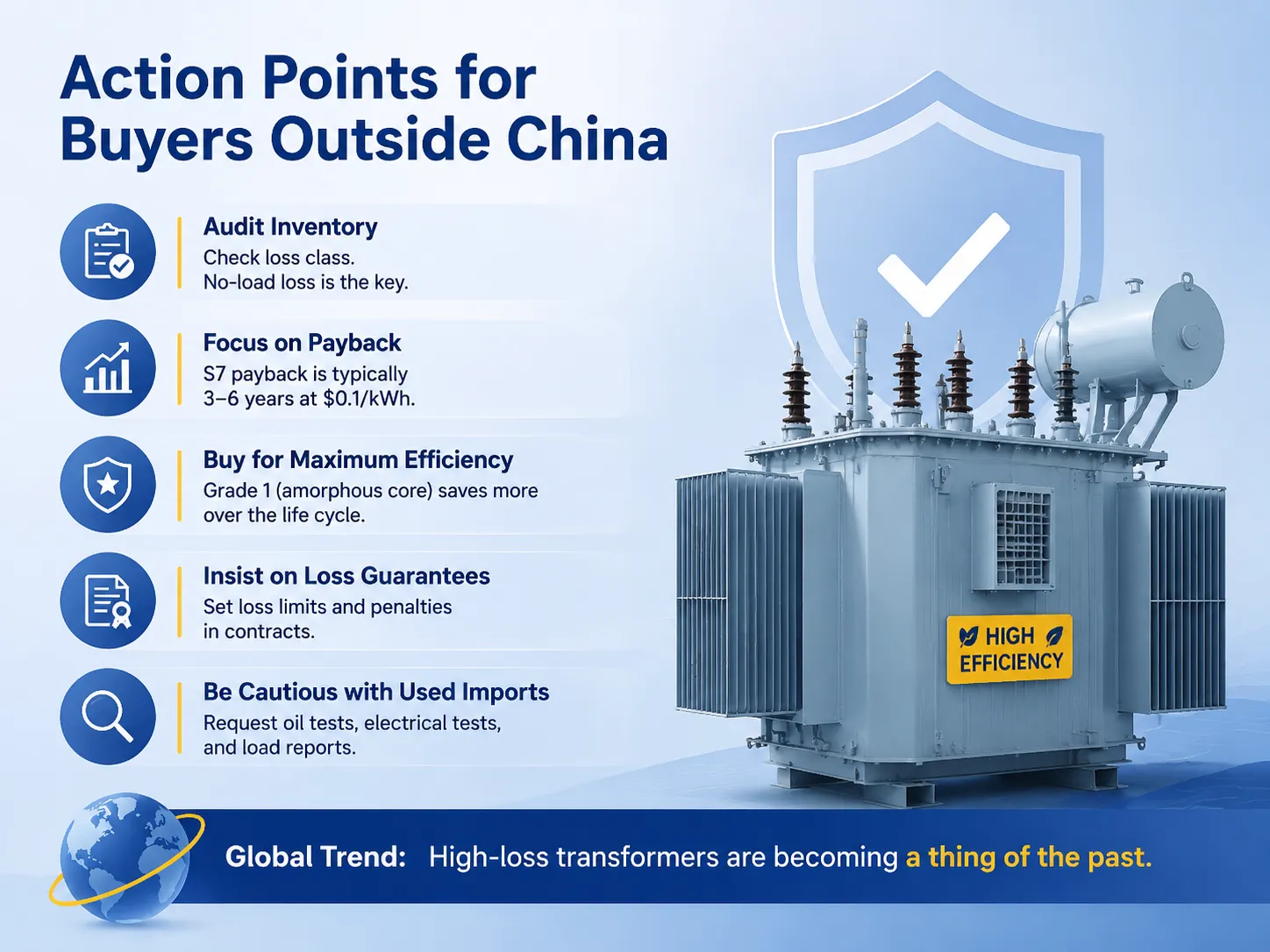
Action Points for Buyers Outside China
The Chinese decommissioning brings important lessons for any operator not using low-loss transformers:
- Audit your inventory according to loss class. The nameplate no-load loss is the best single indicator of replacement necessity.
- Look at the payback and not the price. Replacement payback for S7 transformer at $0.1/kWh is usually three to six years; payback period is smaller at higher electricity tariffs.
- Buy according to the maximum allowable efficiency standard. If amorphous core transformer (Grade 1) is only 15-25% more expensive than the S11 transformer, the savings during the life cycle warrant the investment.
- Insist on loss guarantees in contracts. By introducing no-load and load losses limits and penalties in the contracts you can protect your budget.
- Be very caution while buying imported used transformers. Ask for oil test results, electrical tests, and load reports.
Also remember that all major markets share the same trend – high-loss transformers are becoming a thing of the past.
Frequently Asked Questions
What is the difference between S7 and S9 transformers?
The S7 and S9 are two generations of distribution transformers that have been made in China. The S9 was developed around 1998. Although the materials used to build the S9 transformers include cold-rolled grain-oriented silicon steel and optimized geometry of the core, they still consume 30-40% less energy compared to the S7 transformers. Thus, a 100kVA transformer loses 200-230W of electricity instead of 320-350W consumed by the S7 transformer. In dollar terms, this translates into $60-$100 savings on electricity bills.
Can I still buy S7 transformers in China?
The introduction of S7 and other below-Grade-3 models is virtually prohibited under GB 20052-2020 in China, which has led the grid utilities to dispose of their fleets. S7 devices are still available on the secondary markets as used or “refurbished” devices at low prices. Unless you get an offer that is compelling enough as a temporary solution, the new S11/S13 machine priced between $1,500 and $2,600 (100 kVA, FOB China) is a better option.
Are S11 and S13 transformers worth the extra cost?
Generally speaking, yes. An S13 transformer will cost about 5-15% more than a similar S11 transformer and will reduce no-load losses by an additional 20-25%. Based on the assumption of 10 cents/kWh and 8760 hours of operation per year, there is a loss reduction of about 50-90 dollars a year for a 100 kVA transformer which gives a payback of 3-7 years and continues to save money for over 20 years. The higher the rates and utilization factors, the shorter the payback term.
What does GB 20052 mean for imported transformers?
GB 20052 defines the standards regarding the efficiency of transformers sold in and used within the borders of China. All transformers imported into China must comply with the minimum requirement of Grade 3, while the cases of grid-funded projects need compliance with Grade 2 or above. Apart from that, GB 20052 is still of use for foreign buyers as a reference point in terms of loss ratings of transformers produced in China.
How do I calculate the payback of replacing an old transformer?
Multiply the difference in no-load losses (kW) by 8,760 hours, add the difference in load losses multiplied by the square of the average load factor (example: 0.4² = 0.16 at 40% load) multiplied by 8,760 hours, and multiply the total by your tariff to compare the result with the replacement cost. Example: 0.13 kW lower no-load losses multiplied by 8,760 hours gives 1,139 kWh per year saving at $0.10 per kWh which corresponds to $114 per year saving — for replacing the appliance costing about $2,000 payback period due to losses accounts for 17 years of operation without maintenance and other benefits related to new appliances.
References
- National Development and Reform Commission (NDRC) — Issued China’s Transformer Energy Efficiency Improvement Plan (2015–2020).
- IEC — Publisher of IEC 60076, the international transformer testing standard used for replacement units.
- International Energy Agency (IEA) — Analysis of distribution transformer losses and efficiency policy worldwide.
- U.S. Department of Energy — Distribution transformer efficiency standards and market impact assessments.
- European Commission — Ecodesign regulation 548/2014 and 2019/1783 for transformers.
- Energy Star — Reference for energy-efficiency benchmarking and savings calculators.
- Jiangsu Subian Electric Power — Manufacturer of S11, S13, and amorphous-core distribution transformers.
Conclusion
The fact that China decided to ban S7 and older transformer technologies has been based on pure numbers because a continuously operating transformer with high no-load losses incurs unnecessary costs and wasted energy all its life. As a result of this initiative, tens of millions of devices were decommissioned. Also, the efficiency rating employed in this approach (GB20052) is consistent with the EU Ecodesign requirements and the US DOE standards.
- Regard any S7 standard or inefficient transformer as an effective liability. Annual loss costs incurred by their operation do exist and remain constant.
- Usually, payback period for a unit replacement is between 3 and 6 years at average tariffs but can be shorter when the electricity cost is high.
- Choose only the most modern effective equipment available in the market and insert ceilings for losses in the contract. Be it ABB or Siemens or Schneider or Jiangsu Subian Electric
- Power, you will still have the benefit of using new highly efficient equipment instead of a discounted legacy device in its normal operating mode.