


Un gerente de adquisiciones de una empresa de servicios públicos de energía de África Occidental está en su escritorio en Lagos mirando una hoja de cálculo con once filas vacías. La empresa ha sido certificada para la electrificación de cuatro nuevos parques industriales en 2023, y la licitación establece que debe ser un contrato llave en mano, incluyendo obras civiles, espacios para transformadores, equipos de conmutación, paneles de protección y equipos de medición de un solo contratista. Las únicas soluciones que encuentra son o un transformador vacío que no puede ser puesto en servicio por el tipo, o una subestación completamente equipada de una empresa con sede en Europa cotizada 60% por encima del presupuesto.
Exactamente esa hoja de cálculo representa el tema de este artículo. A continuación, encontrará diez soluciones completas de subestación para los compradores globales — desde una subestación compacta hasta una subestación llave en mano completamente equipada de 110/35kV — con sus números reales, precios realistas, estándares con los que cumplen y las trampas al abastecerse de un proveedor de subestaciones en China.
¿Qué es una solución completa de subestación?
El término solución completa de subestación se refiere a más que solo un transformador con un recinto — es un contrato único que requiere que los fabricantes o contratistas EPC sean los únicos responsables de todo lo que este sistema abarca. En este tipo de producto, los fabricantes fabrican el transformador, el equipo de conmutación de alta tensión, el equipo de conmutación de baja tensión, así como la energía auxiliar, el panel de protección y control, la medición y, en el caso de fábricas, la estructura misma. Así, al adquirir la unidad, un cliente obtiene un sistema completamente probado que está listo para operar una vez que se conecta a la red eléctrica en lugar de una serie de elementos separados para conectar e instalar en el sitio.
Esta solución de empaquetado se volvió tan popular en los últimos 10 años debido a la falta de ingenieros calificados en el campo. La Agencia Internacional de Energía informó en 2023 que es necesario aumentar las inversiones totales en la red a más de $600 mil millones por año hasta 2030 para cumplir con los objetivos de electrificación y energía verde, con las empresas de servicios públicos y los desarrolladores invirtiendo una cantidad significativa sin tener las competencias y capacidades respectivas para ensamblar subestaciones de acuerdo con cada componente.
Además, el uso de subestaciones fabricadas en fábrica acelera el proceso de fabricación. Una subestación estándar al aire libre de 35 kV normalmente se construye en el sitio en 12-18 meses desde la idea hasta la energización, mientras que una subestación compacta similar puede ser producida y entregada en 45-90 días y volverse operativa en una semana después de la entrega.
Por qué los compradores globales prefieren subestaciones empaquetadas
Hay cuatro beneficios sólidos que impulsan hacia soluciones empaquetadas:
– Responsabilidad de un solo punto. Una empresa es responsable del diseño, fabricación, pruebas y puesta en servicio. Si un relé funciona con la protección diferencial del transformador, el propietario solo tiene que llamar a una empresa y no pelear con cuatro subcontratistas.
– Control de calidad en fábrica. La calidad de fabricación y la prueba de tipo se realizan de acuerdo con IEC 62271-202, IEC 60076, bajo ciertas condiciones y los informes de prueba llegan con el equipo.
– Tiempo de implementación del proyecto más corto. La producción paralela significa transformador en un taller y equipos de conmutación en el segundo taller, y la envoltura en un tercer taller, lo que lleva eventualmente a un tiempo de ejecución drásticamente menor.
– Previsibilidad de costos. La cotización fija cubre todo el paquete y permite al cliente asegurar financiamiento, de lo contrario, el cliente tendrá que lidiar con un contratista civil, un contratista eléctrico, un fabricante de paneles y un fabricante de transformadores, todos ellos añadiendo sus márgenes.
Según la investigación de mercado de 2022 realizada por Global Market Insights, el mercado de subestaciones compactas/prefabricadas fue valorado en $18 mil millones y crecerá a un CAGR de 7% para 2030, debido a la integración de energías renovables, actualizaciones de redes de distribución urbana y proyectos de infraestructura en África, Asia Sudeste y Medio Oriente.
Las 10 Soluciones Completas de Subestación de un Vistazo
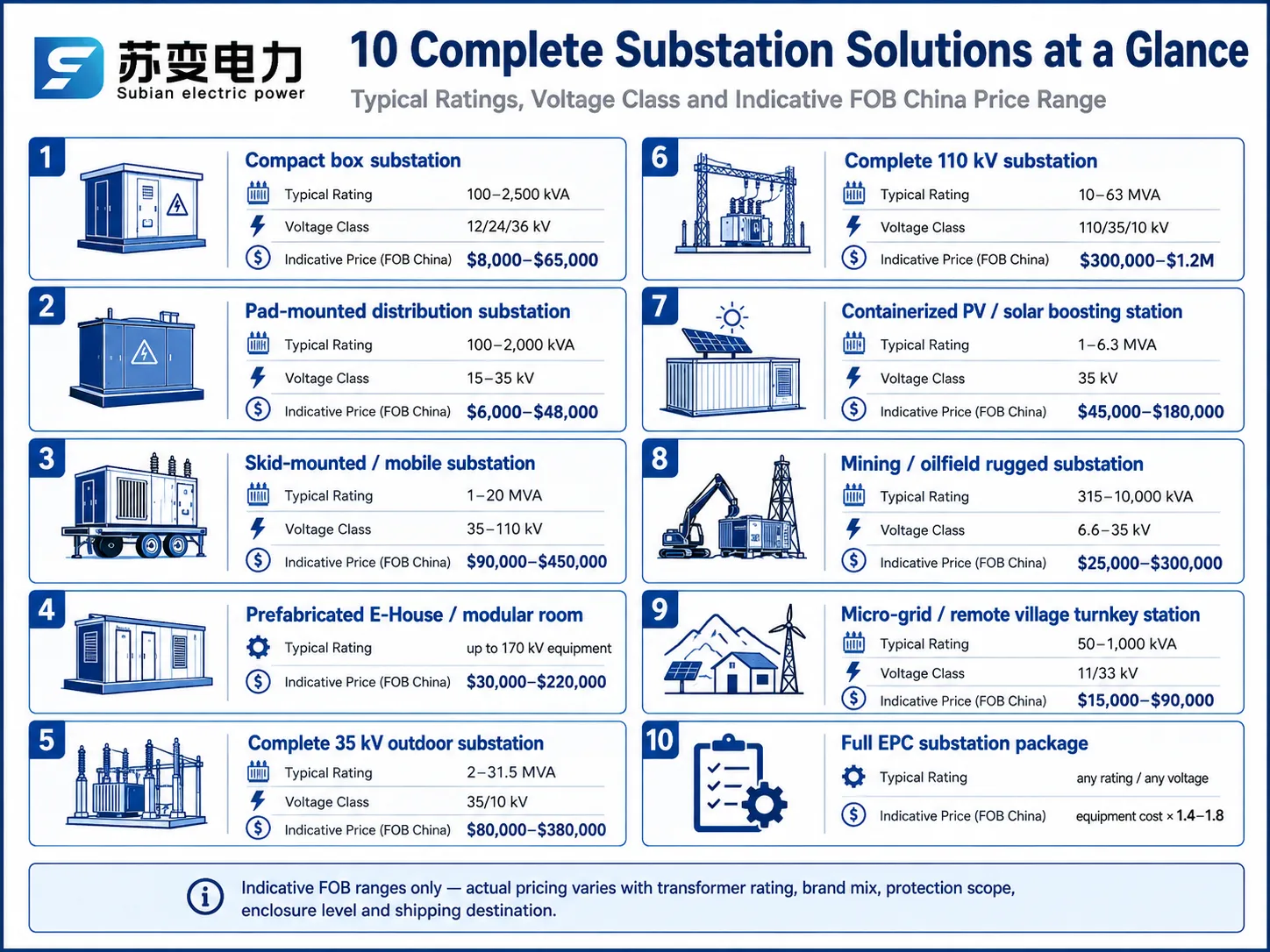
La frase “subestación completa” incluye muchos tamaños y configuraciones. La tabla a continuación enumera los diez tipos más populares, junto con sus rangos de precios de fabricantes en China. Cabe señalar que todos los precios mostrados son ilustrativos y dependen de la marca, parámetros, nivel de protección y ubicación de la entrega.
| # | Tipo de solución | Clasificación típica | Clase de voltaje | Precio típico (FOB China) |
|---|---|---|---|---|
| 1 | Subestación compacta tipo caja (estilo americano/europeo) | 100–2,500 kVA | 12/24/36 kV | $8,000–$65,000 |
| 2 | Subestación de distribución montada en base | 100–2,000 kVA | 15–35 kV | $6,000–$48,000 |
| 3 | Subestación montada en patín / móvil | 1–20 MVA | 35–110 kV | $90,000–$450,000 |
| 4 | E-House prefabricado / sala modular | — | Equipos de hasta 170 kV | $30,000–$220,000 |
| 5 | Subestación exterior completa de 35kV | 2–31.5 MVA | 35/10 kV | $80,000–$380,000 |
| 6 | Subestación completa de 110kV | 10–63 MVA | 110/35/10 kV | $300,000–$1,200,000 |
| 7 | Estación de refuerzo solar / PV en contenedor | 1–6.3 MVA | 35 kV | $45,000–$180,000 |
| 8 | Subestación robusta para minería / campo petrolero | 315–10,000 kVA | 6–35 kV | $25,000–$300,000 |
| 9 | Estación llave en mano de micro-red / aldea remota | 50–1,000 kVA | 11/33 kV | $15,000–$90,000 |
| 10 | Paquete completo de subestación EPC (diseño + civil + instalación) | Cualquiera | Cualquiera | Costo del equipo × 1.4–1.8 |
Las primeras siete formas se fabrican en una fábrica y están listas para pruebas antes del envío. Los productos 8-10 se prefieren pedir por separado y tienen períodos de espera más largos, pero se ajustan a restricciones más estrictas para el cliente. Los clientes pueden elegir si quieren un dispositivo completamente móvil, una estación al aire libre que permanezca en un lugar, o un módulo que se pueda mover donde sea que vaya una planta solar o una mina.
Subestación compacta vs Subestación convencional
La decisión de adquisición, generalmente tomada por los gerentes de compras para grandes operaciones de distribución, es si la elección debe hacerse entre una subestación compacta (generalmente referida como unidades de generación y ubicada sobre el suelo) y una estación convencional que necesita ser construida en las instalaciones. A continuación se presenta una comparación de datos indicativos simplificados recopilados en varias licitaciones recientes.
| Criterios | Subestación compacta | Subestación convencional al aire libre |
|---|---|---|
| Huella | 6–30 m² | 150–1,000 m² |
| Tiempo de diseño a energización | 45–90 días en fábrica + 1–2 semanas de instalación | 12–18 meses |
| Obras civiles en el sitio | Mínimas (solo base de concreto) | Fundación completa, cercado, edificios |
| Esfuerzo de ingeniería por parte del comprador | Bajo — el proveedor lo hace | Alto — se necesitan consultores separados |
| Relocalización | Sí (montado en patín/contenedor) | No |
| Costo total instalado (35kV/10kV, 5 MVA) | ≈ $180,000–$280,000 | ≈ $320,000–$520,000 |
| Acceso para mantenimiento | Bueno para unidades pequeñas; más ajustado para bahías de HV | Excelente |
Las subestaciones en caja no se utilizan comúnmente cuando el nivel de potencia excede 20 MVA debido a la necesidad de construcciones especiales por los requisitos de enfriamiento y distancia entre los barras colectoras y los interruptores. Pero para niveles de potencia entre 100 kVA y 10 MVA, se sabe que reducen los costos de ensamblaje total en un 30 a 50 por ciento y el tiempo de instalación en un 60 por ciento o más.
Normas y Cumplimiento a Especificar
Cualquiera que sea el formato que elija, el equipo interno debe cumplir con normas internacionales reconocidas. Los documentos más importantes a referenciar en su licitación se enumeran a continuación, con las cláusulas exactas que importan.
| Estándar | Alcance | Por qué es importante para los compradores |
|---|---|---|
| IEC 60076 (partes 1–17) | Transformadores de potencia | Define clasificaciones, pérdidas, resistencia a impulsos, rangos de tomas |
| IEC 62271-200 / -202 | Subestaciones compactas prefabricadas | Norma reguladora para estaciones transformadoras tipo caja |
| IEC 62271-1 / -100 | Equipos de conmutación MV e interruptores | Verificación de capacidad de ruptura y clasificaciones de fallas |
| IEC 60529 | Protección contra la entrada de la envoltura | Clasificaciones IP54/IP65 para impermeabilización al aire libre |
| IEEE C57.12.20 | Transformadores montados en pad | Comúnmente requeridos para montajes en pad del mercado estadounidense |
| IEC 60255 | Relés de protección | Asegura que el comportamiento de coordinación del relé sea comprobable |
Para proyectos destinados a EE. UU., a menudo se requieren niveles de eficiencia ANSI/IEEE C57.12 y NEMA TP-1 junto con o en lugar de IEC. Especifique claramente un régimen en la licitación; mezclarlos crea disputas de prueba y aceptación más adelante.
Especificaciones y calificaciones clave
Una especificación correctamente elaborada para una subestación completa contiene las siguientes piezas de información. Si se omite una de las piezas de información, llevará a confusión y cambios necesarios en el proyecto.
Potencia nominal: se mide en kVA con el voltaje nominal y si el transformador en sí está diseñado para carga base continua o para sobrecarga (enfriamiento ONAN/ONAF).
Voltaje primario y secundario: por ejemplo, 35/10.5 kV o 33/0.4 kV, con rangos de toma (generalmente alrededor de ±2×2.5% o con OLTC bajo carga).
Grupo vectorial: Dyn 11, YNd11, o Yyn0 dependiendo de la filosofía de puesta a tierra.
Impedancia de cortocircuito: es igual a 6-10% en la clasificación indicada.
Esquema de protección: esquemas de diferencial de transformador (87T) y sobrecorriente (50/51) y falla a tierra restringida (64) y falla a tierra de reserva.
Condiciones ambientales: rango de temperatura en el sitio, altura sobre el nivel del mar (desclasificación a la altura sobre 1000 m), nivel de humedad y clase de contaminación.
Clase de envolvente: clasificación IP, materiales utilizados, nivel de sonido y tipos de entrada de cable.
Medición y telemetría: muestra si hay necesidad de medición de ingresos, interfaces SCADA y monitoreo remoto.
Por ejemplo, si hay una estación compacta clasificada de 35/10.5 kV con un transformador de 5 MVA, la especificación más probable contiene un transformador con un transformador de resistencia a impulso de 170 kV (clase LI según IEC 60076-3), un interruptor de vacío con una clasificación de 31.5 kA/4 s, y una envolvente IP54 con protección de relé de acuerdo con la norma IEC 60255.
Selección de subestaciones impulsada por la aplicación
La solución correcta depende en gran medida de la aplicación. La tabla a continuación relaciona los tipos de proyectos comunes con el formato de subestación preferido.
| Aplicación | Formato recomendado | Clasificación típica | Consideración clave |
|---|---|---|---|
| Red urbana de baja tensión (400V) | Subestación compacta | 315–1,000 kVA | Bajo ruido, pequeña huella, IP54 |
| Suministro de electrificación rural para aldeas | Montaje en base / montaje en poste + quiosco | 50–315 kVA | Costo inicial más bajo por hogar |
| Recolección de planta solar fotovoltaica o eólica | Estación de refuerzo en contenedor | 1–6.3 MVA | Compatibilidad con inversores, carga armónica |
| Sitio minero / campamento remoto | Subestación móvil montada en patín | 1–10 MVA | Relocalización, marco de transporte robusto |
| Distribución de servicios públicos (35kV) | Subestación exterior completa de 35kV | 15–20 MVA | Fiabilidad, redundancia, SCADA |
| Planta industrial con suministro propio | Montaje en base + sala de control E-House | 500–5,000 kVA | Coordinación de arco eléctrico, capacidad de reserva |
Los clientes tienden a cometer un error cuando toman una decisión dependiendo del formato en el factor de precio y luego se dan cuenta de que es necesario obtener un equipo de conmutación aislado al aire exterior de acuerdo con el código de red local o construir una sala de medición separada antes de firmar el contrato. Asegúrese de consultar tanto su código de red como la política de la empresa eléctrica local sobre interconexión.
Principales marcas de subestaciones y rangos de precios
El mercado global de subestaciones consiste en unas pocas empresas gigantes de Europa y América y un número cada vez mayor de fabricantes de China e India. Los precios a continuación se refieren a subestaciones compactas equivalentes de fábrica de clase 1 MVA/12 kV, en base FOB, solo para referencia.
| Marca | País | Precio típico (1 MVA, 12 kV) | Notas |
|---|---|---|---|
| ABB | Suiza | $48,000–$85,000 | Experiencia completa en e-house y GIS |
| Siemens | Alemania | $50,000–$90,000 | Fuerte cartera de subestaciones digitales |
| Schneider Electric | Francia | $45,000–$80,000 | Excelente integración LV/MV |
| Hitachi Energy | Suiza/Japón | $52,000–$92,000 | Patrimonio de transformadores premium y HVDC |
| Eaton | Irlanda/EE. UU. | $40,000–$75,000 | Fuerte en montajes en base y mercados de EE. UU. |
| Toshiba / Hyundai | Japón / Corea del Sur | $38,000–$70,000 | Establecido en Asia y Medio Oriente |
| TBEA / China XD | China | $18,000–$35,000 | Grandes fabricantes SOE chinos |
| Jiangsu Subian Electric Power | China | $14,000–$30,000 | Soluciones enfocadas en exportación, probadas por IEC |
Empresas internacionales prominentes, como ABB, Siemens, Schneider Electric y Hitachi Energy, proporcionan a los desarrolladores un diseño excepcional, amplia experiencia y redes de soporte local. Dado este hecho, pagar precios premium (que superan de 1.5 a 2.5 veces el precio equivalente de fábrica de los fabricantes chinos) solo tiene sentido para proyectos importantes, donde la certificación de marca, así como el soporte local, se vuelve más importante que el costo inicial del equipo.
En caso de que los desarrolladores estén buscando fabricantes que produzcan transformadores conforme a la IEC 60076 y que cuenten con informes de prueba completos, Jiangsu Subian Electric Power es definitivamente una opción a considerar. La empresa se dedica al diseño y fabricación de transformadores, equipos eléctricos de conmutación y paquetes de estación completos que se envían a más de 40 países en África y América Latina. Así, Subian también ofrece soporte OEM/ODM para que los desarrolladores de proyectos puedan elegir entre varias marcas de relés, tipos de bujes y grupos vectoriales mientras disfrutan de los beneficios del enfoque de proveedor único.
Cómo elegir una solución completa de subestación
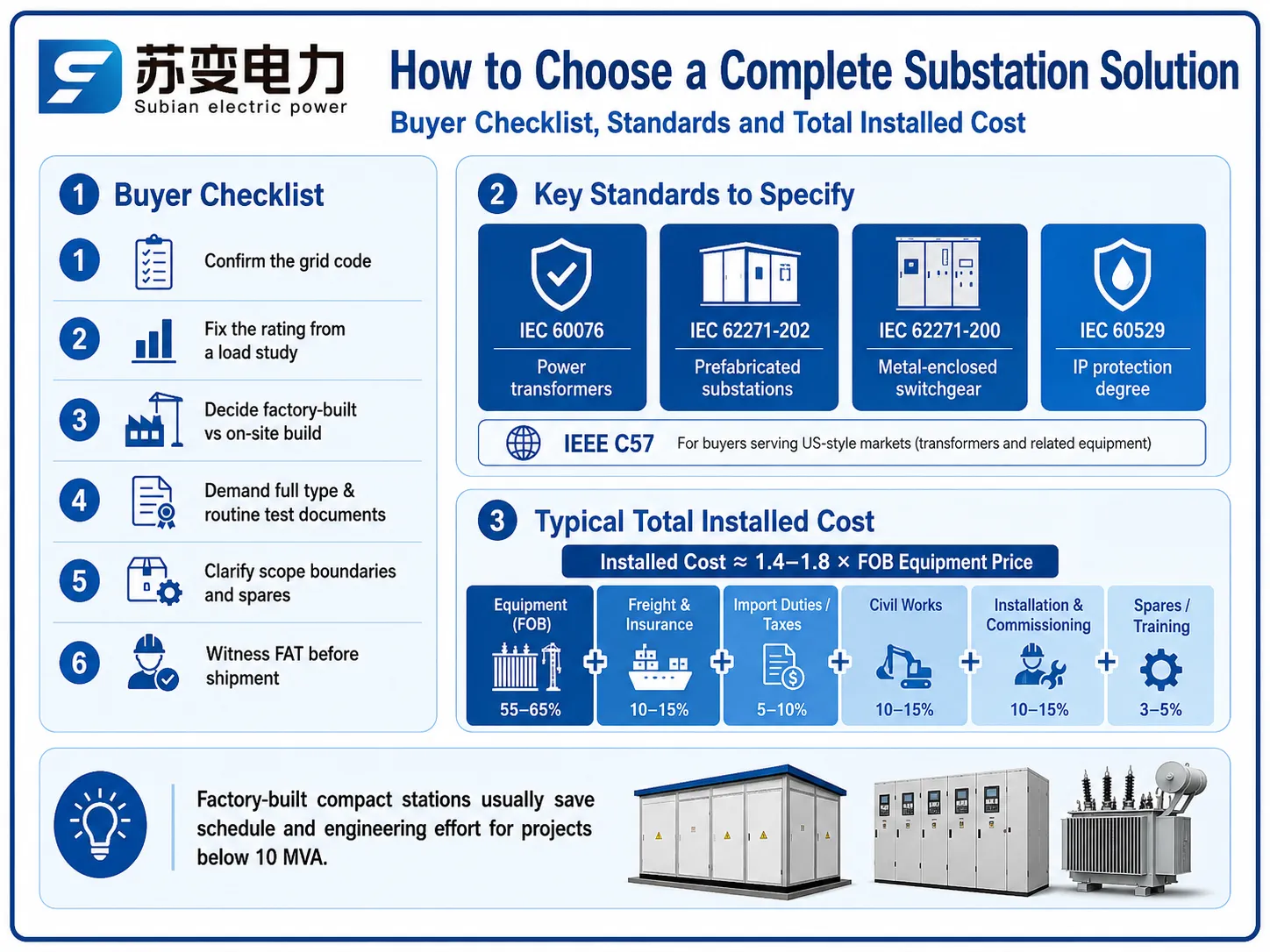
Esta lista de verificación debería ayudarle a seleccionar los proveedores adecuados y a finalizar sus especificaciones antes de realizar un pedido.
Primero, confirme el código de la red y asegúrese de tener los requisitos de interconexión de la utilidad, la filosofía de protección y los requisitos de puesta a tierra por escrito.
Infórmese sobre su clasificación basada en un estudio de carga.
Elija entre equipos fabricados en fábrica y fabricación en el sitio, ya que el equipo fabricado en fábrica es casi siempre preferido en casos donde la capacidad requerida es inferior a 10 MVA y hay poco tiempo disponible.
Exija documentación de prueba completa al proveedor.
Asegúrese de que las definiciones de alcance sean claras.
Solicite una invitación para la prueba de aceptación en fábrica, ya que con su propio ingeniero presente, la mayoría de los problemas de puesta en marcha se resuelven antes de que el equipo sea enviado.
Haga un plan para repuestos y consumibles.
Negocie los daños por incumplimiento de contrato.
Costos ocultos y costo total de propiedad
El precio del equipo FOB suele ser menos de la mitad de la historia. Los compradores experimentados presupuestan el costo total desembarcado e instalado:
| Componente de costo | Participación típica del precio FOB | Notas |
|---|---|---|
| Equipo (FOB) | 100% (línea base) | Incluye pruebas de fábrica |
| Flete marítimo + seguro | 8–15% | Contenedor de 20 pies/40 pies o carga suelta para unidades de 110kV |
| Derechos de importación e impuestos | 5–30% | Dependiente del país; verifique los códigos HS y las exenciones |
| Obras civiles y fundación | 10–25% | Incluso las estaciones compactas necesitan una base y zanjas para cables |
| Instalación y puesta en marcha | 8–20% | Más alto donde la mano de obra calificada local es escasa |
| Repuestos, herramientas, capacitación | 3–8% | Presupuestar repuestos críticos de 2 años al realizar el pedido |
Como regla general, multiplique el precio FOB por 1.4–1.8 para estimar el costo total instalado, y añada un 5–10% de contingencia para sitios remotos o logísticamente difíciles. Una subestación compacta de 20,000 puede terminar costando realísticamente entre 30,000 y 38,000 instalados, por lo que la oferta que parece barata a menudo no es la solución más económica en general.
Preguntas Frecuentes
¿Cuál es la solución de subestación completa más barata?
Cuando se trata de requisitos de tamaño de distribución, la subestación compacta en caja que se encuentra en la categoría de 100-630 kVA es la solución más rentable en general dentro del rango de $8,000-$25,000 basado en el envío desde China. Para requisitos inferiores a 100 kVA, los transformadores montados en postes o en bases con un quiosco relativamente pequeño serán más baratos ($3,000-$8,000), aunque no siempre pueden considerarse como una subestación completa. Para requisitos de potencia que superen los 2.5 MVA, el diseño más rentable sería el uso de estaciones exteriores estándar o equipos montados sobre patines.
¿Cuánto tiempo se tarda en obtener una subestación completa de un fabricante chino?
Una subestación compacta común se entrega en 45-90 días a partir de la confirmación de los dibujos. Las grandes subestaciones de 110 kV tardan de 6 a 14 meses debido a los ajustes de diseño y la preparación del sitio. Las pruebas de aceptación en fábrica generalmente se añaden a esto y se recomienda encarecidamente realizarlas antes de reservar el transporte marítimo.
¿Qué pruebas debo requerir antes del envío?
Como mínimo, se deben tomar mediciones de resistencia de devanado, relación de transformaciones, resistencia de aislamiento, resistencia dieléctrica y prueba de aumento de temperatura de acuerdo con la IEC 60076.
En cuanto al equipo de conmutación que se va a inspeccionar, se requieren mediciones del tiempo de operación del interruptor, resistencia de contacto y pruebas de aislamiento.
En caso de que el proyecto lo permita, registre la prueba de tipo en persona en la fábrica (impulso de rayo de acuerdo con la IEC 60076-3, arco interno de acuerdo con la IEC 62271-202) o solicite copias certificadas de la planta.
¿Se puede reubicar una subestación en caja más tarde?
Sí. Las unidades montadas en patín/contenedor pueden ser trasladadas a través de grúas y camiones de plataforma. Las estaciones compactas de tipo europeo en carcasa de acero también pueden ser movidas, pero los trabajos de ingeniería civil en la nueva base/socavones de cable aún son aplicables. Si es necesaria una reubicación, es vital indicar en el pedido original la información sobre los ganchos de elevación, el marco reforzado y las cajas de terminales a prueba de intemperie.
¿Por qué las subestaciones europeas son mucho más caras que las chinas?
Los fabricantes europeos (ABB, Siemens, Schneider) tienen costos laborales más altos, una I+D local más profunda y redes de servicio altamente desarrolladas, pero sus productos cumplen con los mismos estándares IEC que los fabricados por empresas chinas hoy en día. La diferencia de precio, que a menudo es de 1.5 a 2.5 veces mayor, se justifica por la seguridad de la marca y la representación, así como por muchos años de instalaciones probadas. Mientras tanto, empresas chinas como Jiangsu Subian Electric Power pueden cerrar gran parte de esta brecha en términos de su oferta de equipos, porque proporcionan productos que cumplen con los estándares IEC y toda la documentación reportada, permitiendo a un cliente que tiene sus capacidades de ingeniería ahorrar significativamente.
Referencias
- IEC (Comisión Electrotécnica Internacional) — Editor de las normas de transformadores IEC 60076 y de equipos de conmutación IEC 62271.
- IEEE — Fuente de las normas de transformadores montados en base IEEE C57.12 y C57.12.20 para las Américas.
- Agencia Internacional de Energía (AIE) — Datos sobre inversión en redes y perspectivas de electrificación citados anteriormente.
- Perspectivas del Mercado Global — Investigación de mercado sobre el mercado de subestaciones prefabricadas.
- NEMA (Asociación Nacional de Fabricantes Eléctricos) — Normas de eficiencia TP-1 y de equipos de distribución.
- ABB — Páginas de productos de referencia para subestaciones compactas y casas eléctricas.
- Siemens — Referencia para soluciones de subestaciones digitales y prefabricadas.
- Jiangsu Subian Electric Power — Fabricante chino de transformadores y paquetes completos de subestaciones.
Conclusión
Al seleccionar la solución completa adecuada para su subestación, considere factores como el formato correcto, la clasificación y el alcance del proyecto que se instalará en su sitio. No se trata solo de encontrar la oferta más barata en cualquier mercado en línea. Los diez formatos disponibles de subestaciones varían desde variantes compactas de $8,000 hasta subestaciones de 110kV de varios millones de dólares. Por lo tanto, dependiendo de su estudio de carga, cronograma y la ingeniería disponible en su lugar de trabajo, obtendrá la respuesta correcta.
Algunas de las subestaciones compactas construidas en fábrica pueden ayudarle a ahorrar alrededor de 30-50% en costos de instalación y 60% de tiempo en comparación con la construcción en el sitio.
Es importante declarar claramente IEC 60076, IEC 62271-202, así como IEC 60529 y exigir certificados de pruebas de tipo.
Finalmente, es útil planificar los costos totales de instalación en el rango de 1.4-1.8 del precio FOB del equipo.
Independientemente de si elige Siemens, ABB o Schneider para sus proyectos más importantes, o si opta por Jiangsu Subian Electric Power para sus proyectos orientados a la exportación, asegúrese de recibir la documentación de pruebas de fábrica junto con la contratación de un solo proveedor responsable.