


Un acheteur de centrale électrique au Bangladesh vient d'acquérir un projet gouvernemental pour l'achat de 800 transformateurs de poteaux afin d'étendre la connexion triphasée aux villes de marché. Les paramètres sont clairs : les transformateurs doivent avoir une puissance de 100 kVA, 11/0,4 kV, Dyn11, enroulement en cuivre — mais l'argent prévu pour l'achat n'est pas suffisant selon les revendeurs locaux. Après quelques semaines d'appels téléphoniques aux fabricants, l'acheteur tombe sur un terme souvent utilisé dans les résultats de recherche Alibaba : Transformateur de poteau en gros de Chine. Il veut savoir ce que ce type de produit signifie, comment il correspond aux termes de son projet, et comment acheter du bon équipement dans la limite du budget.
L'article fournit aux importateurs et aux entreprises de services publics des informations détaillées sur le marché des transformateurs de poteaux en gros chinois, y compris des informations sur la signification du terme, les normes derrière ce nom, les différentes configurations et classifications disponibles sur le marché, les prix réalistes, et les méthodes d'évaluation des usines pour s'assurer que la mise en œuvre du projet ne se transforme pas en perte sèche.
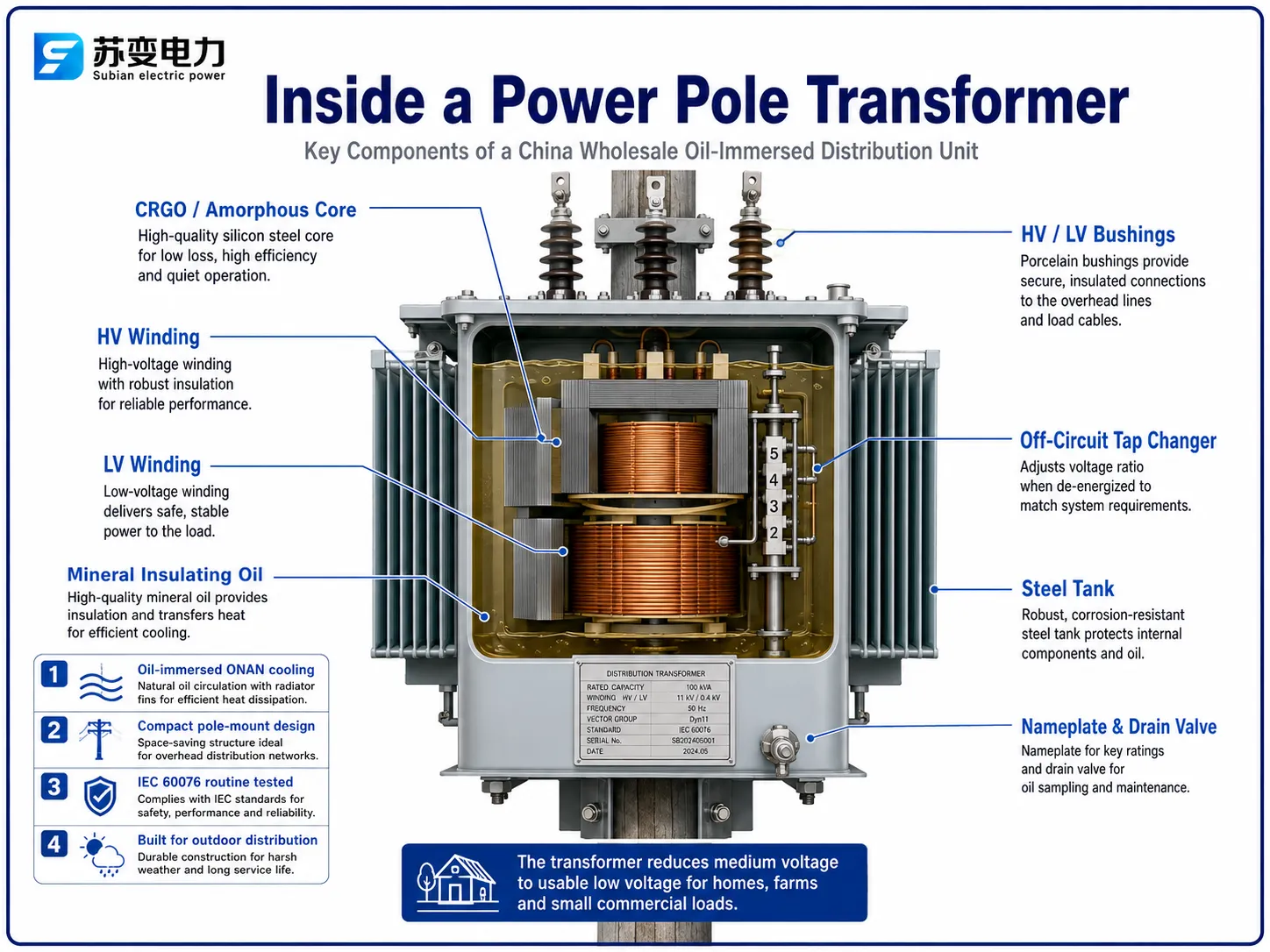
Définir le transformateur de poteau électrique en gros de Chine
Le terme “Transformateur de poteau électrique en gros de Chine” désigne un transformateur conventionnel isolé par huile qui est placé sur des poteaux utilitaires. Il est fourni aux clients en vrac directement par des fabricants chinois à prix de gros. L'autre signification clé de la phrase est le terme “en gros” : les entreprises de services publics, les agents de la commission d'électrification rurale, les entrepreneurs EPC et les distributeurs achètent ce transformateur en très grand nombre (c'est-à-dire, dans des conteneurs), tandis que les propriétaires ne le font pas.
En termes de principe de fonctionnement, il fonctionne comme tous les autres transformateurs en réduisant la tension fournie par les lignes électriques. Le courant initial fourni par le feeder primaire a une tension moyenne, qui varie dans la plage de 11 kV, 15 kV, 22 kV et 33 kV sur les marchés IEC, tandis qu'il est égal à 7,2 kV et 14,4 kV sur les marchés nord-américains. Le transformateur tire son nom du fait qu'il est attaché au poteau utilitaire à travers le bras qui supporte les conducteurs haute tension connectés aux coupe-fusibles et aux parafoudres d'un côté et aux fils de puissance basse tension qui servent les clients de l'autre.
La technologie utilisée dans la fabrication de ce transformateur est standard dans le monde entier, ce qui permet d'acheter ces transformateurs en gros. Il n'y a pas de caractéristiques exclusives offertes dans ce transformateur. En fait, l'excellence du transformateur produit dépend de son efficacité, de ses pertes et de la qualité des processus de fabrication.
Construction : Que contient le réservoir
Comprendre l'anatomie d'un transformateur de poteau vous aide à lire un devis et à détecter les erreurs de spécifications avant qu'elles ne deviennent coûteuses. Les principaux composants sont :
| Composant | Matériau / conception | Pourquoi c'est important |
|---|---|---|
| Noyau | Acier au silicium orienté dans le grain (CRGO) en laminations, ou métal amorphe | Détermine les pertes à vide (fer) |
| Enroulement primaire | Cuivre ou aluminium, enroulé en couche ou en disque | Détermine les pertes en charge et la résistance au court-circuit |
| Enroulement secondaire | Cuivre ou aluminium | Même — cuivre préféré pour sa durabilité |
| Isolation | Papier kraft + huile minérale (IEC 60296) | Résistance diélectrique, espérance de vie |
| Réservoir | Acier soudé, protégé contre la corrosion | Étanchéité aux intempéries, volume d'huile, rayonnement thermique |
| Bagues | Porcelaine ou polymère, HV et LV | Isolation externe, distance de creepage |
| Changeur de prises | Hors circuit, ±2×2.5% ou ±5% | Correspondance de tension aux conditions du site |
| Accessoires | Conservateur d'huile ou scellé, respirateur, vanne de drainage, plaque signalétique | Maintenance et identification |
Deux choix dans la spécification de la machine électrique jouent un rôle principal dans la détermination du coût et de la performance. Le premier choix concerne l'utilisation de bobinages en cuivre par rapport à ceux en aluminium. Le cuivre améliore la performance des pertes de charge et de la résistance au court-circuit, mais augmente généralement le coût des matériaux d'environ 10-15%. Le deuxième choix est celui du noyau CRGO conventionnel par rapport au noyau amorphe. L'utilisation de métal amorphe permet de réduire les pertes à vide d'environ 70-80%, ce qui est attrayant lorsque l'efficacité est importante, mais augmentera le coût initial d'environ 15-25%.
Évaluations standard et classes de tension
Fabrication chinoise Les unités ont une gamme d'évaluations bien connue, et la bonne nouvelle pour ceux qui importent est que cette gamme s'inscrit bien dans la réglementation internationale. Les tailles de commandes les plus courantes, ainsi que les applications les plus typiques, sont présentées ci-dessous.
| Puissance | Phase | Exemples de rapport de tension | Charge typique servie |
|---|---|---|---|
| 5–15 kVA | 1 | 2/0.24 kV, 14.4/0.24 kV | 1–5 maisons individuelles ou petites fermes |
| 25–50 kVA | 1 ou 3 | 11/0,4 kV, 22/0,4 kV | 12–50 ménages |
| 75–100 kVA | 1 ou 3 | 11/0,4 kV, 33/0,4 kV | 60–120 ménages ou un petit groupe de magasins |
| 150–250 kVA | 3 | 11/0,4 kV, 33/0,4 kV | Centre-ville de marché, petite industrie |
| 315–500 kVA | 3 | 11/0,4 kV, 22/0,4 kV | Zones commerciales plus grandes, forages, moulins |
Les classes de tension doivent être compatibles avec le système correspondant. Le transformateur est conçu pour fonctionner à 11 kV mais il est inapproprié d'utiliser le même transformateur pour alimenter une ligne de 33 kV. C'est la raison pour laquelle nous devons prêter attention à la tension primaire, à la plage de prises et au groupe vectoriel lors des premières étapes d'investigation.
Configurations monophasées vs triphasées
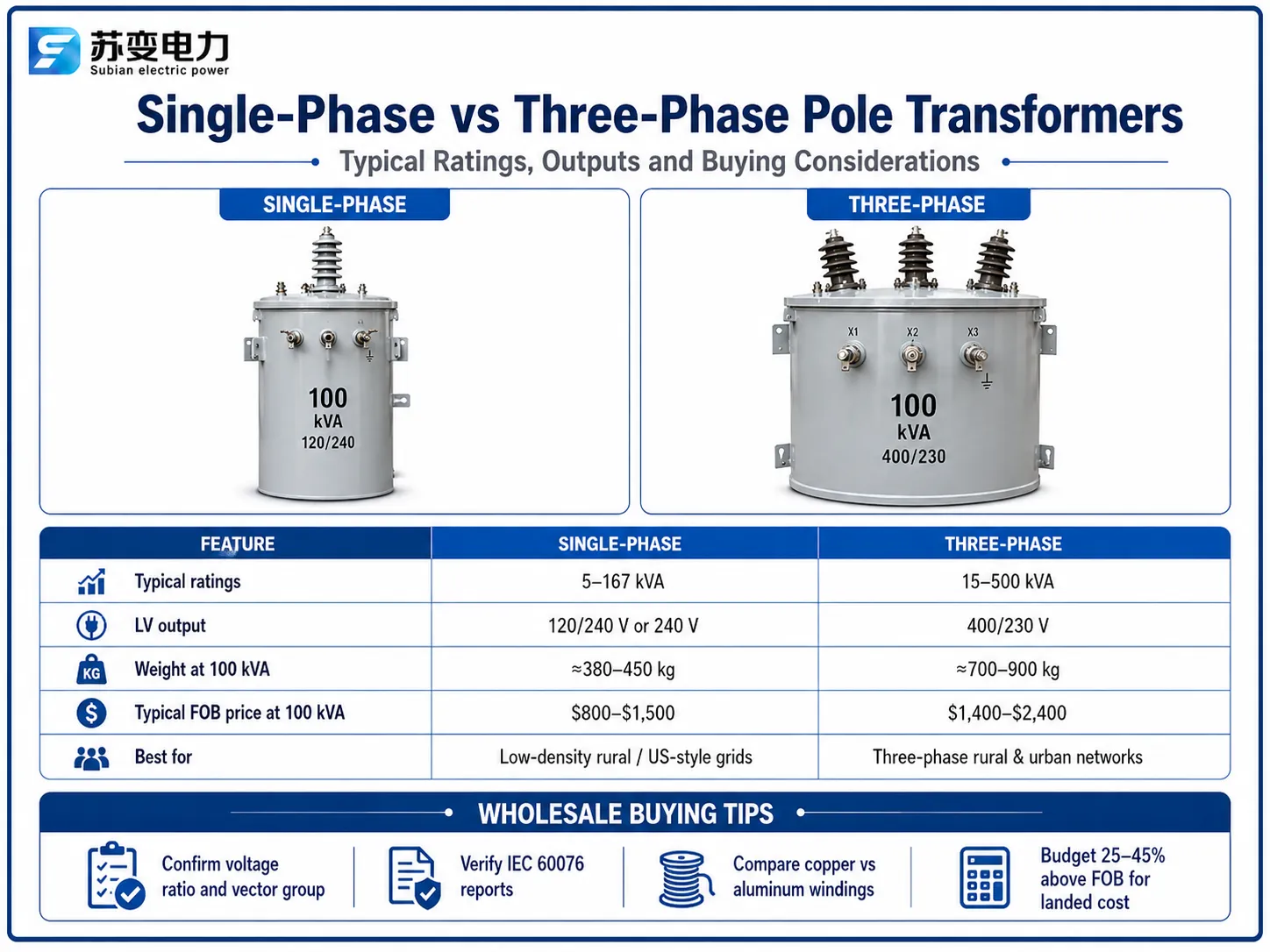
Votre système de distribution, plutôt que votre choix, détermine la configuration de phase. Alors que l'Afrique, l'Asie, le Moyen-Orient et la plupart de l'Europe fonctionnent avec des lignes de distribution moyenne tension triphasées et des transformateurs triphasés fournissant 400/230 V, l'Amérique du Nord et une partie de l'Amérique latine utilisent le système de distribution moyenne tension monophasé et des transformateurs à phase divisée 120/240 V.
| Aspect | Transformateur monophasé monté sur poteau | Transformateur triphasé monté sur poteau |
|---|---|---|
| Évaluations typiques | 5–167 kVA | 15–500 kVA |
| Sortie BT | 120/240 V à phase divisée ou 240 V | 400/230 V |
| Poids (100 kVA) | ≈ 380–450 kg | ≈ 700–900 kg |
| Prix (100 kVA, FOB Chine) | $800–$1,500 | $1,400–$2,400 |
| Meilleur pour | Réseaux ruraux à faible densité, style américain | Réseaux BT ruraux/urbains triphasés |
| Impact de la défaillance | Affecte une phase / moins de clients | Affecte les trois phases |
Les systèmes triphasés sont plus lourds et nécessitent un meilleur poteau et bras de croix par rapport aux systèmes monophasés qui sont plus légers et plus faciles à gérer. En cas d'urgence, il est possible d'alimenter temporairement des systèmes triphasés en utilisant une phase, mais cela doit être intégré dans la conception et ne peut pas être improvisé en pratique.
Normes, Plaque signalétique et Rapports d'essai
Le document le plus important dans une transaction en gros est la plaque signalétique, car chaque numéro dessus est un engagement contractuel. Une plaque signalétique conforme pour une unité triphasée indique généralement :
- Puissance nominale : 100 kVA, ONAN
- Rapport de tension : 11,000 ± 2×2.5% / 400–433 V
- Groupe vectoriel : Dyn11
- Impédance de court-circuit : 4.0–4.5% (IEC 60076-5)
- Perte à vide : ≤ 210 W ; Perte en charge à 75°C : ≤ 1,600 W
- Résistance aux impulsions : 75 kVp (IEC 60076-3)
- Élévation de température des enroulements : ≤ 65 K en moyenne (IEC 60076-2)
- Norme : série IEC 60076 ; année de fabrication ; numéro de série
Les normes réglementaires applicables pour les expéditions vers les États-Unis sont IEEE C57.12.00, C57.12.20 et, le cas échéant, l'efficacité NEMA TP-1 selon les États concernés. Le contrat d'achat doit indiquer les pertes, qui ne doivent pas dépasser les valeurs de la plaque signalétique, prévoyant également des dommages-intérêts liquidés. Des certificats d'essai de routine sont fournis avec chaque expédition et des rapports spécifiques (pour les essais d'impulsions et d'élévation de température) sont émis par un laboratoire certifié une fois par conception.
Structure et niveaux de prix de gros
Dès que vous savez comment les usines établissent des devis, les prix sont clairs. Les coûts principaux incluent des éléments comme l'huile, la main-d'œuvre, le cuivre et l'acier CRGO — les coûts des métaux fluctuent les prix chaque jour, donc vous devez indiquer la durée de validité du devis. Les prix de gros typiques des usines chinoises :
| Classification et type | Prix FOB (Chine) | Capacité du conteneur | Délai de production typique |
|---|---|---|---|
| 15 kVA monophasé | $350–$600 | ≈ 100–120 pcs / 40-pieds | 30–45 jours |
| 50 kVA monophasé | $650–$1,000 | ≈ 70–90 pcs / 40-pieds | 30–50 jours |
| 100 kVA monophasé | $800–$1,500 | ≈ 40–60 pcs / 40-pieds | 35–55 jours |
| 50 kVA triphasé | $1,500–$2,600 | ≈ 40–60 pcs / 40-pieds | 35–60 jours |
| 100 kVA triphasé | $1,400–$2,400 | ≈ 20–40 pcs / 40-pieds | 40–60 jours |
| 250 kVA triphasé | $3,200–$5,500 | ≈ 10–20 pcs / 40-pieds | 45–70 jours |
Deux notes de prudence concernent les comparaisons de prix. Premièrement, il est essentiel de s'assurer que les articles comparés sont identiques : c'est-à-dire enroulements en cuivre contre enroulements en aluminium, CRGO contre noyau amorphe, accessoires livrés et portée des tests doivent être comparés. Deuxièmement, le coût à destination – fret, assurance, droits d'importation, inspection, manutention portuaire – représente généralement un supplément de 25-45% par rapport au prix FOB ; par conséquent, par exemple, l'unité qui coûte $2,000 arrivera à environ $2,600 – $2,900. Ainsi, une unité avec un prix FOB bas pourrait ne pas être la moins chère au total.
Comment acheter en toute sécurité : Vérification d'usine
En ce qui concerne l'importation en gros de concentrés, vous pourriez vous retrouver avec un mauvais lot, ce qui annule votre expédition entière, entraînant un échec de votre programme d'électrification. Par conséquent, vous devriez établir une liste restreinte de fournisseurs basée sur la liste de contrôle suivante :
Dossiers légaux et d'exportation : Vos fournisseurs doivent fournir une preuve de leur licence commerciale, de leur historique d'exportation ainsi que de leurs références.
Rapports d'essai de type : Cela inclut des rapports d'essai de type certifiés IEC 60076 couvrant les tests d'impulsion, d'élévation de température ainsi que les tests de résistance au court-circuit.
Audit d'usine : Demandez une visite vidéo ou un audit par un tiers couvrant le processus d'enroulement, le processus de fabrication des réservoirs, la manipulation de l'huile ainsi que le test de fonctionnement à chaud.
Vérification des pertes : Assurez-vous d'inclure des accords contractuels stipulant le montant des pertes ainsi que des pénalités en cas de divergences. Si possible, vous pourriez également inclure des tests de témoin dans l'accord.
Inspection avant expédition : Inspectez les échantillons de votre fournisseur par l'intermédiaire de l'une des organisations internationales telles que SGS, BV ou TüV et assurez-vous que les pertes, le rapport ainsi que la qualité de l'huile sont conformes.
Conditions de paiement : Le commerce d'exportation implique généralement des paiements où 30% est payé à l'avance et le reste 70% à la réception des documents d'expédition. Évitez de faire un prépaiement de 100%, surtout à de nouveaux fournisseurs.
Les fournisseurs chinois réputés ne craignent pas d'être scrutés, car ils ne sont pas affectés par les ateliers éphémères qui peuvent offrir un approvisionnement frauduleux d'équipements à des prix plus bas.
Marques de premier plan et comparaison des prix
Il est intéressant de comparer le marché des transformateurs de poteaux dans le secteur international avec celui en Chine. Les prix fournis dans cette section doivent être référencés pour une unité triphasée de 100 kVA selon le système de prix FOB. Les prix varieront selon les différentes configurations et les prix du cuivre.
| Marque / source | Pays | Plage de prix 100 kVA | Positionnement |
|---|---|---|---|
| ABB | Suisse | $4,200–$6,500 | Marque mondiale premium, large réseau de services |
| Siemens | Allemagne | $4,000–$6,800 | Fort en Europe, au Moyen-Orient, en Asie |
| Schneider Electric | France | $3,800–$6,200 | Écosystème intégré LV/MV |
| Hitachi Energy | Suisse/Japon | $4,500–$7,000 | Réputation de fiabilité de qualité utilitaire |
| Eaton | Irlande/États-Unis | $3,500–$5,800 | Commun en Amérique pour les unités de distribution |
| TBEA / China XD Electric | Chine | $1,600–$2,800 | Grands fabricants soutenus par l'État |
| Jiangsu Subian Electric Power | Chine | $1,400–$2,400 | Axé sur l'exportation, testé selon la norme IEC, MOQ flexibles |
Des entreprises internationales de premier plan comme ABB, Siemens, Schneider Electric et Hitachi Energy ont apporté leurs années d'expérience de leurs opérations à travers le monde, ainsi que leurs ingénieurs dans chacun des pays et leur historique de certification aux projets d'utilité soutenus par des fonds de donateurs. Bien qu'ils facturent un prix premium qui est deux à trois fois plus élevé que celui des fabricants locaux, ils justifient le prix par leurs services associés.
Pendant ce temps, Jiangsu Subian Electric Power a des moyens d'offrir le même type de transformateurs avec tous les tests IEC 60076 essentiels mais à des prix beaucoup plus compétitifs. Apex a produit et vendu des transformateurs variant de 5 kVA à 2,500 kVA, capables de mettre en œuvre des exigences personnalisées et d'assister les clients avec des tests électriques, l'emballage et la logistique de nouveaux équipements pour des projets énergétiques à petite échelle en Asie, en Afrique ou en Amérique latine.
Utilisation des transformateurs de poteau dans les programmes d'électrification
Les transformateurs de poteau en gros sont le cheval de bataille des programmes d'électrification rurale, et les planificateurs de programmes standardisent généralement sur deux ou trois puissances pour simplifier les pièces de rechange et la formation. Un schéma courant est :
- 25 kVA pour les villages jusqu'à 20 foyers ;
- 50–100 kVA pour les plus grands villages et les petits centres commerciaux ;
- 200–315 kVA pour les sièges de district et les clusters industriels.
Les initiatives financées par des donateurs, telles que celles des organismes internationaux comme la Banque mondiale et la BAD, nécessitent le respect des normes IEC 60076, une inspection par un tiers et un package de pièces de rechange d'environ 3 à 5 % des unités. Les planificateurs définissent le complément de protection, qui comprend des coupe-fusibles, des parafoudres et la mise à la terre, qui est généralement expédié séparément du transformateur. Comme règle générale pour le budget, prévoyez 1,3 à 1,6 fois le prix FOB du transformateur installé pour chaque unité, y compris la protection, les accessoires, la main-d'œuvre pour l'installation et les mises en service.
Questions Fréquemment Posées
Quel est le prix typique d'un transformateur de poteau en gros en Chine ?
Les unités monophasées (10–167 kVA) fonctionnent $350–$1,500 FOB Chine; les unités triphasées (15–500 kVA) fonctionnent $1,500–$12,000. Un transformateur triphasé Dyn11 de référence de 100 kVA coûte $1,400–$2,400 FOB. Le coût à destination ajoute 25–45% pour le fret, les droits, l'assurance et l'inspection. Les prix évoluent avec les prix du cuivre et de l'acier CRGO, donc demandez des devis avec une validité de 15 à 30 jours.
Quelles normes un transformateur de poteau fabriqué en Chine doit-il respecter ?
La série IEC 60076 est la référence universelle : partie 1 évaluations, partie 2 élévation de température, partie 3 isolation et impulsion, partie 5 court-circuit. Pour les Amériques, utilisez IEEE C57.12.00/C57.12.20 et l'efficacité NEMA TP-1. Insistez sur des certificats de test de routine par unité et des rapports de test de type certifiés par conception.
Combien de transformateurs de poteau tiennent dans un conteneur ?
Un conteneur de 40 pieds contient environ 100 à 120 petites unités monophasées, 40 à 60 unités de taille moyenne ou 10 à 40 unités triphasées selon la puissance et les dimensions du réservoir. Le chargement en vrac est typique pour les transformateurs de cette taille, avec un blocage approprié pour éviter d'endommager le réservoir ; la palettisation et le conditionnement à l'exportation sont disponibles à un coût supplémentaire.
Les unités à enroulement en cuivre et en aluminium sont-elles interchangeables ?
La déclaration suivante s'applique : Les enroulements en cuivre offrent des pertes de résistance réduites (pendant les opérations) et une meilleure capacité à résister aux courts-circuits, tandis que l'aluminium est moins cher mais quelque peu plus grand et moins durable lors de plusieurs événements de défaut. Les valeurs de perte, la plaque signalétique et les résultats des tests de court-circuit doivent s'appliquer à l'enroulement spécifié. Le terme “ équivalent en aluminium ” peut entraîner des malentendus et des problèmes.
Comment protéger le transformateur au sommet du poteau ?
Les caractéristiques de sécurité normales comprennent un coupe-fusible sur le primaire, un parafoudre (type ZnO) sur le primaire, et la mise à la terre à la fois du réservoir et du neutre basse tension. Dans les zones sujettes aux éclairs, utilisez un parafoudre supplémentaire ou maintenez la résistance de mise à la terre inférieure à 10 ohms. Dans les transformateurs CSP intégrés, les fonctions de fusible, de parafoudre et de disjoncteur secondaire sont intégrées à la structure du réservoir et offrent moins d'entretien et une plus grande facilité d'utilisation lors du changement des composants.
Références
- IEC — Éditeur de la série de normes de transformateurs IEC 60076 référencées tout au long.
- IEEE — Source de IEEE C57.12.00 / C57.12.20 pour les transformateurs de poteau nord-américains.
- NEMA — Norme d'efficacité TP-1 pour les transformateurs de distribution.
- Banque mondiale — Cadres d'approvisionnement et normes techniques pour l'électrification rurale.
- SGS — Services d'inspection avant expédition et d'audit d'usine pour les équipements électriques importés.
- Département de l'Énergie des États-Unis — Réglementations sur l'efficacité des transformateurs de distribution et données d'essai.
- Jiangsu Subian Electric Power — Fabricant chinois de transformateurs de distribution et de transformateurs montés sur poteaux.
Conclusion
Un transformateur de poteau électrique en gros de Chine est défini comme un transformateur immergé dans l'huile standardisé qui est produit en masse dans des usines en Chine et peut être acheté à un prix inférieur d'environ 40% à 60% par rapport à des modèles similaires en Occident. Son coût peut être justifié mais uniquement si les spécifications sont respectées, le fabricant est vérifié et les pertes sont assurées.
Cela signifie que vous devez spécifier la classe de tension, le groupe vectoriel, la plage de prises et la configuration de phase avant de faire une comparaison des devis.
Vous devez également comprendre la fourchette de prix de $350 à $1,500 pour les transformateurs monophasés et de $1,500 à 12,000 pour les transformateurs triphasés et ajouter environ 25-45% pour les frais de transport et de manutention.
Il est essentiel d'exiger la certification de routine IEC 60076 pour chaque équipement acheté.