


Transformer specifications reveal only part of the whole picture. Many transformer manufactured to meet the same voltage, efficiency, and power ratings will still differ widely. In almost all cases, it can be traced down to the manufacturing process. The winding tension, core stacking pattern, insulation drying conditions, and testing methods are all determined at the factory and decide whether the transformer will work quietly for thirty years or break down soon after installation.
As the electrical industry is undergoing rapid development, the concept of transformer manufacturing is also changing. New core materials, modern production methods, advanced testing processes are making two transformers manufactured to the same specifications differ from each other in terms of energy efficiency.
Why Manufacturing Technology Defines Transformer Quality
Every performance figure on a nameplate is the result of a manufacturing decision made earlier. No-load loss depends on how precisely the core is cut and stacked. Load loss and mechanical strength depend on how accurately the windings are formed and clamped. Dielectric reliability depends on the cleanliness of the winding area and the thoroughness of the drying and impregnation process. Even the noise a transformer makes in service is set by how tightly the core laminations are held together.
Because so much is locked in during production, superior transformer manufacturing technology is what separates a unit that merely passes its factory tests from one that keeps performing at the edge of its rating for decades. A capable transformer manufacturer treats the process as an engineered system, controlling materials, tooling, environment, and testing together rather than relying on skilled hands alone. The sections below break down where the biggest advances are happening.
The Core and Materials Revolution
The core is considered to be the key part of any transformer, and it accounts for the biggest part of no-load loss; this is why it is crucial that innovations in materials take place here. State–of–the–art silicon steel with high permeability and grain orientation, which is created through the laser process, gets magnetized using much less energy than old–steel materials. The precise cutting process and stacking eliminate air gaps that create losses and sound.
The minimum no-load losses are possible due to the use of amorphous alloy core, which means that the transformer is manufactured using the ribbon of amorphous metal, which is much easier to magnetize than crystalline steel due to the disordered structure of the ribbon materials. It should be noted that the handling and cutting of amorphous ribbon require the use of special technology since the material is very thin and fragile. This is a clear example of energy saving innovations in transformers.
It is necessary to say that advances in materials apply not only to the cores, but also to insulation systems and other types of paper, thus increasing the difference between temperature and increasing the lifetime. What is important, innovation in insulating fluids, including ester liquids, improves fire safety, and environmental characteristics.
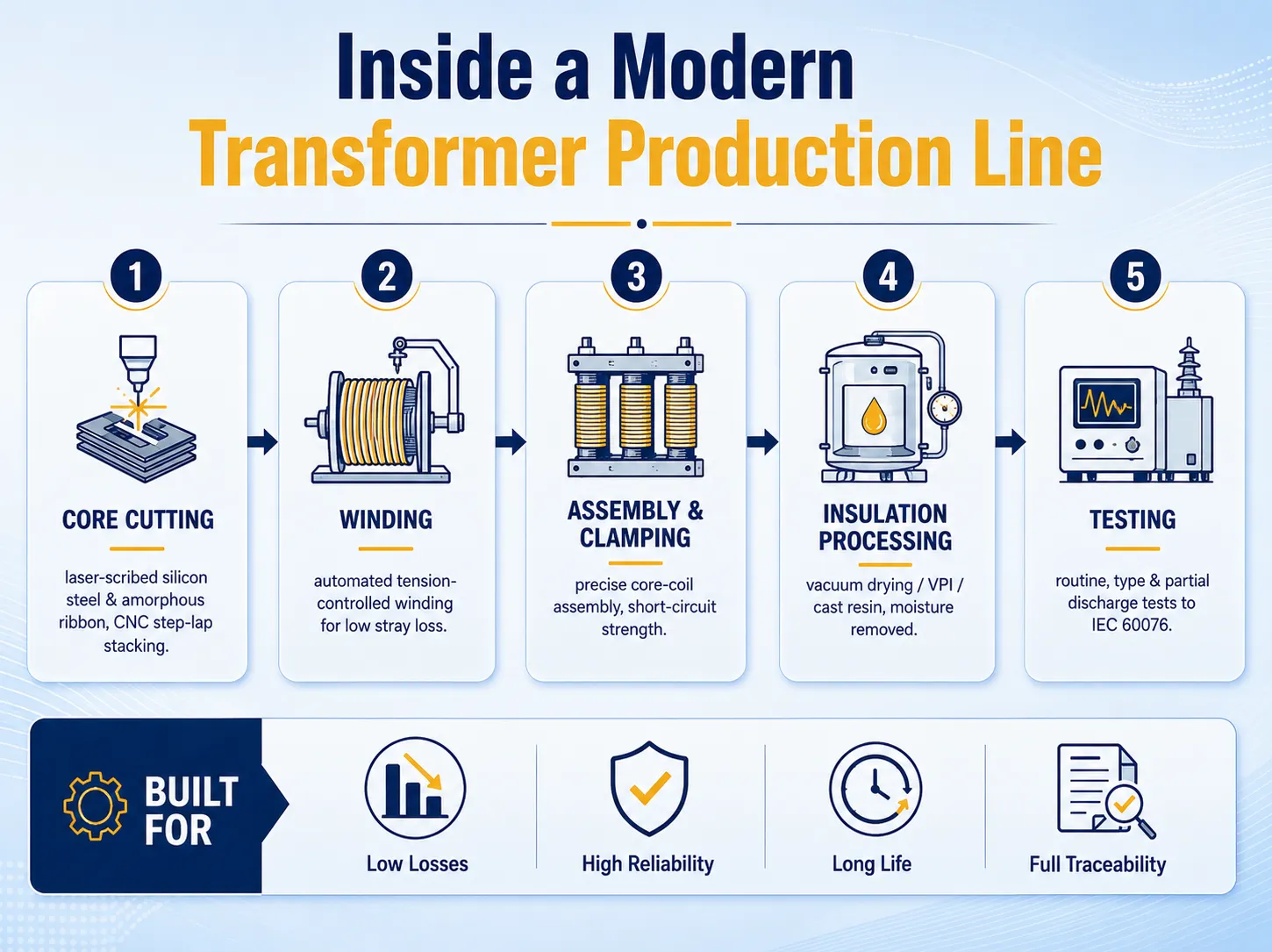
History of the Industry: Transition to Advanced Manufacturing
Traditionally, transformer manufacturing was manual labor. Workers had to cut laminations, wind conductors and check the quality of the product based on experience. The manual approach was successful in many cases in making good transformers but it created many instances of inconsistencies as the work was done by different people at different times.
This practice was continuously improved to gain in automation. The tool making process was changed. Manual cutting was replaced by precision machines, manual fabrication was substituted for high–performance winding machines and qualitative tests have been automated. Nowadays, advanced technologies for the production of transformers have been developed which allow reaching much better results tha before.
Precision and Automation on the Production Line
Consistency is the quiet hero of transformer quality. A design is only as good as the factory’s ability to reproduce it, unit after unit, without drift. This is where automation has changed the game. Computer-controlled cutting and stacking lines produce core laminations to tolerances that manual work cannot match, and they do it identically every time.
Winding is being transformed in the same way. Automated winding machines control conductor tension, turn count, and layer placement with a precision that directly lowers stray loss and improves the mechanical strength a transformer needs to survive short-circuit forces. Robotic handling and material transport reduce contamination and damage, while a well-instrumented transformer production line captures process data at each step. The result is not just higher quality but repeatable quality, so the tenth unit and the ten-thousandth unit perform the same. Automation also improves worker safety and frees skilled engineers to focus on design and problem-solving rather than repetitive tasks.
Digitalization and the Smart Factory
The most far-reaching shift in transformer manufacturing technology is digital. The modern smart factory connects design, planning, production, and testing into a single data-driven system rather than a chain of separate steps. Manufacturing execution systems schedule and track every order, sensors on machines report their condition in real time, and every material lot is traceable from arrival to shipment.
A powerful enabler here is the digital twin, a detailed virtual model of a transformer or a production process. Engineers can simulate electromagnetic behavior, thermal performance, and mechanical stress before any metal is cut, refining the design and catching problems in software instead of on the shop floor. During production, live data feeds back into these models to keep quality on target. This move toward Industry 4.0 transformer manufacturing shortens development time, reduces waste, and gives customers documented, traceable evidence of how their unit was built and tested.
Digitalization also changes what happens after delivery. Sensors and connectivity increasingly extend from the factory into the field, so a transformer can report its temperature, loading, and condition throughout its working life. This supports condition-based maintenance, where service is scheduled according to the transformer’s actual state rather than a fixed calendar, reducing both unexpected failures and unnecessary interventions. The same data-driven mindset that improves the factory therefore keeps adding value for the owner long after commissioning, closing the loop between how a transformer is made and how it is operated.
Insulation Processing: The Hidden Step That Decides Reliability
Some of the most important work in transformer manufacturing is invisible in the finished product. Insulation processing, meaning the drying, impregnation, and treatment of the windings and insulation system, is where much of a transformer’s long-term reliability is determined, and it is a stage where advanced technology pays off quietly for decades.
Moisture is the enemy of insulation. Even small amounts of trapped water accelerate aging and raise the risk of dielectric failure, so quality manufacturers use vacuum drying and controlled thermal processing to remove moisture thoroughly before a unit is sealed. For dry-type designs, vacuum pressure impregnation or cast-resin technology encapsulates the windings to lock out moisture and contamination and to strengthen the coil mechanically. Doing this well requires tightly controlled ovens, vacuum systems, and clean handling, all part of the broader transformer manufacturing technology that distinguishes a serious factory. Because a customer cannot see this step in the delivered unit, it is worth confirming that a supplier has the equipment and process discipline to do it right.
Advanced Testing and Quality Assurance
Innovation on the production side is only credible if it is proven on the test side. A serious manufacturer subjects every transformer to a structured program of routine tests and, for representative designs, type and special tests, all defined by the IEC 60076 series and equivalent standards. Routine tests measure winding resistance, voltage ratio, no-load and load losses, and dielectric strength on every unit before it leaves the factory.
Beyond the routine checks, advanced quality control relies on more demanding measurements. Partial discharge testing detects tiny insulation weaknesses long before they would cause a failure in service, temperature-rise tests confirm the thermal design under load, and impulse tests verify that the insulation can withstand lightning and switching surges. High-quality manufacturers invest heavily in these testing laboratories precisely because catching a defect in the factory is far cheaper than a failure in the field. Full factory acceptance testing, witnessed by the customer where required, turns those measurements into documented assurance that the unit meets its guarantees.
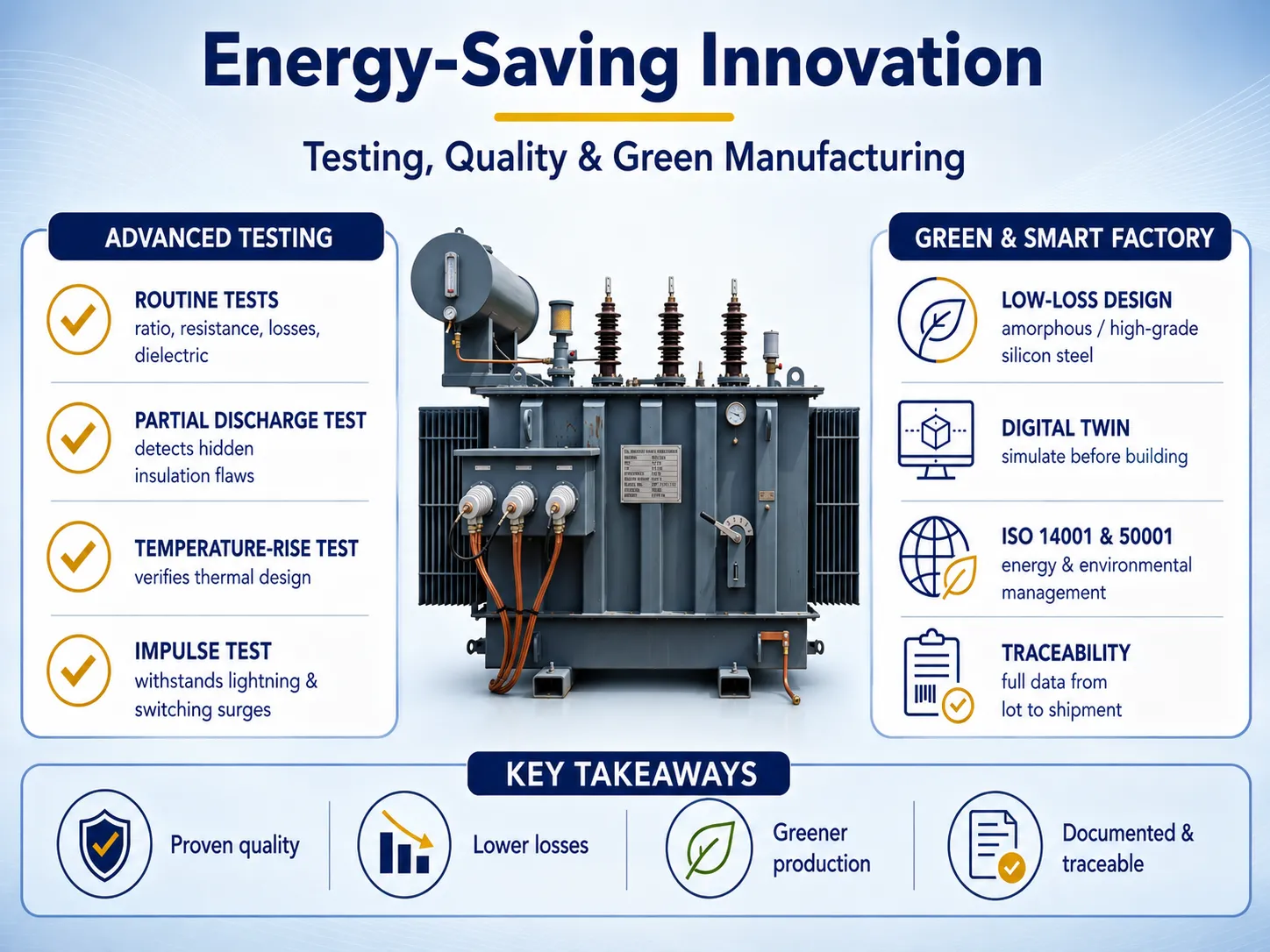
Green and Energy-Saving Manufacturing
Efficiency is no longer merely a property of the finished product but rather that of the manufacturer’s plant. The current innovative energy efficient transformer allow achieving lower losses and wasteful manufacturing processes as well as the improvement of the production process throughout the product life cycle.
In terms of product efficiency, it would mean reducing no-load and load losses through the application of advanced materials and manufacturing technologies. On the side of process efficiency, it is a matter of the implementation of recognized environmental and energy management systems like ISO 14001 and ISO 50001, the use of low-impact and recyclable materials, the reduction of solvent waste, and improved energy utilization. For customers who are committed to reducing their carbon footprint and would like to promote sustainability, it means that it is desirable to deal with companies that have green energy efficient production processes and ensure achieving sustainability in the complete value chain from the raw material to the final use of the product.
From Factory Floor to Field: Real-World Benefits
All of this technology matters because of what it delivers to the owner. Better manufacturing produces measurable, practical advantages that show up long after the purchase order is closed.
- Higher efficiency, because precise cores and windings realize the low losses a low-loss transformer is designed for, cutting energy waste for the life of the unit.
- Greater reliability, because partial discharge testing and rigorous quality control catch weaknesses before shipment rather than after installation.
- Longer service life, because superior insulation processing and thermal design slow the aging that eventually retires a transformer.
- Stronger short-circuit withstand, because automated winding and precise clamping give the unit the mechanical strength to survive fault currents.
- Lower total cost of ownership, because efficiency, reliability, and longevity together outweigh a modest difference in purchase price.
- Full traceability, because Industry 4.0 transformer manufacturing documents how each unit was built and tested, simplifying audits and long-term support.
What to Look for in a Transformer Manufacturer
Because so much quality is decided during production, choosing the right supplier is as important as choosing the right specification. When evaluating a transformer manufacturer, these points separate genuine capability from marketing:
- In-house testing to the IEC 60076 series, including routine tests on every unit and the ability to perform type and special tests such as impulse and partial discharge.
- Evidence of advanced transformer manufacturing technology, such as automated core and winding lines and a digitally managed smart factory.
- Demonstrated R&D and transformer design innovation, including experience with amorphous cores and low-loss designs.
- Recognized quality, environmental, and energy management certifications.
- Capability across both oil-immersed and dry-type transformer manufacturing, so the format is chosen for the application rather than the factory’s limits.
- Transparent documentation and factory acceptance testing, ideally with customer witnessing available.
- A track record of references in demanding applications and reliable after-sales support.
Frequently Asked Questions
Why does transformer manufacturing technology matter more than the datasheet?
The datasheet states targets, but transformer manufacturing technology determines whether those targets are actually met and sustained over decades. Losses, dielectric reliability, mechanical strength, and noise are all set by how precisely the unit is built, so two transformers with identical specifications can perform very differently depending on the factory that made them.
What is an amorphous alloy core and why is it important?
An amorphous alloy core is made from a metallic glass ribbon that magnetizes with far less energy than conventional silicon steel, giving very low no-load loss. Because it is thin and brittle, manufacturing it well requires specialized technology, which makes it a strong example of both capability and energy-saving transformer innovation.
How does a smart factory improve transformer quality?
A smart factory connects design, production, and testing through data, using tools like a digital twin to simulate performance before building and sensors to monitor quality during production. This Industry 4.0 transformer manufacturing approach improves consistency, reduces waste, and gives customers traceable proof of how each unit was made.
What tests should a quality transformer pass?
At minimum, every unit should pass routine tests for ratio, resistance, losses, and dielectric strength per the IEC 60076 series. For higher assurance, look for advanced quality control including partial discharge testing, temperature-rise tests, and impulse tests, ideally with factory acceptance testing the customer can witness.
Does manufacturing innovation help with sustainability goals?
Yes. Energy-saving transformer innovation lowers losses so each unit wastes less energy in service, while green manufacturing practices reduce the footprint of production. Together they help owners meet efficiency requirements and carbon commitments across the full lifecycle of the equipment.
Building the Transformers of Tomorrow
The transformer may look like a simple, static box, but the technology that goes into building it is advancing quickly. Advanced materials, automation, digital factories, and rigorous testing are raising the standard for what a transformer can deliver in efficiency, reliability, and service life. For buyers, understanding this shift is the key to seeing past identical-looking datasheets and choosing equipment that will truly perform.
Subian Electric combines advanced transformer manufacturing technology with continuous energy-saving transformer innovation, backed by in-house testing to international standards and a commitment to green, efficient production. Whether your project needs oil-immersed or dry-type units, standard designs or engineered solutions, our team is ready to help you specify and build transformers made to last. Talk to us about how our manufacturing capability can support your next project.