


In 2023, a northeastern utility replaced a pool of 40-year-old transformers with new amorphous-core transformers and tracked the results for the following twelve months. Overall, no-load losses decreased by about 65%, feeder temperatures dropped, and the total annual savings of energy supplied by 2000 transformers would be enough to power more than 1200 homes for a year. This information is not based on any laboratory forecasts but is the result of field data that is spurring utilities all over the globe to rethink the value of transformers as the most efficient energy efficiency upgrade available to the power grid.
This article talks about innovative developments in transformer technology that make transformers more energy-efficient and reliable. These innovations include amorphous and high-permeability cores, cast resin dry insulation, smart monitoring, and eco-designed products that bring these innovations to the market. You will find numbers that reflect each innovation: loss reduction percentages, efficiency rates, payback periods, and price markups.
Briefly: The latest advancements in transformer technology involve three key developments: amorphous metal cores capable of reducing no-load losses of 60-80%, cast resin dry-type insulation eliminating indoors oil hazards, and smart monitoring allowing for prediction of problems and extending asset lifespan by 10-15 years. Together with the stricter eco design regulations, the technologies regularly ensure that distribution transformer efficiency is above 98.5-99.2%.
What Is the Breakthrough?
Transformers have evolved slowly in a hundred years: the technology has employed laminated silicon steel cores, copper coils, and oil insulation so far. Now the cutting-edge player in the game is not the product itself but the combination of material science, manufacturing science, and digital technology, which cut the most significant loss component by 60-80% within the last ten years while adding the intelligence that allows for forecasting the behavior of transformers rather than being surprised by them.
Three innovations are responsible for this product revival. The use of non-crystalline metal cores is the first one, as it substitutes the technology of grain-oriented silicon steel for that of iron-boron-silicon alloy with the atomic structure that wastes less energy when magnetizing metal. Another breakthrough can be called cast resin insulation, with dry-type transformers now capable of operating at up to 12,500 kVA with the level of partial discharge less than 10 pC. The last improvement is intelligent monitoring, which can process operational data into maintenance decisions.
The Technologies Behind the Breakthrough
| Technology | What It Replaces | Key Gain | Cost Impact |
|---|---|---|---|
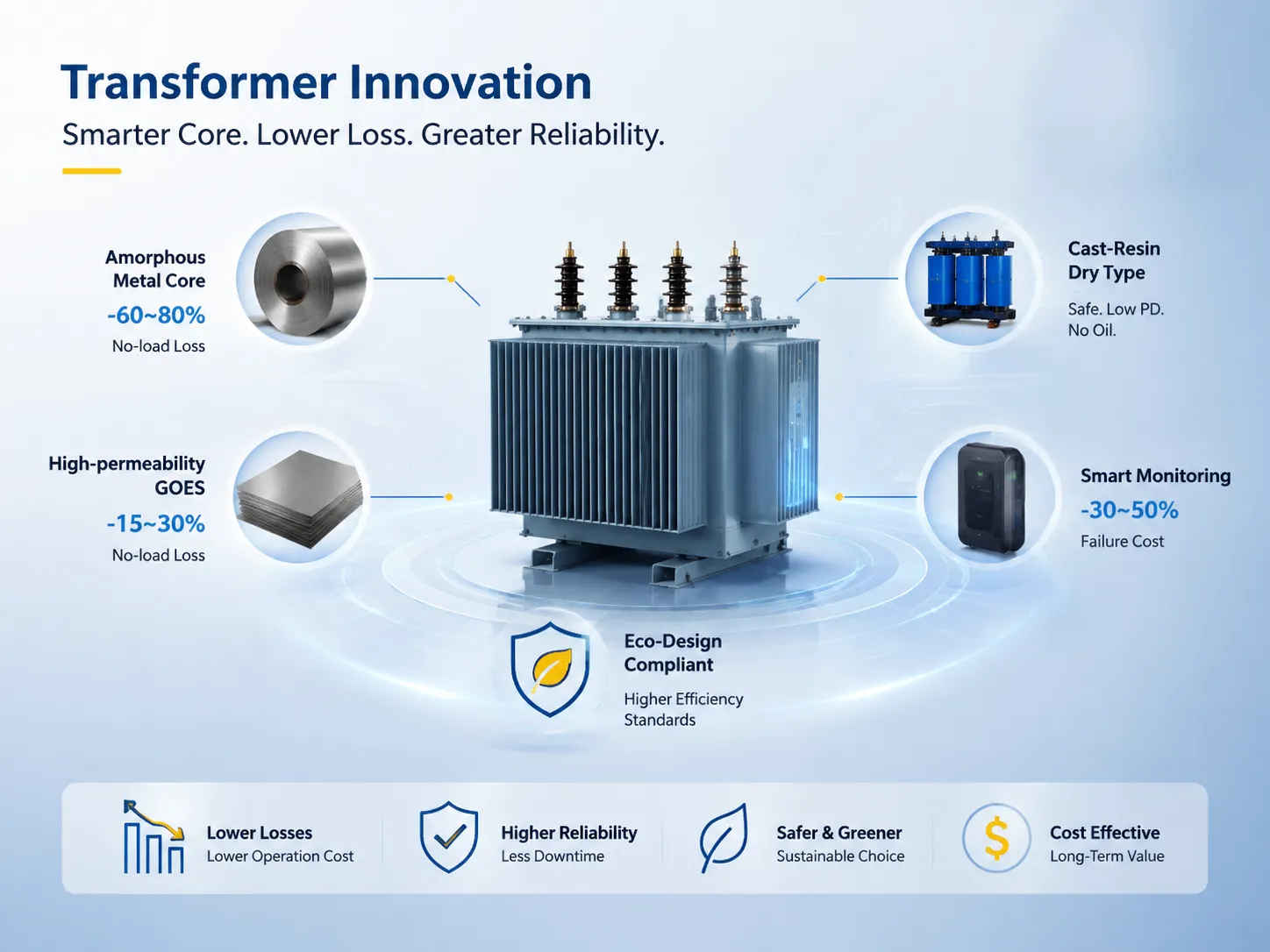
| Amorphous metal core | Silicon-steel core | No-load loss down 60–80% | +15–30% first cost |
| High-permeability GOES | Standard CRGO | No-load loss down 15–30% | +5–10% |
| Cast-resin dry type | Oil-immersed indoor units | No vault, self-extinguishing, low PD | Similar installed cost |
| Smart sensors / DGA | Calendar-based maintenance | Failure costs down 30–50% | +3–15% of unit price |
| Eco-design compliant design | Pre-2019 loss levels | Mandatory efficiency floor | Part of new builds |
Amorphous Cores: The Loss Revolution
Amorphous metal is created by cooling molten alloy made of iron, boron, and silicon at approximate rate of one million degrees per second. This cooling process freezes atoms in a disordered, glass-like state. The result is a structure that has very low coercivity, which means those magnetic losses incurred as a result of hysteresis require very little energy.
Results from testing distribution type transformer: with no-load losses dropping from approximately 0.3-0.6% of the rated power to only 0.1-0.2%, energy savings amounted to 60-80%. The trade-offs are upfront costs and size. One of the known disadvantages of amorphous core transformer is that the initial cost is 15-30% higher than for steel core transformers and the size is also 15-20% bigger due to lower saturation core density. However, for electric transformer that has energy losses of approximately $500-$750 per year, costs may be entirely compensated in 4-8 years of service, after which the operation of the device brings only benefit for 25-30 years.
Cast-Resin Dry-Type Advances
Cast-resin dry-type transformers are constructed with their windings completely encapsulated in vacuum-cast epoxy and do not use any oil whatsoever. The last decade has seen significant changes in resin applications involving improved resin formulations working at higher hotspot temperatures, the use of automated methods to make sure there’s no partial discharge over 10 pC, and designs that have now been standardized to include all 10–36 kV systems up to 12,500 kVA. Since this type of transformer has self-extinguishing capacity, dry-type transformers can be used indoors in close proximity to switchgear without requiring vaults or any containment systems, leading to a decrease in building expenses, size, and space.
For data centers, high-rise construction, railway, and marine applications dry type is no longer an uncommon option – in most cases, it’s cheaper than other indoor alternatives in the market. The costs of the installation of a 1,000 kVA cast-resin dry-type transformer are estimated to be between $14,000 and $26,000 considering that with oil-filled transformers one should take installation costs into consideration.
Smart Monitoring and Predictive Maintenance
The second element of our “efficient and reliable” commitment is intelligence. Modern transformers incorporate fiber-optic temperature sensors, coupled with online monitoring of dissolved gas in oil-filled transformers, partial discharge measurement devices in dry-type transformers, and data transmission of vibration and load information to a digital twin. The application of IEC 61850 to substation communication allows these data to be put into practice by the network control center.
From an economic standpoint, the benefits of such technology are obvious. Replacement of a broken 30 MVA transformer requires an investment of $600,000–$1.2 million in repair work and losses due to not providing energy. The cost of monitoring equipment constitutes 3%–15% of the price of the transformer, while predictive maintenance based on monitoring system data minimizes failure costs by 30%–50% and extends the life of the equipment by 10-15 years.
Eco-Design Regulation as a Driver
Appropriate statutes can foster transition. The EU Ecodesign Regulation (EU) 2019/1783 applies minimum efficiency standards concerning distribution transformers and small power transformers in the region; the measures will become stricter over a period till 2024 and after. The U.S. DOE 10 CFR 431 prescribes minimum effectiveness levels applicable to distribution transformers with losses being decreased. In some cases, states adopt NEMA TC-1 and TC-2 standards.
| Regulation / Standard | Region | Effect |
|---|---|---|
| EU 2019/1783 | EU | Bans low-efficiency classes; tightens tiers |
| U.S. DOE 10 CFR 431 | USA | Mandatory minimum efficiency, phased |
| NEMA TP-1 | North America | Industry efficiency benchmark |
| IEC 60076-1 | Global | Loss measurement and tolerance baseline |
New vs. Conventional Technology
| Parameter | Conventional (CRGO) | New (Amorphous / High-Grade) |
|---|---|---|
| No-load loss (630 kVA) | 1,000–1,400 W | 400–700 W |
| No-load current | 0.6–1.5% | 0.3–0.8% |
| Efficiency @50% load | 98.3–98.9% | 99.0–99.4% |
| First cost (630 kVA) | $6,000–$12,000 | $8,000–$15,000 |
| Payback of premium | — | 4–8 years |
| Design life | 25–30 years | 25–35 years |
Specifications and Loss Tables
| Rating | Core Type | No-Load Loss | Load Loss | Efficiency @50% |
|---|---|---|---|---|
| 250 kVA | Amorphous | 150–250 W | 2,500–3,600 W | 99.0–99.4% |
| 630 kVA | Amorphous | 400–700 W | 5,500–8,000 W | 99.0–99.4% |
| 1,000 kVA | High-grade GOES | 900–1,400 W | 8,000–11,000 W | 98.8–99.2% |
| 2,000 kVA | Cast resin | 2,200–3,200 W | 14,000–19,000 W | 98.6–99.0% |
Where the New Technology Delivers Most
- Rural and home distribution: this application benefits most from low-loads as the use of amorphous cores here saves the most.
- Renewable facilities: energy-efficient step-up transformers always offer savings for multiple units.
- Data center: cast resin dry transformers are used in the building.
- Urban and high-rise: dry transformers mitigate fire hazards while saving money in dense installations.
- Utilities replacing outdated fleet: eco-design units cut losses at fleet levels and help meet the carbon objectives.
Brands and Price Ranges
| Brand | Country | 630 kVA Standard | 630 kVA Amorphous | 1,000 kVA Dry Type |
|---|---|---|---|---|
| Hitachi Energy | Switzerland/Japan | $9,500–$15,000 | $12,000–$19,000 | $20,000–$32,000 |
| Siemens | Germany | $9,000–$14,500 | $11,500–$18,500 | $19,000–$31,000 |
| ABB | Switzerland | $9,000–$14,000 | $11,500–$18,000 | $19,000–$30,000 |
| Schneider Electric | France | $8,500–$13,500 | $11,000–$17,500 | $18,000–$29,000 |
| Eaton | Ireland/US | $7,500–$12,000 | $10,000–$16,000 | $15,000–$25,000 |
| Jiangsu Subian Electric Power | China | $5,000–$9,500 | $7,000–$12,000 | $11,000–$20,000 |
Leading companies such as Siemens, ABB, Schneider Electric, and Hitachi Energy are making a substantial investment in eco-design and amorphous core lines, and their monitoring technologies are recognized as a benchmark in terms of heavyweight pieces of equipment. However, the core manufacturing materials come from the same suppliers across the globe, and the quality of production is assessed according to IEC 60076. Thus, Jiangsu Subian Electric Power Company included the technology of production of amorphous core and cast resin in its offering, making available IEC 60076-compliant devices that have undergone repeated tests and have attractive pricing being 25-45 percent lower than that in Europe.
How to Evaluate a Technology Upgrade
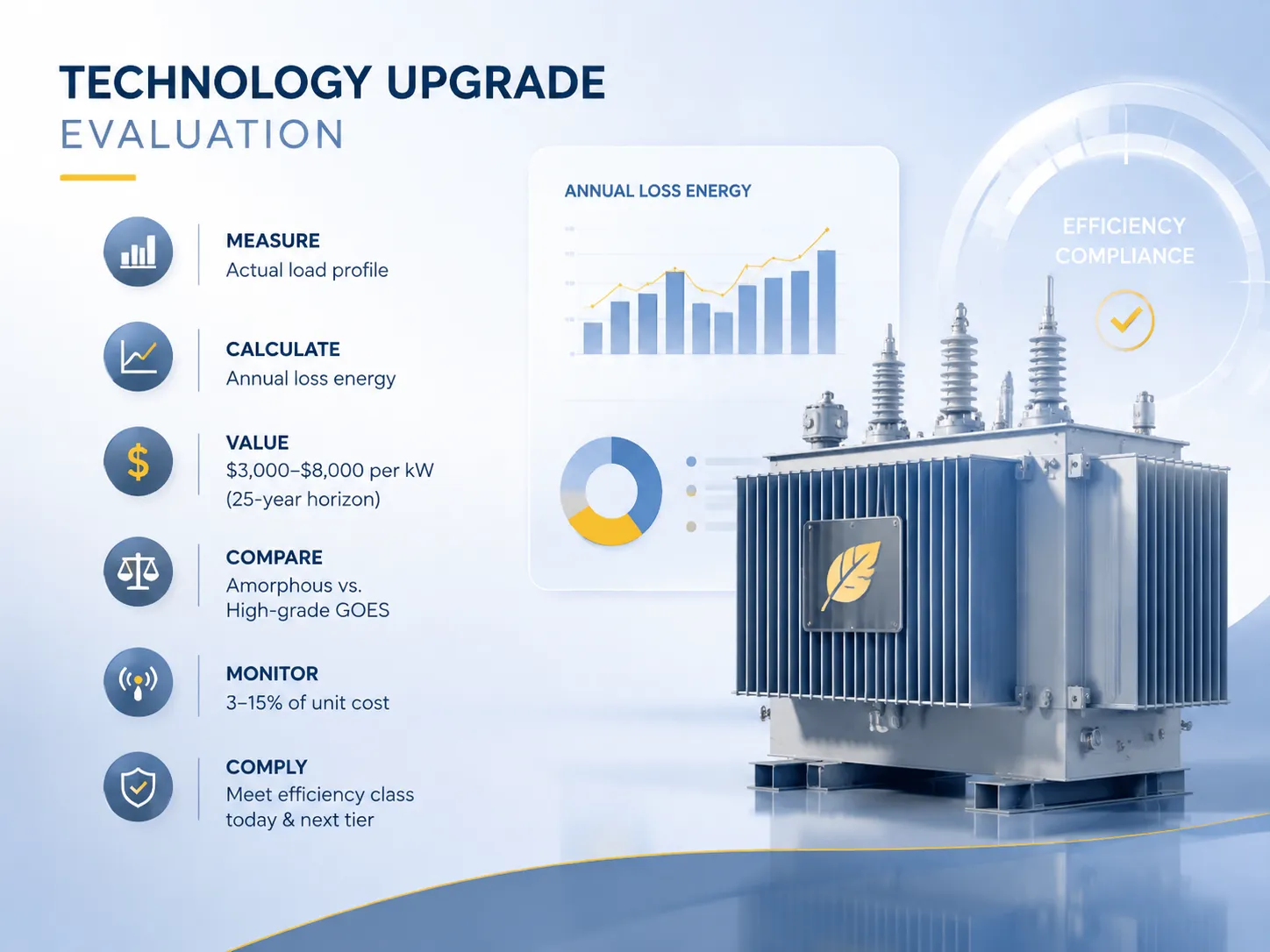
- It is important to measure your actual load profile, as losses tend to be more load dependent than nameplate dependent.
- Annual loss energy can be calculated using the following formula: (no-load loss × 8,760 h) + (load loss × equivalent full-load hours).
- In order to assess the financial impact of the loss, you need to assign it a monetary value, which is somewhere between $3,000 and $8,000 per kW arithmetically calculated over the 25-year period. Alternatively, mathematically you can assess the loss based on the tariffs assigned to your particular situation according to kWh rate pricing.
- Analyze difference between amorphous steel and high-grade GOES with regard to your loads and payback period.
- Consider putting monitoring systems in place when dealing with large or critical equipment, with costs that generally approximate 3% to 15% of the entire equipment.
- Make sure that the efficiency class is compliant with local efficiency regulations as per the current regulations (EU 2019/1783, DOE 10 CFR 431) as well as future perspectives.
Frequently Asked Questions
What is the biggest recent breakthrough in transformer technology?
The use of amorphous-material cores enables 60%-80% reduction in no-load losses. By using cast resin insulation and state-of-the-art monitoring, the providers enable more effective and more reliable operation of the transformer. The no-load loss value of around 1,000-1,400 watts was lowered to 400-700 watts for the 630 kVA transformer.
How much does an amorphous-core transformer cost versus a conventional one?
The price range of a 630 kVA amorphous transformer is between $8,000-15,000, while that of a traditional transformer is between $6,000-12,000, thus establishing an amorphous technology at 15%-30% higher price. Given that the cost savings per year are estimated at $500-750 for the traditional transformer, the costs will be compensated in 4-8 years and the transformer will be functioning for about 25-35 years.
Do new dry-type transformers really eliminate oil risks?
Yes. The cast resin technology is used to manufacture the cast resin windings by vacuum casting in self-extinguishing epoxy and with lower than 10 pC partial discharge. Therefore, there is no flammable liquid in the transformer which makes the dry-type transformers the first choice for indoor applications.
How do smart monitoring features reduce transformer costs?
With the help of online technologies for monitoring DGA, partial discharge, and temperature, traditional maintenance model can be replaced with predictive. The studies and experience of operators show 30-50% reduction in related expenditure and lifespan increase by up to 10-15 years, which is the reason for monitoring to be a norm at the price of 3-15% of the equipment price of large transformers.
Are efficiency regulations forcing the technology shift?
Yes. EC regulation (EU) 2019/1783 and U.S. DOE 10 CFR 431 state mandatory minimum efficiency levels which prohibits losses due to legacy loss technology. NEMA TP-1 efficiency requirements and guidelines are widely used in North America for testing the transformers in service.
References
- EU Ecodesign Regulation (EU) 2019/1783 for Transformers — the regulation setting minimum transformer efficiency in the EU.
- U.S. DOE: Distribution Transformer Efficiency — mandatory efficiency standards under 10 CFR 431 and loss evaluation guidance.
- IEC 60076-1: Power Transformers – General Requirements — global baseline for loss measurement, ratings and tests.
- IEC 60076-11: Dry-Type Transformers — requirements for cast-resin and VPI dry-type units.
- NEMA TP-1 — the North American efficiency benchmark for distribution transformers.
- NREL: Amorphous Alloy Transformer Research — technical analysis of amorphous-core loss performance and applications.
- Jiangsu Subian Electric Power — manufacturer of amorphous-core, cast-resin and conventional IEC 60076-compliant transformers.
Conclusion
This decade’s breakthrough in transformers is the merger of three technologies: the use of amorphous cores, cast-resin insulation, and the implementation of intelligent monitoring, which minimize losses, eliminate the risk of oil spillage, and render failures predictable. With the help of eco-design regulations and evidence from the field, these technologies make transformers one of the best investments in efficiency on the part of facilities and grids.
- The use of amorphous cores reduces no-load losses by 60–80%, with a payback period of four to eight years.
- Cast-resins used for dry types of transformers exclude the need for vaults and oil risk indoors.
- The installation of monitoring equipment for 3–15% of the transformer price allows to reduce the cost of failures by 30–50%.
When buying transformers, regardless of whether you purchase from Hitachi Energy, Siemens, Schneider Electric, or Jiangsu Subian Electric Power, make sure to find out the efficiency class of the transformer, loss test results, and monitoring options available at your disposal before making the final decision based on price.