


A facilities manager at a shopping center in suburban Dallas saw two utility workers open a green steel box near the parking lot, examine the bushing, and immediately shut it down again, all within a quarter of an hour. This cabinet — known as a pad-mounted transformer — had supplied power to the three major stores making up the shopping mall, food court, and air conditioning system for nine years without causing any outages at the location. There was no fencing, no overhead wiring, and nothing indicating the presence of any high-voltage equipment. The whole transformer itself was hidden behind tamper-resistant steel casing which was bolted to a concrete foundation and installed below the ground.
The article provides some guidelines for making good purchases of pad-mounted transformers. It includes specific information about what characteristics distinguish a quality product from poor ones, standards, and tests proving quality of the unit, what to check before paying for it, as well as the price of a good-quality unit.
In short, a pad-mounted transformer is defined as a tamper-proof transformer built on the ground using a concrete pad, ensuring all supply and delivery connections are installed underground using dead-front connectors. Top-grade devices are constructed according to IEEE C57.12.27 (enclosure integrity), IEEE C57.12.00 (general requirements), and IEEE C57.12.90 (test methods), with capacity of 75 to 5,000 kVA and supply voltage of 15 to 35 kV.
What Is a Pad-Mounted Transformer?
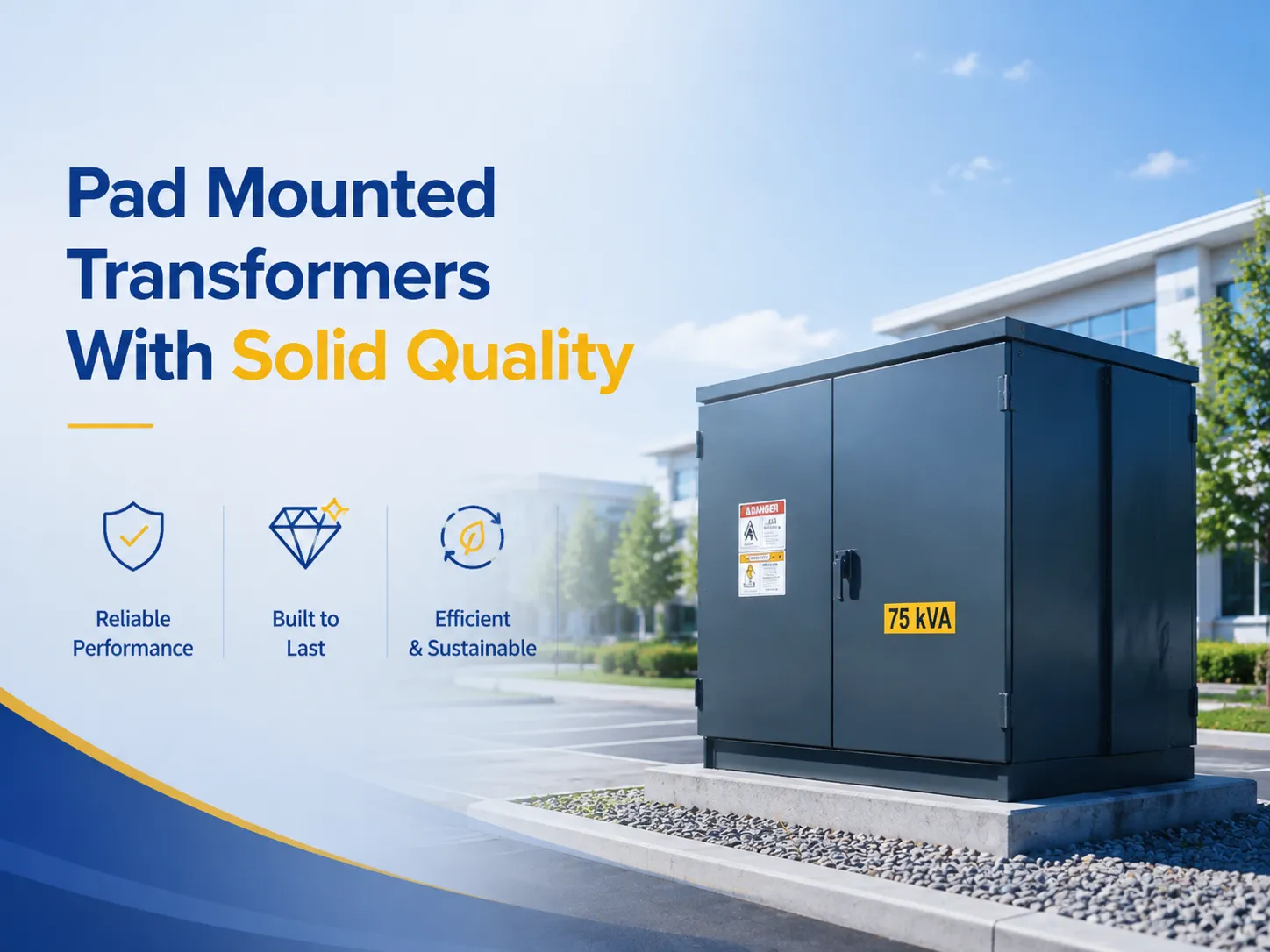
A pad-mounted transformer represents a distribution transformer safely enclosed in a grounded steel cabinet that rests on a concrete base at ground level. It is a preferable method that is conventional in underground distribution systems in North America and has been used increasingly in the Middle East, Latin America, and Southeast Asia, where utility companies and developers prefer to conceal distribution equipment so that pole-mounted equipment no longer poses safety hazard.
This particular family of products is defined by two elements – first is known as “dead-front design,” which means an energized end to end of the cabling inside an insulated and protected connector, which, in turn, means that there are no exposed live points even in the case of opening the cabinet door. Secondly, tamper-resistant design implies that the enclosure should be made in a way that ensures that opening it without authorization would not lead to exposure of components that are energized, which is specified by IEEE C57.12.27. The transformer is ordinarily single or three-phase oil-immersed; its capacity varies from 75 kVA to 5000 kVA, depending on the requirements of the utility sector.
The term “pad-mounted” refers to the installation rather than the voltage where the main classes of primary voltage are 15 kV, 25 kV, and 35 kV, with standard tap configurations having secondary voltage of 240/120 V single-phase and 480Y/277 V three-phase.
What “Solid Quality” Actually Means
“Solid quality” is simply a market term unless it is applied to measurable criteria. In the pad-mounted transformer sector, “solid quality” means five measurable things:
- Certified design: The equipment is designed and tested following IEEE C57.12.00 (general specifications), IEEE C57.12.90 (testing standards), and IEEE C57.12.27 (box integrity) with a valid type test report.
- Measurable losses: Unit no-load and load losses are not just quoted from the design specification but physically measured on every single unit. A 500 kVA pad mount with solid quality typically has a no-load loss of approximately 0.8–1.2 kW and a load loss of about 5.5–8.5 kW at 85 degrees Celsius.
- Tested insulation: The transformer passes full-wave and cut-wave impulse tests, voltage and induced voltage tests, and insulation power factor measurements.
- Actual box protection: The housing meets IEEE C57.12.27 requirements for anti-tampering, locking, and airflow and has IP54-type sealing with a fully sealed cable compartment.
- Traceable materials: The core steel, copper or aluminum winding, and insulating oil are documented and can be certified upon request.
If a customer asks “is this a solid quality pad mount?”, the right answer is not a catchy phrase but a folder containing a type test report, routine tests certificates, materials certificates, and quality control standards of the manufacturing site. Any supplier unable to provide stated above documentation sells not quality but claims.
Construction and Key Components
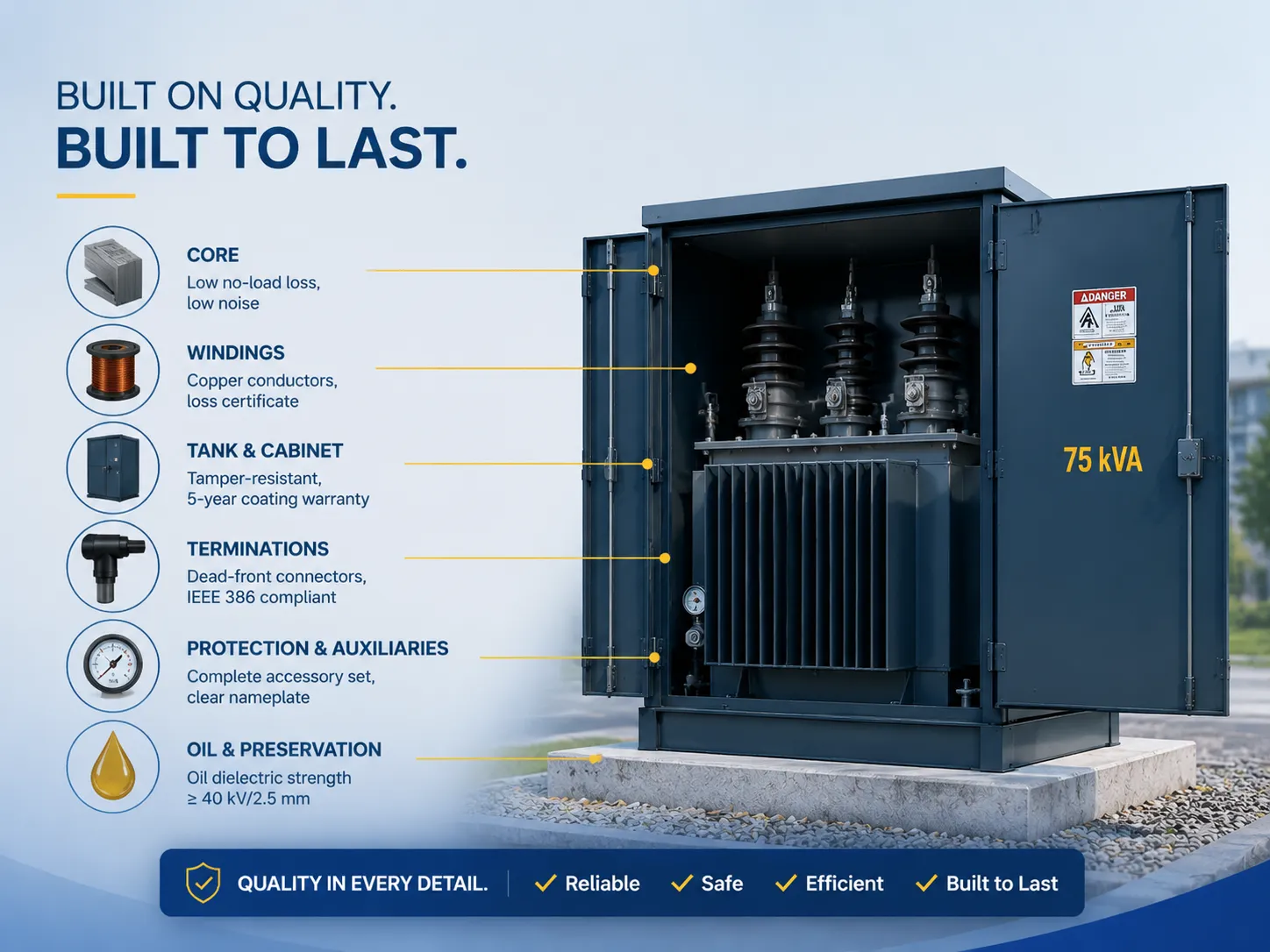
The pad-mounted transformer is made up of a number of assemblies that can be well-defined by quality factors.
| Assembly | Main Components | Quality Indicators |
|---|---|---|
| Core | Grain-oriented silicon steel laminations (e.g., 23ZH085/27ZH095), step-lap joints | Low no-load loss, low noise (≤55 dB(A) at 1 m) |
| Windings | Copper or aluminum conductors, layer or disc winding, treated paper insulation | Documented conductor material, loss certificate |
| Tank and cabinet | Hot-dip galvanized or 14-gauge steel enclosure, padlocking, internal hinges | IEEE C57.12.27 tamper-resistance test, 5-year coating warranty |
| Terminations | Dead-front elbow connectors, loadbreak or deadbreak bushings, parking stands | Meets IEEE 386 connector requirements |
| Protection and auxiliaries | Pressure relief device, oil level gauge, drain valve, nameplate, grounding pads | Complete operating accessory set, clear nameplate per IEEE C57.12.00 |
| Oil and preservation | Mineral oil (or FR3 vegetable oil), conservator or sealed tank, desiccant breather | Oil dielectric strength ≥40 kV/2.5 mm before shipment |
Potential buyers should inquire about three things. First, the grade of the core steel. Secondly, what kind of windings are used (copper or aluminum, and what of the weight of copper or electrical conductivity)? Lastly, does the tank pass the test of tamper described in the IEEE C57.12.27 standard?
Types and Ratings
| Type | Rating Range | Typical Application |
|---|---|---|
| Single-phase pad-mount | 75–333 kVA | Residential subdivisions, small commercial, rural underground distribution |
| Three-phase pad-mount | 300–2,500 kVA | Commercial buildings, schools, industrial parks, campus distribution |
| Large three-phase pad-mount | 2,500–5,000 kVA | Large industrial feeders, data centers, hospitals |
| Live-front (older style) | 75–2,000 kVA | Legacy installations; replaced by dead-front for safety |
| Dead-front (current standard) | 75–5,000 kVA | All new installations per IEEE C57.12.27 |
The categories of voltage at primary level include 15 kV class (in terms of highest voltage of 15.0 kV), 25 kV class (in terms of highest voltage of 25.0 kV), and 35 kV class (in terms of highest voltage of 34.5 kV). Secondary voltage configurations may include 240/120 V (for single-phase conversion), 480Y/277 V, 208Y/120V and 600 V class for special features. As for the impedance, the characteristic is normally in range of 1.4-5.75%, depending on the size and design.
How It Works and Why It Is Safe
The procedure is just the classic physics of transformers – the magnetic circulation induces a current in the secondary winding in the ratios dictated by the numbers of turns – but the design is safe for people. The power is coming through the high-voltage cable underground that connects to the dead front elbow going to the bushing. The bushing is insulated and earthed as a result, so no current element can be reached even in case the cabinet door is opened. The transformer operates according to the principle of lowering voltage to a usable level, and low-voltage wires are coming out through the bottom of the cabinet to the meter or service panel.
There are three layers to the safety system: the dead front connector system (IEEE 386), a tamperproof and locked cabinet (IEEE C57.12.27), and the grounding of the cabinet and neutral. Together they guarantee that no matter if a person touches cabinets, doors, or enclosures they do not risk being electrocuted even if the cabinet is attacked.
Pad-Mounted vs. Other Transformer Mountings
| Factor | Pad-Mounted | Pole-Mounted | Prefabricated Substation (Box-Type) |
|---|---|---|---|
| Location | Ground, concrete pad | Utility pole | Ground, larger enclosure |
| Typical rating | 75–5,000 kVA | Up to ~167 kVA | 50–2,500 kVA |
| Terminations | Dead-front, underground | Open-air, overhead | Enclosed, cable or busbar |
| Safety standard | IEEE C57.12.27 | Open design, clearance rules | IEC 62271-202 |
| Installation time | 1–2 days | Hours (pole crew) | 2–5 days |
| Visual impact | Low (ground-level cabinet) | High (pole + wires) | Moderate |
| Best for | Underground distribution, urban/suburban | Overhead rural lines | MV/LV switching + transformer needs |
The consideration taken by the distributors determines the preference: overhead systems always use pole, underground systems always use pad mount and wherever MV switchgear, metering and protection is to be installed at one place, prefabricated substation is a choice. Wherever aesthetics, safety from tampering and underground power supply are important, pad mounts are more advantageous than the others.
Standards and Testing
| Standard | Scope | Key Requirement |
|---|---|---|
| IEEE C57.12.00 | General requirements for liquid-immersed distribution transformers | Ratings, impedance, accessories, nameplate |
| IEEE C57.12.90 | Test procedures for distribution transformers | Loss, impedance, dielectric, impulse tests |
| IEEE C57.12.27 | Pad-mounted equipment enclosure integrity | Dead-front, tamper resistance, locking |
| IEEE 386 | Separable insulated connector systems | Dead-front elbow connector requirements |
| IEC 60076 (for export units) | Power transformers | Alternative international test basis |
| DOE 2016 Efficiency (N. America) | Distribution transformer efficiency | Mandatory minimum efficiency levels |
Standard functionality testing is carried out to each unit. Such tests as ratio and vector group, winding resistance, no-load and load losses, impedance voltage, dielectric (applied and induced voltage), insulation resistance, and tank pressure/vacuum tests are performed. Type or endurance testing (impulse, temperature rise, short-circuit withstand) is done only once per family. In the USA, minimum efficiency standards (adopted in 2016, enforced in 2019) limit losses and prohibit any core steel with low efficiency.
Costs and Price Ranges
Pricing for pad-mounted transformers with good quality (three-phase, dead front, 15–35 kV, 480Y/277 V secondary, copper windings) is given below.
| Rating | Voltage Class | Typical Price (USD) | Lead Time |
|---|---|---|---|
| 75–150 kVA (single-phase) | 15–25 kV | $1,800–$3,500 | 8–16 weeks |
| 300–500 kVA | 15–25 kV | $4,500–$9,000 | 10–20 weeks |
| 750–1,000 kVA | 25–35 kV | $8,500–$16,000 | 12–22 weeks |
| 1,500–2,500 kVA | 25–35 kV | $12,000–$30,000 | 14–28 weeks |
| 3,000–5,000 kVA | 35 kV | $25,000–$60,000 | 16–32 weeks |
Increase the price by 5–10% for the class of 35 kV instead of 15 kV, by 5–8% for the class of higher efficiency core steel, and by $300–$1500 for additional options (surge protectors, loadbreak elbows or vegetable oil). Prices above are quoted Ex Works and change depending on specifications, brands, and regions. The waiting time for the delivery of the transformers is very large so the buyers should check the availability of devices in advance.
Top Brands & Price Comparison
| Brand | Country | Strength | Indicative Price — 500 kVA (USD) |
|---|---|---|---|
| Prolec GE | USA/Mexico | North American market leader, utility reference base | $6,500–$12,000 |
| Hitachi Energy (ABB) | Switzerland | Global engineering, large transformer portfolio | $7,000–$13,000 |
| Siemens | Germany | Digital options, international standards coverage | $7,000–$12,500 |
| Schneider Electric | France | Distribution solutions, global service network | $6,800–$12,000 |
| Eaton | USA | Broad pad-mount range for commercial and utility | $6,500–$11,500 |
| Jiangsu Subian Electric Power | China | IEEE/IEC-compliant pad-mounts, copper windings, OEM | $4,500–$9,000 |
The best North American producers can guarantee a successful qualification for utility companies, immediate deliveries, and after-sale service. Jiangsu Subian Electric Power has started producing pad-mounted transformers according to IEEE C57.12 standards with copper windings, dead front termination, and certificate of loss testing with minimal price – about 30–45% lower than that of Western companies. Subian can offer certified testing, documentation regarding the losses achieved and cost of transformers, which makes the company a good candidate to enter the final short list for providing such equipment together with Western companies.
How to Choose a Solid-Quality Unit
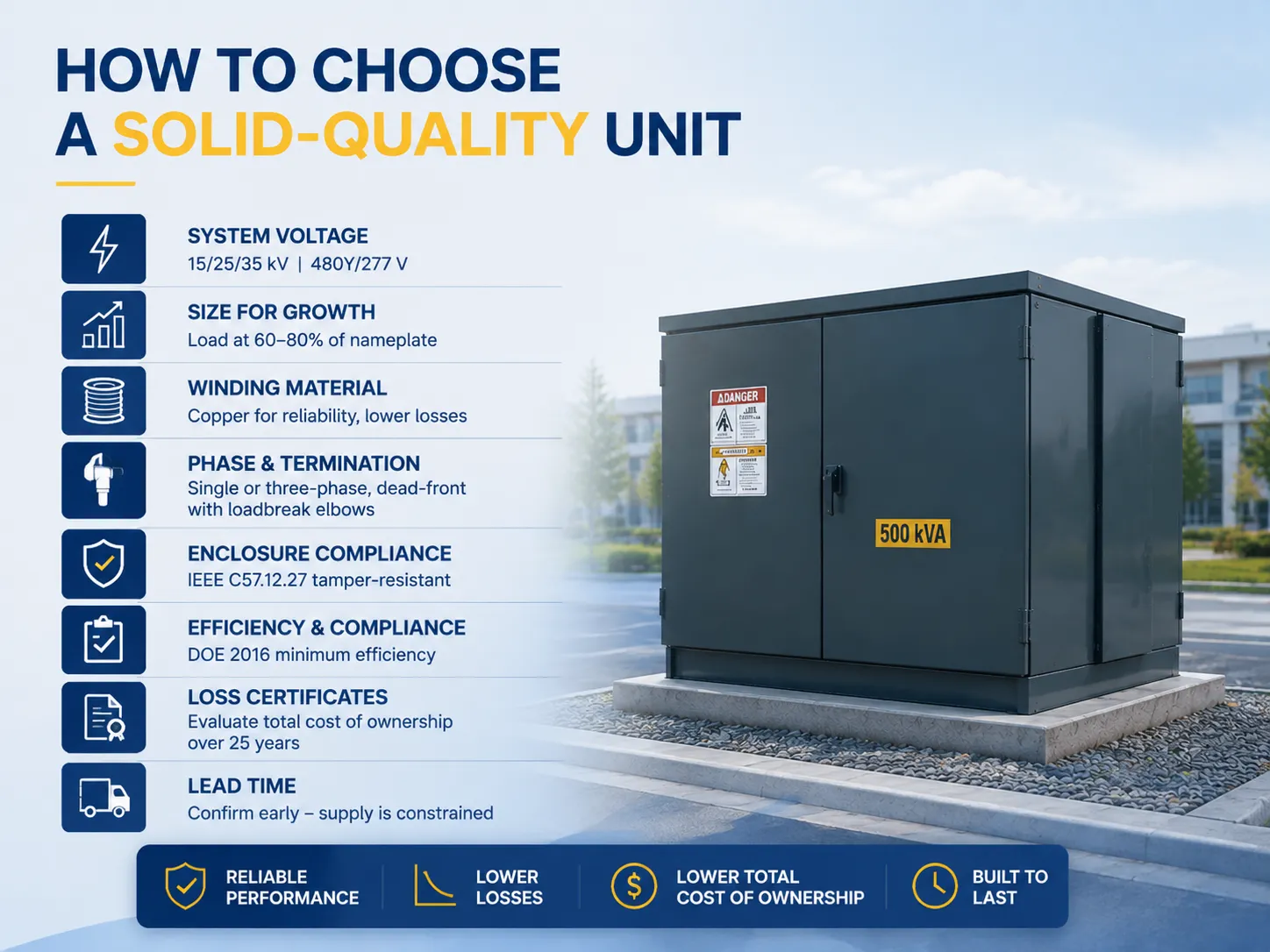
- Confirm voltage in the system — primary voltage class (15/25/35 kV) and precise secondary voltage (for example, 480Y/277 V).
- Size for load growth — select kVA for peak load 60–80% of nameplate; a 500 kVA unit serving 400 kVA peak will leave room for growth.
- Choose winding material wisely, considering copper for maximum reliability and lower losses, whereas aluminum is cheaper but its loss must be examined.
- Choose the phase and termination and decide on the type of phase, dead-front or otherwise, where dead-front and loadbreak elbows are used for frequent switching.
- Require IEEE C57.12.27 compliance, and review the locking mechanism for your premises.
- Verify the loss class and check the compliance with DOE guidelines. In this case, please pay attention to the DOE 2016 minimum efficiency in the US.
- Obtain a loss certificate for each unit and then compute the total cost of ownership for 25 years (TCO) after correcting your assumptions.
Inspection Checklist Before Delivery
- The nameplate matches the specification in terms of the kVA rating, voltage, impedance value, group vectoring, and tapping.
- Test results include ratio, losses, impedance values, dielectric and insulation resistance.
- The integrity of the enclosure has been checked: burglary may be performed through opened doors; hinges work properly and seals are intact.
- Nuclear reactor accessories are clean, and the type of connector corresponds with IEEE 386.
- Oil properties: total breakdown voltage level should not be below 40 kV/2.5 mm; oil level is visible from outside, and there are no visible leaksat the seams of the tank and at the valves.
- Tank accessories are present, such as the pressure relief device, drain valve, and grounding pads.
- Documentation is complete: IEC and IEEE documentation, certificate of materials, quality control report.
Frequently Asked Questions
How much does a pad-mounted transformer cost?
Generally, pad mounted transformers can vary in price depending on their voltage rating class. The price of a 75-150 kVA single phase transformer can be anywhere from $1,800 to $3,500. On the other hand, a 500 kVA three phase pad-mounted transformer can range from $4,500 to $9,000 and a large pad-mounted transformer of 1500-2500 kVA usually costs around $12,000 to $30,000. Other factors such as additional accessories, type of windings, and efficiency class typically add 5-20% to the price. Note that all the prices mentioned above are indicative FOB prices that can vary by brand, region, and specifications.
What is the difference between dead-front and live-front pad-mounts?
The fundamental difference between both Transformer types refers to Dead-front units. Those kinds of transformers are insulated and shielded Dead-front units with no live parts present, not even in a case where a cabinet door is open. Dead-Front transformers meet IEEE C57.12.27 standards for any new installations. As for live-front transformers, the safety issues they may cause regarding the exposed live bushings are the reasons why they have become obsolete decades ago. Note that the Dead-front units have more advantages than live-front ones.
How long does a pad-mounted transformer last?
In general, transformers can last up to 25-40 years if they are properly maintained and manufactured. A number of aspects determine the expected lifespan of transformers including the age of insulation until the moment of the failure (which depends on temperature and moisture levels), the conditions of the oil used in a transformer and the operation history of the equipment. That is the reason why operators usually take samples of oil every two to five years to monitor the levels of moisture content, dissolved gas levels (DGA), and electric strength.
Do pad-mounted transformers need a fence?
The main advantage of pad-mounted transformers refers to the fact that it is not required to build any additional fencing around the transformer. Due to the tamper safety provisions these transformers comply with IEEE C57.12.27, it is not needed to protect transformers with surround fencing and more other safety solutions. In addition, pad transformers are usually positioned nearby many important objects around the playgrounds, sidewalks and even entrances.
How long is the lead time for pad-mounted transformers?
The expected lead time for transformers usually depend on their capacity and factory workload. Standard three-phase transformers need around 10-22 weeks for the manufacturing process while larger transformers (with capacity of 3000-5000 kVA) can be produced in 16-32 weeks. The lead time across the United States has increased to more than 30 week period because of the current shortages in equipment and the production slots need to be booked in advance.
References
-
-
- IEEE C57.12.00 — General requirements for liquid-immersed distribution transformers — the base design and rating standard for pad-mounts.
- IEEE C57.12.90 — Test procedures for distribution transformers — the testing basis for losses, dielectric, and impulse performance.
- IEEE C57.12.27 — Pad-mounted equipment enclosure integrity — the dead-front and tamper-resistance requirement defining solid enclosure quality.
- IEEE 386 — Separable insulated connector systems — requirements for dead-front elbow connectors.
- U.S. DOE — Distribution transformer efficiency standards — mandatory minimum efficiency levels for units sold in the United States.
- NEMA — Distribution transformer application guidance — application and rating guidance for the North American market.
- Jiangsu Subian Electric Power — official site — manufacturer and exporter of IEEE-compliant pad-mounted transformers.
-
Conclusion
The extensive quality found in pad-mounted transformers is not merely a marketing statement; it is a combination of a certified process, verified losses, tested insulation, impassable covers, and traceable materials. All clients that are able to check these five factors in writing, visually inspect the product before payment, and compare tested losses will prevent themselves from low-quality imports’ issues.
- Demand compliance with IEEE C57.12.00/.27/.90 and regular test reports for all the appliances.
- Order appliances for at least 60-80% of the nameplate value of the load and indicate dead-front copper-wound solutions where reliability is required.
- Compare the offers based on the evaluated losses over the 25 years instead of considering only the first price and estimate the turnaround time beforehand.
- Make sure to inspect the enclosure, connections, oil, and documentation before accepting final delivery.
- Consider leading North American companies, e.g. Prolec GE, Eaton, and IEC/IEEE certified ones like Jiangsu Subian Electric Power.