


An operations director at a food processing factory in East Africa finds himself looking over last week’s voltage log. In one day he saw the 10.5 kV bus dip below 9.9 kV three times during the daytime grinding period. He also saw it get up to 11.2 kV overnight when the load from the town was minimal. The food factory has its own 10 MV transformer, but the supply from the utility is not stable. Therefore, he is looking for a transformer that can handle the load of 10,000 kVA and maintain voltage stability and is thinking about the possible purchase of SZ11-10000kVA 35/10.5 kV oil immersed transformer as recommended by a contractor.
Thus, the article describes the details of SZ11-10000kVA 35/10.5 kV oil immersed transformer: its advantages compared to cheaper transformers, the meaning of quality in production and operation, theoretical price range and key questions that should be asked by a smart customer before buying an oil immersed transformer within this class.
Short answer: The SZ11-10000kVA 35/10.5kV transformer is a three-phase oil-refilled power transformer with a 10,000 kVA rating (10 MVA), which has a primary voltage of 35 kV and a secondary voltage of 10.5 kV and comes with an on-load tap-changer for adjustment of voltage without breaking the supply. Under normal IEC 60076 design, the no-load losses can be about 8–12 kW and the losses during load about 45–55 kW at 75°C, impedance of about 7–8% and the efficiency at full load over 99.2%.
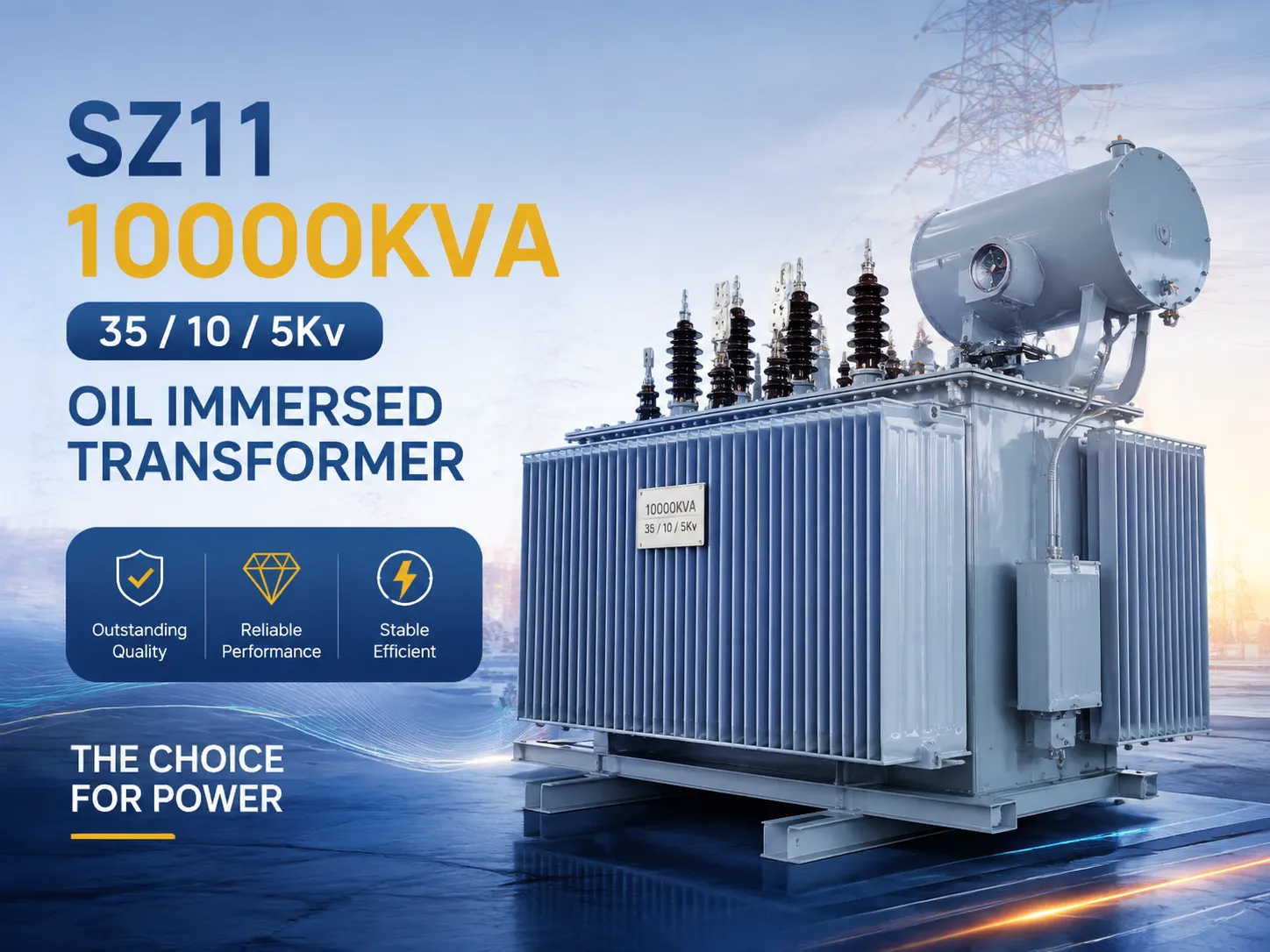
What Is the SZ11-10000kVA Transformer?
The SZ11-10000kVA 35/10.5kV transformer is a 10 MVA transformer of power which is designed according to SZ11 series from China and is tested as per IEC 60076. The alphabet “Z” in SZ11 identifies it as a transformer with on-load tap changer and the number “11” represents the modernized series in GB/T 6451. A 10 MVA rated transformer can serve the needs of medium industrial plant, hospital facility in a single plant, port goods handling terminal and municipality and is a popular choice when it comes to making orders in 35kV transformers.
The SZ11-10000 transformer is different from S11-10000 transformer in that it is equipped with a tap changer. Such a feature allows using on-tap regulation of the transformer, which helps it to adjust the ratio in the process of its operation. The significance of such an attribute is obvious because, for those consuming large power amounts, even a brief voltage drop can cause damage to their equipment. An occurrence of a motor starting somewhere or a fault in conductors may drop the busbar voltage by 5-8% in a matter of seconds directly affecting the output of the transformer.
The primary voltage of 35 kV is another distinguishing feature of this transformer. Many customers decide to use this transformer due to a need of switching to 35 kV transformers after they got acquainted with 11 kV or 20 kV transformers and also due to the fact that their transmission lines operate at that voltage level. The weight of this transformer can be about 22-28 metric tons, which allows achieving easy logistics and installation.
What “Outstanding Quality” Means in Practice
Quality in a transformer cannot be considered to be a single aspect. Rather, it is an assemblage of decisions that can be traced in the end product and in the test certificate. Some exceptionally important signs of good quality for a 10MVA transformer would include the following.
- Grade of steel used for the core and the methodology for stacking the steel. High-quality CRGO steel of grades of around 27ZH100-30ZH120 with step-lap joints would be expected to be used. Its use will define the no-load loss as well as the level of noise that will be produced. In a good workshop, the actual values will be in line with the design features without any extra margins introduced because of over dimensioning.
- Copper verses aluminum for windings. First, let it be understood: copper is definitely more expensive, but it will definitely save you on load losses in addition to increasing short-circuit withstand. The majority of SZ11-10000 transformers are expected to have copper windings. In order to be sure, it makes sense to ask for written confirmation.
- Quality of insulation. It should involve paper wrapping, oil-impregnated pressboard barriers and moisture content control. It should be mentioned that moisture is detrimental for insulation as every doubling of water in paper cuts the insulation lifetime for almost a half.
- Vacuum drying and oil filling. The proper procedure to carry out the vacuum drying process must be followed in order to eliminate moisture from the transformer before the oil filling. Unfortunately, buyers find it very hard to control the quality of this stage of production.
- Full set of accessories. Buchholz relay, pressure relief device, oil and winding temperature indicators, oil level gauge, and silica-gel breather are all needed by a transformer for its normal operation. Being points that can potentially fail, all the mentioned accessories must be provided by quality manufacturers.
Quality manifests itself in consistency too. The one proof of this would be the effective implementation of quality management systems, such as ISO 9001, and ability to provide records of tests performed in relations to shipped units.
Core Design and Key Components
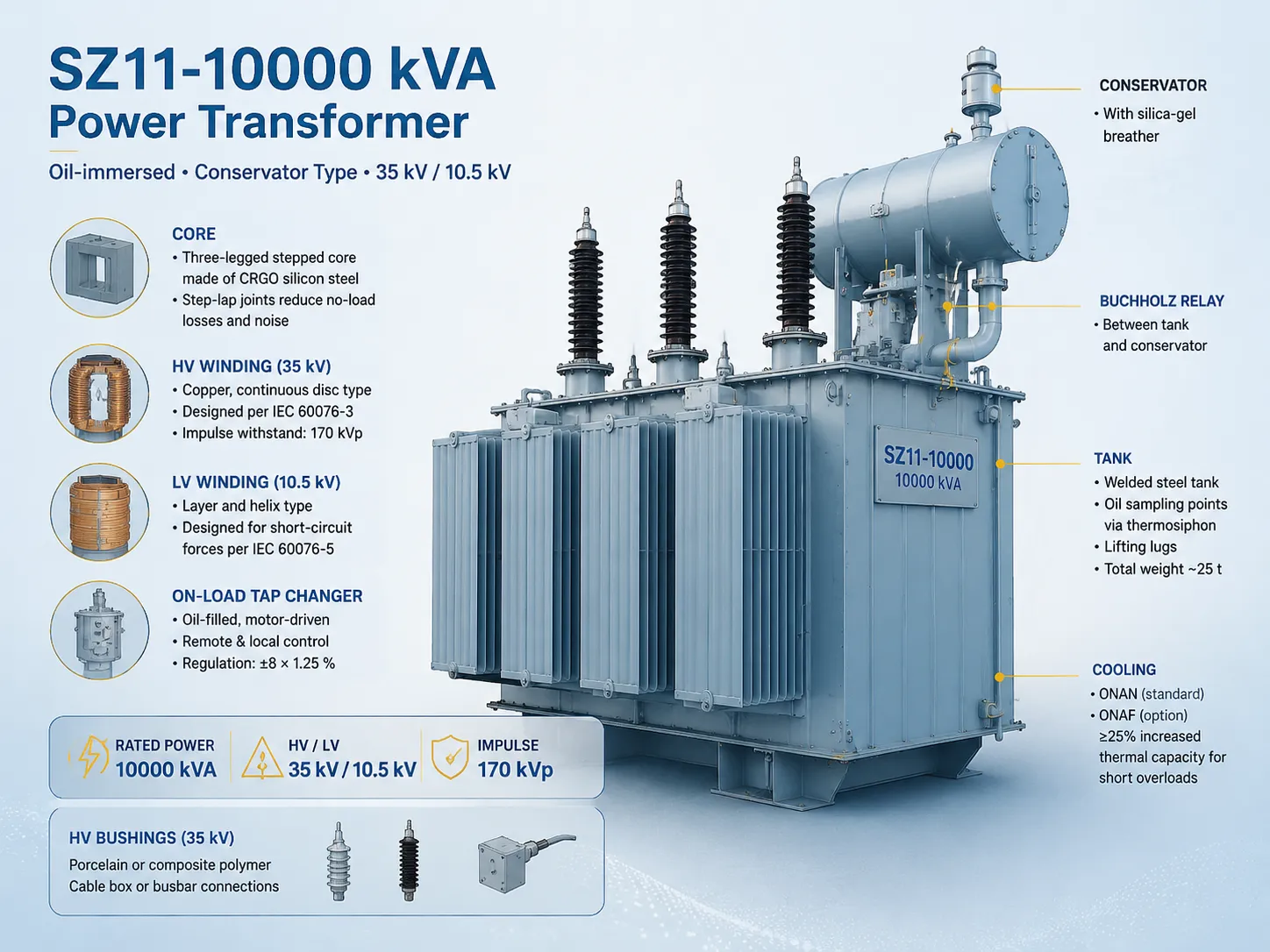
An SZ11-10000 kVA transformer is an oil-immersed conservator-type transformer featuring:
- Core: consists of a three-legged stepped core made of CRGO silicon steel. The joints between each core are done step-lap which helps limit the no-load losses as well as noise.
HV Windings: consist of 35 kv windings in copper made up of continuous disc types. It is built according to the acceptable impulse level and switching surge level according to IEC 60076-3 standards. The impulse withstand should be at 170 kvp for the high voltage side. - LV Windings: consist of layer and helix type winding for 10.5 kv. The size of the windings is done based on the short-circuit forces mentioned in the IEC 60076-5 standard.
- On-load tap changer: an oil-filled motor-driven regulator placed on the high-voltage side with the capacity for both remote and local control. The regulation normally does not exceed ±8 × 1.25 %.
- Tank and conservator: the tank is made of welded steel and contains conservators made with silica-gel breathers, oil sampling points by using thermosiphon, and lifting lugs designed for a total weight of ~25t.
- Cooling: ONAN as basic; ONAF can be utilized as the option of increasing thermald capacity by at least 25% for short overloads.
The high-voltage 35 kv bushings can be used either in porcelain or composite polymer and can be either cable box or busbar connections. The Buchholz Relay is located between tank and conservator, and it is the primary protection system against internal faults.
Technical Specifications at a Glance
| Parameter | Typical Value | Reference |
|---|---|---|
| Rated power | 10,000 kVA | Continuous rating |
| Voltage ratio | 35 ± 8 × 1.25% / 10.5 kV | IEC 60076-1 tapping rules |
| Frequency | 50 Hz (60 Hz option) | — |
| Vector group | YNd11 | Common 35/10.5kV arrangement |
| Impedance | 7.5–8% | IEC 60076-5 |
| No-load loss | 8–12 kW | GB/T 6451 S11 level |
| Load loss | 45–55 kW | At 75°C |
| No-load current | 0.6–0.9% | — |
| HV impulse withstand | 170 kVp | IEC 60076-3, LI |
| Temperature rise | 65K average winding | 40°C ambient |
| Cooling method | ONAN / ONAF | IEC 60076-2 |
| Total weight | ~22–28 metric tons | Including oil |
| Design standards | IEC 60076 series, GB/T 6451 | Also GB 20052 efficiency |
Losses in monetary terms can be quantified: a transformer of a 10 MVA rating, having no-load loss of 10 kW and load loss of 50 kW, and working for about 8,000 hours with an average load factor of 60%, will lose, in total, around 290 MWh in a year. The costs associated with these copper losses at a rate of $0.08 per kWh are equal to roughly $23,000 a year — which at the same time means that with the difference of 10% in the level of losses between two alternative bids, the expenditure will amount to almost $2,300 annually or more than $50,000 in 25 years. Loss capitalization should be always involved in discussions.
| Loss class | No-load loss (P0) | Load loss (Pk) | Relative first cost |
|---|---|---|---|
| S9 (legacy) | ~14 kW | ~58 kW | Baseline |
| S11 | ~10 kW | ~50 kW | +10–15% |
| S13 | ~8 kW | ~48 kW | +20–30% |
| Amorphous (SBH15) | ~4 kW | ~48 kW | +35–55% |
At the rate of $0.08 for every kWh consumed, each kW of loss when the machine is not under load generates a profit of $700 a year in its continuous usage, meaning the difference between S9 and S11 is worth about $2,800 a year.
SZ11-10000 vs. Fixed-Ratio and Dry-Type Units
| Option | Voltage regulation | Loss profile | Maintenance | Typical price (FOB) |
|---|---|---|---|---|
| S11-10000, off-circuit taps | None during operation | Same as SZ11 | Simple | $22,000–$38,000 |
| SZ11-10000, on-load | Continuous ±8 × 1.25% | Same as S11 | OLTC oil/contacts | $28,000–$48,000 |
| S13-10000, off-circuit | None during operation | ~20% lower no-load loss | Simple | $26,000–$44,000 |
| Dry-type 10MVA (rare) | Depends | Higher load loss typical | Low | $60,000–$100,000 |
| Amorphous core 10MVA | Off-circuit typically | ~60–70% lower no-load loss | Simple | $38,000–$65,000 |
While dry-type transformers are a good option indoors in cases where flammable liquids are banned, with ratings of 10 MVA and 35 kV, they become large, costly, and inefficient during operation. For a substation that is located outdoors and is properly contained, oil-filled units are the normal choice. The main choice to be made is whether to go for fixed-ratio or variable-ratio transformers: if the utility supply is stable (the voltage does not change more than ±2.5%) and the load is steady, it would be more cost-effective to buy S11 or S13 transformers. If one is operating in an environment with weak grids or with varying load patterns, then SZ11’s regulating properties will make the difference between uninterrupted production and constant breakdowns.
Who Uses a 10MVA Transformer
- Mining and processing plants: Crushers, mills, and flotation circuits work under heavy and fluctuating loads. The SZ11, rated at 10 MVA, keeps the bus voltage stable.
- Food and beverage industry: Freezing and packaging lines are sensitive to voltage changes, hence any undervoltage would be costly.
- Ports and terminals: Gantry cranes and refrigerated containers lead to sudden changes in the load.
- Hospitals and educational institutions: Backup switching and high-reliability loads are well provided before starting generators.
- Municipal water and waste treatment: Pump stations with large motors both generate and suffer from voltage dips.
- Renewable microgrids: Energy storage with solar generation, which is dynamic, requires regulating voltage characteristics at the coupling point.
In all the above cases, the transformer is usually the single most expensive piece of equipment installed in the electrical system and is expected to last more than 25 years with normal maintenance. That is why the choice of specifications, the level of losses, and the manufacturer should be taken seriously and be given more attention than any switches on the same project.
Brand Landscape and Price Ranges
| Brand | Origin | Typical price (USD, FOB) | Positioning |
|---|---|---|---|
| ABB | Switzerland/Global | $52,000–$78,000 | Premium engineering and service |
| Siemens Energy | Germany/Global | $50,000–$75,000 | Utility-grade reliability |
| Hitachi Energy | Japan/Global | $55,000–$82,000 | High-spec, longer lead times |
| Schneider Electric | France/Global | $48,000–$72,000 | Broad distribution portfolio |
| Toshiba / Hyundai | Japan/Korea | $46,000–$68,000 | Industrial-grade build quality |
| Jiangsu Subian Electric Power | China | $28,000–$48,000 | IEC-certified, export-focused value |
European and Japanese manufacturers excel in every aspect including engineering sophistication, after-sales service, and long-term proven reliability. In light of the prices commanded in these countries, many organizations view the additional costs (sometimes up to 60% higher) as the necessary expense to procure other equipment from abroad. This difference in performance is decreasing as the CRGO steel and testing equipment are used by the factories located in China.
One such company is Jiangsu Subian Electric Power, a Chinese transformer manufacturer. Its SZ11-10000kVA 35/10.5kV transformers are built according to IEC 60076 standards and subjected to numerous tests including ratio, vector group, and impedance. Subian operates in Asia, Africa, the Middle East, and South America and is capable of fulfilling its promises of compliance with all deadlines and production quality standards.See subian-electric.com for the product catalog.
Selection Checklist for Power Users
- Size your unit based on actual demand, not installed load. Carry out either a load study or refer to historical peak values with a 15-20% additional margin in order to avoid the increased losses due to an oversized transformer, which will be inflation for the rest of its life.
- Establish the loss percentage considering the tariff. If power costs are high, pay for the efficiency at the outset – you will have your money back in 3-7 years.
- Make sure what is the tap range based on the voltage supply profile. Get in touch with the utility for a voltage log, and only after that fix either ±8 × 1.25% or a narrower range.
- Choose the brand of OLTC. MR or ABB OLTCs are the benchmarks, but a Chinese OLTC can save you considerably; in this case, check the operational results of the apparatus and availability of spare parts in your region.
- Indicate cooling truthfully. If you plan to run your unit above 100% on a regular basis, you should prefer ONAF cooling.
- Check site accessibility. Make sure to confirm both crane capacity and truck access for a unit of approximately 22-28 tons in weight and 3.5-4.5 m in length.
- Negotiate the extra parts and test report package. It is better to include Buchholz relay, breathers, gaskets, and whole factory acceptance testing in the contract.
Factory Quality Assurance and Testing
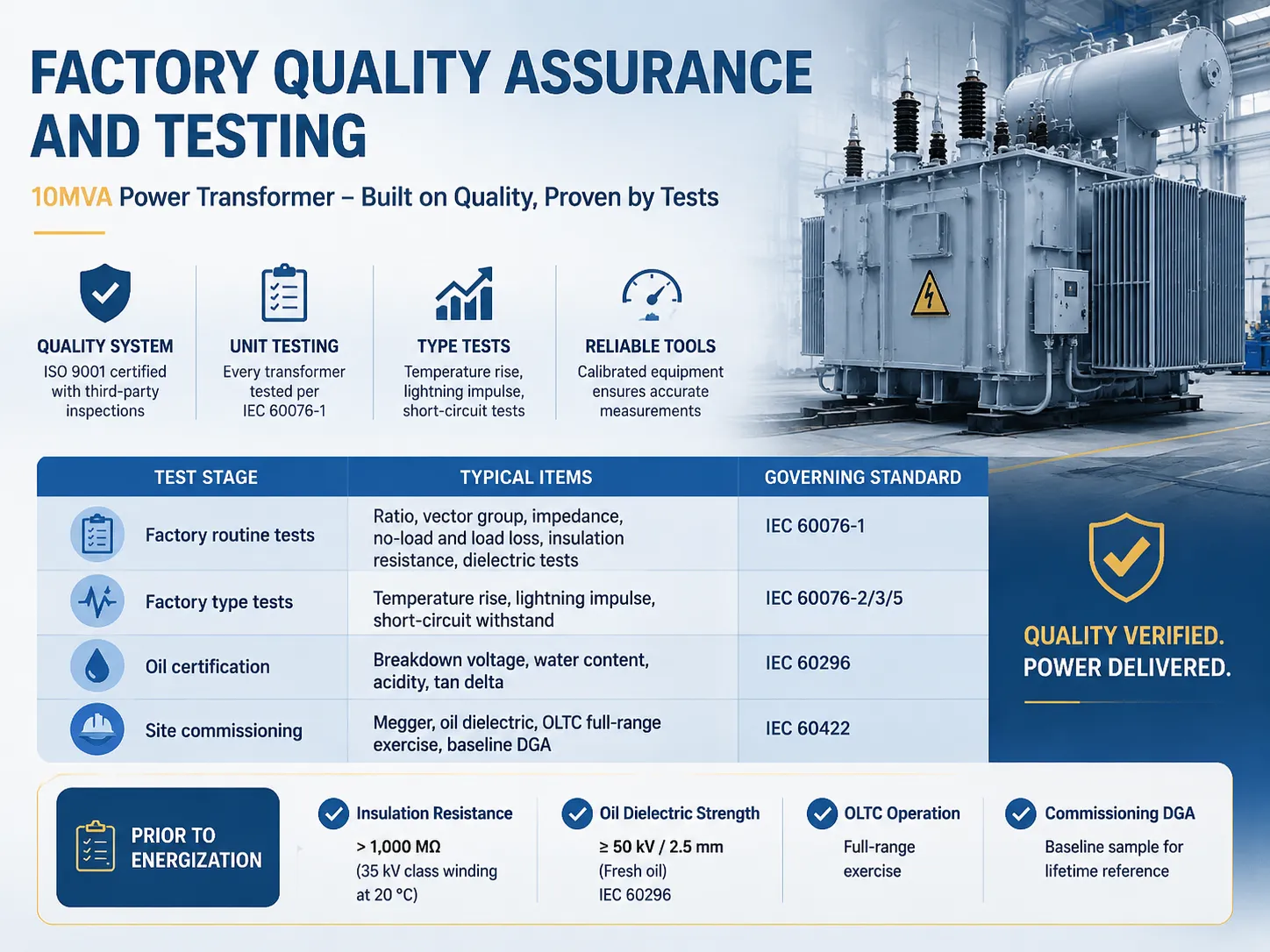
A top-notch 10MVA power transformer rolls out of a factory that is much more than just component manufacturing. Check for the following aspects:
- ISO 9001 quality system and third-party inspections required by the purchaser for export projects at major production milestones.
- Testing of each unit as per IEC 60076-1, namely, winding resistance, turns ratio, vector group, short-circuit impedance and power losses, and insulation resistance.
- Testing reports before the production of each transformer family, such as temperature rise tests, lightning impulse tests, and short-circuit tests performed on similar types of transformers.
- Measuring tools’ reliability.
Commissioning at the site means further quality check.
| Test stage | Typical items | Governing standard |
|---|---|---|
| Factory routine tests | Ratio, vector group, impedance, no-load and load loss, insulation resistance, dielectric tests | IEC 60076-1 |
| Factory type tests | Temperature rise, lightning impulse, short-circuit withstand | IEC 60076-2/3/5 |
| Oil certification | Breakdown voltage, water content, acidity, tan delta | IEC 60296 |
| Site commissioning | Megger, oil dielectric, OLTC full-range exercise, baseline DGA | IEC 60422 |
Prior to energization, the contractor must confirm insulation resistance (generally > 1,000 MΩ for 35 kV class winding at 20 °C), verify oil dielectric strength according to IEC 60296 (≥ 50 kV/2.5 mm for fresh oil), operate the OLTC over its entire range of motion, and take the commissioning DGA sample in order to have a reference for the unit’s lifetime.
Frequently Asked Questions
How much does a 10MVA 35/10.5kV transformer cost?
A feasible budget should range from $28,000 to $48,000 for the SZ11-10000 made in China and from $48,000 to $82,000 for the same equipment of European or Japanese brands, not including freight costs, insurance, installation costs, and civil costs. The loss level, brand of OLTC, accessories, and the copper prices contribute to variations in the price and should be quoted based on a written specification instead of the nominal rating.
Is an on-load tap changer worth the extra cost on a 10MVA unit?
In general, that is true, but only if your supply is not constant. The cost difference between a fixed ratio unit and its variable counterpart is approximately $6,000–$12,000; however, one undervoltage incident could lead to losses for the factory equal to many times that amount due to lost production. If everything is stable and you have a flat load, there is no need to go for this option and you should buy a standard unit instead.
What is the typical lifespan of this transformer?
If the 10 MVA oil-immersed transformer is well maintained, a life span of 25 to 35 years is possible. Insulation aging follows the Arrhenius principle regarding temperature — 6 degrees K above the temperature of the windings doubles or halves the insulation life. Therefore, observe the load conditions described in the guidelines of IEC 60076-7 and check on the oil quality by performing annual DGA tests.
Can a 50Hz unit be used on a 60Hz network?
A new design is necessary. Flux density is frequency dependent; supplying a design designed for 50Hz for a 60Hz application changes its magnetizing current and can lead to overexcitation issues. Ensure that proper frequency is specified correctly from the beginning in the documentation, as it greatly influences the design of a core and tap range verification.
How often should oil be tested?
The IEC 60422 standards dictate that yearly testing is needed for any facility working under normal operating circumstances. The yearly assessment should include DGA (dissolved gas analysis), dielectric strength tests, water content, acidity, and tan delta according to IEC 60599. If there are any marked changes in gas key ratios, begin monthly sampling until there is a clear trend.
References
- IEC 60076-1: Power transformers – General — Rating, temperature rise, and tapping requirements for all power transformers.
- IEC 60076-3: Insulation levels, dielectric tests and external clearances in air — Defines the 170 kVp impulse level for 35kV class windings.
- IEC 60076-5: Ability to withstand short circuit — Short-circuit design and testing requirements.
- IEC 60422: Mineral insulating oils in electrical equipment – Supervision and maintenance guidance — Oil testing and maintenance schedules.
- IEEE C57.104: Guide for the Interpretation of Gases Generated in Oil-Immersed Transformers — DGA interpretation reference.
- Siemens Energy transformers — Product family reference for large power transformers.
- Jiangsu Subian Electric Power official site — IEC-certified transformer manufacturer, product and certification information.
Conclusion
The SZ11-10000kVA 35/10.5kV oil-immersed transformer is a major financial success of every energy consumer; specifications made today will define operation costs and dependability for the next quarter of a century. On-load voltage regulation addresses actual voltage quality issues within fragile grid markets, while loss capitalization makes it possible to maintain proper economical return.
Main facts:
- Do budget $28,000–$48,000 FOB for a Chinese model; if getting a premium brand, budget even more.
- Compare bids for TCO with your specific tariff, not just initial price.
- Do ensure you have copper winding and the brand of OLTC secured in your contract, along with copper winding and core steel quality.
- Do from now on plan to conduct yearly oil testing and DGA.
If you are shortlisting suppliers for a 10MVA 35/10.5kV project, Jiangsu Subian Electric Power supplies IEC 60076-certified SZ11 units with competitive pricing and export experience. Browse the range and request factory test documentation at subian-electric.com.