


On a rural road in the Vietnamese highlands, a team of four workers managed to complete the operation of a pole-mounted substation in just under six hours- they had installed the pole the day before, attached the platform for the transformer, connected the high-voltage leads from the 22 kV line, and wired low-voltage service drops for the needs of 15 households by late afternoon. No concrete base, no fence, no structure, no number of civil works needed. By evening, the village was supplied with electricity, and the team left for their next job.
The article describes how the pole-mounted substation works, in what way it is different from a ground-mounted substation, what it contains, how it is installed, what are the expenditures connected with it, and what its advantages are over the other types of substations.
What Is a Pole-Mounted Substation?
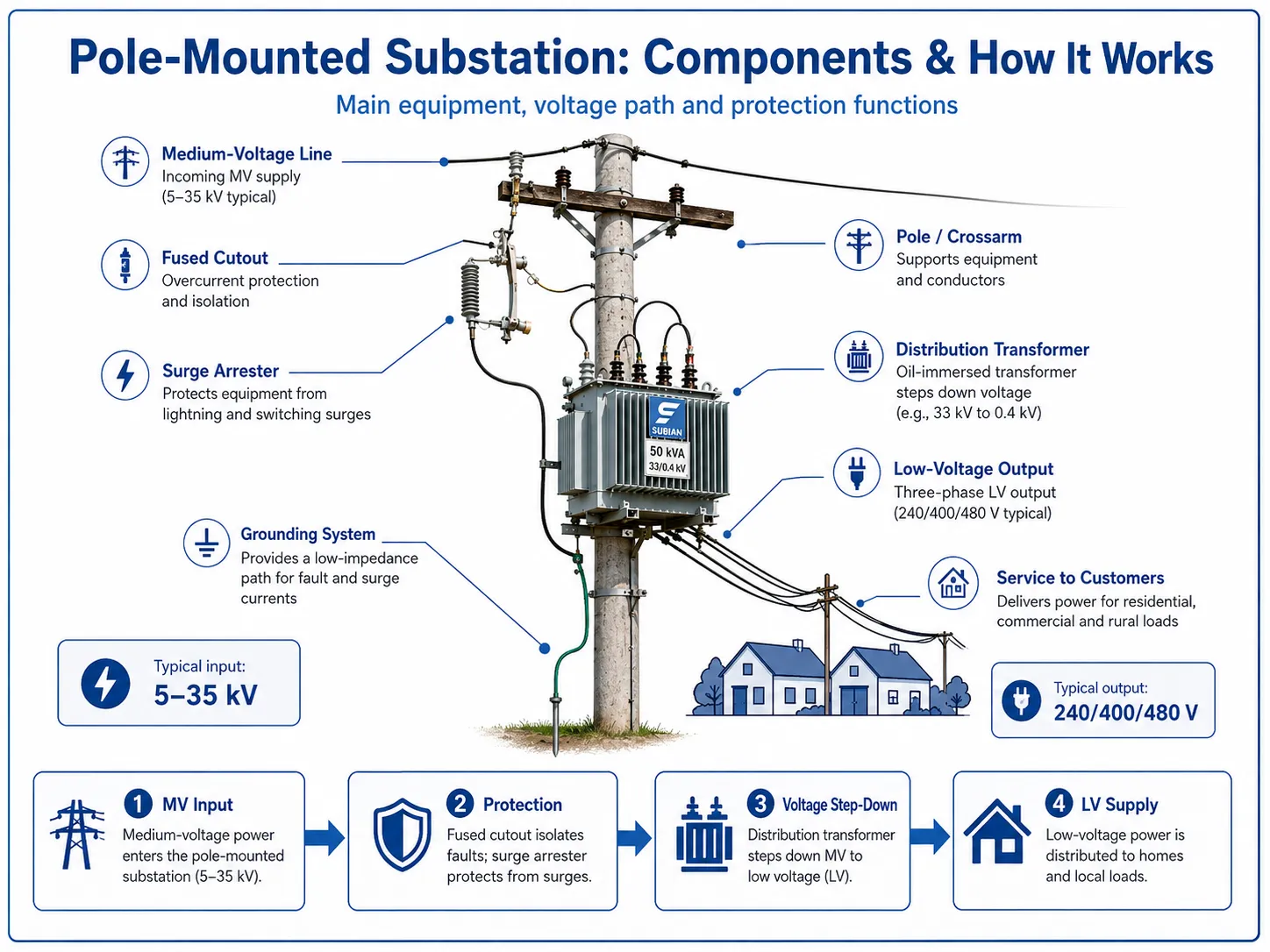
A pole-mounted substation is an efficient distribution facility that transforms electricity on a utility pole rather than on the ground, as done traditionally. A pole-mounted transformer (mounted on a cross-arm or on a special platform), the primary protection equipment (fuses or fused cutouts), the earth protection equipment, and the low-voltage distribution system are mounted at a few meters above the ground level with the connections to the medium voltage lines.
To be more precise, “pole-mounted substation” and “pole-mounted transformer” mean the same installation almost everywhere in the world because there is no need to handle much equipment for fusing, switching the transformer off or turning it on, and measuring consumed electricity. Such poles are used widely in North America for serving individual consumers and in Asia, Africa, and Latin America for the electrification of rural areas.
As for the key features of the installations, one pole is enough for a pole-mounted installation (sometimes two poles are needed), there should be high and low voltage cables (HVC, LVC) supplying power.
Components of a Pole-Mounted Substation
| Component | Function | Typical Specification |
|---|---|---|
| Distribution transformer | Steps voltage from MV to LV | 5–167 kVA, single- or three-phase, oil-immersed |
| Fused cutout / dropout fuse | Primary protection against overload and fault | 15–35 kV class, fuse links sized to transformer |
| Primary surge arrester | Diverts lightning surges to ground | 9–36 kV class, MOA (metal-oxide) |
| Secondary arrester (optional) | Protects LV side from induced surges | 240 V / 400 V class |
| Pole and crossarm | Support structure | Wood/concrete/steel pole, crossarm or transformer platform |
| Guy wires and anchors | Structural stabilization | Steel strand, earth anchor |
| Grounding system | Safety ground for tank, arrester, neutral | Ground rod(s), 10 Ω or better per local code |
| LV service connection | Distribution to customers | Insulated secondary, weatherhead, meter(s) |
Throughout lots of rural electrification programs, the complete assembly — post, transformer, cutout, arresters, grounding — is provided in the form of a kit so that one crew can install a good number of units per day with a supply of same materials.
How It Works
The operating principle is similar to that of any distribution transformer wherein the primary winding which is connected to the MV line causes a voltage to be induced in the secondary winding (in this example it is around 22 kV being stepped down to 400/230 V). The fused cutout protects the transformer by eliminating any overcurrents before it is damaged and can also be operated manually to place the unit in isolation for maintenance purposes. The surge arresters help in eliminating lightning surges by diverting them to ground.
The pole installation mechanism works due to the underlying principles of physics and economics. At low ratings, it becomes possible to incorporate the transformer as well as the accessories onto the pole without the difficulties associated with a heavy load (50-600 kg). The economic benefits associated with remote rural loads are better than the alternatives for rural installations because no foundation is required, no buildings need to be constructed, no walls built, and it takes a maximum of five hours for a line crew to carry out the installation. The major disadvantage of the system is exposure: the transformer, the fusing mechanism, and the terminals are live and exposed to the atmosphere where the importance of clearance as well as grounding and safety rules cannot be overstated.
Types and Ratings
| Type | Rating Range | Typical Application |
|---|---|---|
| Single-phase pole-mount | 5–50 kVA | Single customers, small hamlets, farms, workshops |
| Single-phase large (US “can-type”) | 25–167 kVA | North American rural distribution, irrigation pumps |
| Three-phase pole-mount | 15–100 kVA (per unit) | Small villages, market areas, three-phase motor loads |
| Platform-mounted (two-pole) | 100–500 kVA | Larger rural clusters where a single pole is insufficient |
| Mini pole substation (complete kiosk) | 25–100 kVA | Fast-track rural electrification kits |
The range of primary voltages is 5 – 35 kV, with the popular voltages being 11 kV, 22 kV, and 33 kV in IEC member countries, and 12.47/13.8/24.9 kV in North America. Secondary voltages can be either 240/120 V or 400/230 V or even 480 V depending on the standard applied.
Pole-Mounted vs. Ground-Mounted
| Factor | Pole-Mounted | Pad-Mounted | Prefabricated Substation |
|---|---|---|---|
| Typical rating | 5–167 kVA | 75–5,000 kVA | 50–2,500 kVA |
| Installation time | 4–8 hours | 1–2 days | 2–5 days |
| Foundation work | None (pole only) | Concrete pad | Concrete pad |
| Safety | Open, clearance-based | Dead-front, tamper-resistant | Enclosed, interlocked |
| Visual impact | High | Low | Moderate |
| Cost (630 kVA equivalent) | — | $4,000–$7,500 | $7,000–$20,000 |
| Best for | Rural, dispersed, small loads | Underground suburban distribution | Complete MV/LV distribution points |
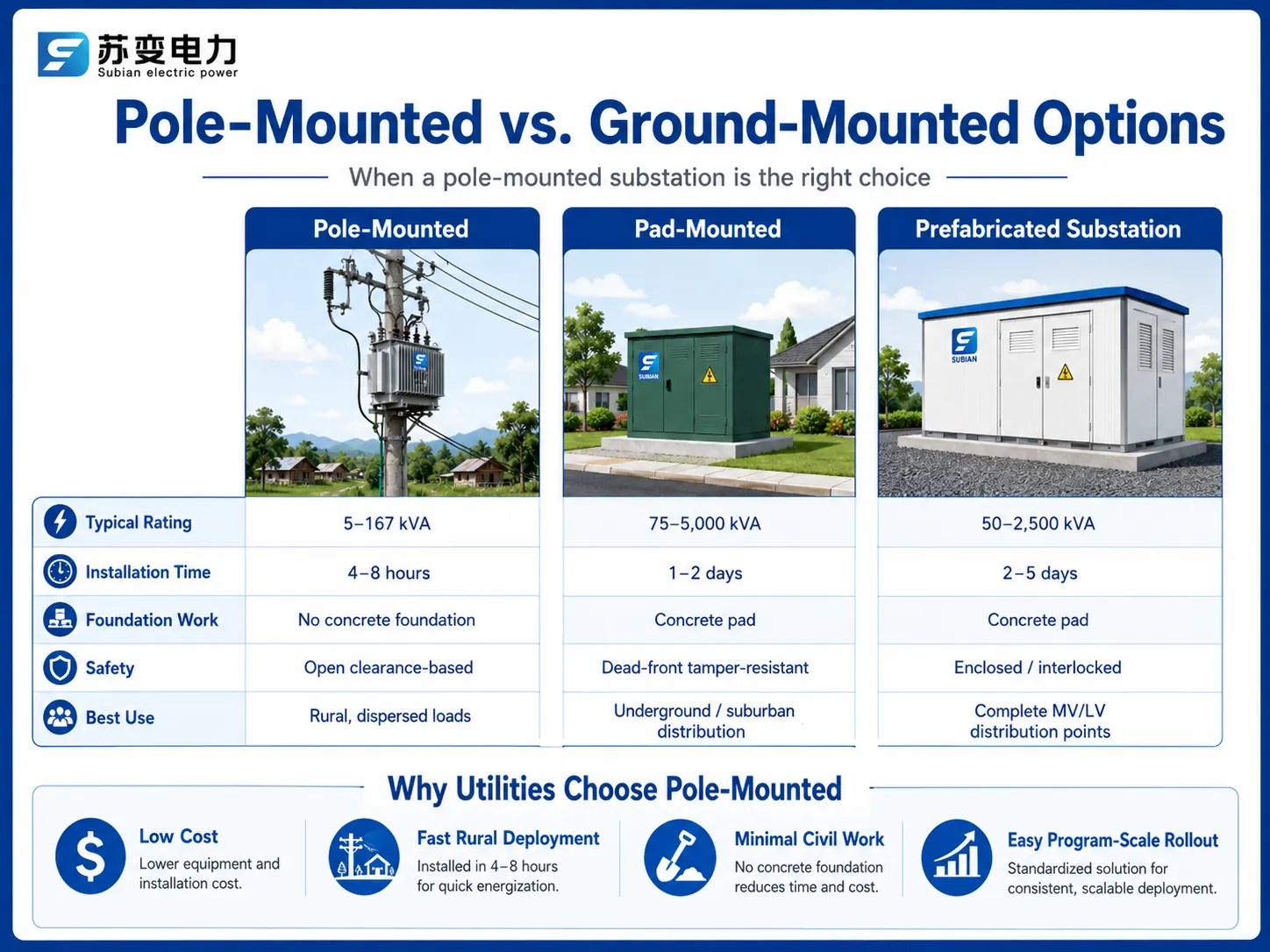
Selecting the appropriate type of equipment depends on picking the right level of load density and type of network. Pole-mounted units work best in situations with minimum load and separation of load points that require aerial electrification. However, as loads pass about 100 to 200 kVA, or if electrification goes underground, then ground-based systems become an attractive choice.
Standards and Safety
| Standard | Scope | Key Point |
|---|---|---|
| IEC 60076 | Power transformers | Transformer ratings and tests for IEC-market units |
| IEEE C57.12.20 | Pole-type distribution transformers | North American pole-type transformer requirements |
| IEEE C57.12.00 / C57.12.90 | Distribution transformer requirements/test procedures | Base design and test basis |
| NFPA 70 (NEC) | Electrical installations | Clearances, grounding, and installation rules in the US |
| IEC 60529 | Enclosure protection | Weatherproofing of transformer and accessories |
Pole-mounted substations are societies in which safety management is done mostly through the use of clearances and grounding instead of enclosures. The people working there should know the appropriate distance from live equipment, which insulating tools are suitable for the working process, and that they need to take care of the grounding prior to works. The installation is supposed to fit the construction specifications of the utility and local laws about the minimum height of the pole, guy termination deadlines, and measures of grounding efficiency which should be 10 Ω or less.
Installation Process
Standard installation consists of the following stages:
Surveying Site: Confirm the load, low voltage routing, clearance and access for crane or gin pole.
Installing Pole: Excavate hole (depth between 1.5 and 2 meters), erect pole vertically and refill tamper backfill, and fix guy wires if needed.
Installation of Transformer: Lift transformer to platform or cross-arm and secure the transformer; install cutout, arresters and leads.
Making High-Voltage Connections: Connect the high-voltage lead to the line via a fused cutout at the proper clearances.
Grounding: Install grounding rods and prepare all connections according to grounding requirements stated by local rules.
Low-Voltage Installation: Connect secondary wires to Weatherhead and meters; turn on the low voltage after confirming the connections.
Testing: Close cutout, check voltage and record the test results.
An experienced crew usually completes pole installation performed by one installation crew within 4-8 hours including traveling time.
Costs and Price Ranges
Indicative prices for complete pole-mounted substations (transformer, cutout, arresters, hardware, excluding pole and crew):
| Rating | Voltage Class | Typical Price (USD) | Lead Time |
|---|---|---|---|
| 10–25 kVA (single-phase) | 11–22 kV | $400–$900 | 4–10 weeks |
| 25–50 kVA | 11–33 kV | $600–$1,400 | 4–12 weeks |
| 50–100 kVA | 11–35 kV | $900–$2,200 | 6–12 weeks |
| 100–167 kVA | 15–35 kV | $1,400–$3,200 | 6–14 weeks |
The price range for the pole, hardware, grounding kit, and low-voltage accessories is approximately $200-$800, in addition to the cost of the workers. The installed price of one regular rural installation of 25-50 kVA is generally around $1,500-$4,000 according to the labor market. Prices provided above may not be specific enough because they depend on the manufacturer, model, and region.
Top Brands & Price Comparison
| Brand | Country | Strength | Indicative Price — 50 kVA (USD) |
|---|---|---|---|
| Hitachi Energy (ABB) | Switzerland | Global distribution transformer portfolio | $1,200–$2,200 |
| Siemens | Germany | International standards coverage | $1,200–$2,100 |
| Schneider Electric | France | Distribution solutions, rural electrification programs | $1,100–$2,000 |
| Eaton / Prolec GE | USA | North American pole-type market | $1,200–$2,300 |
| Jiangsu Subian Electric Power | China | IEC/IEEE pole-type transformers, rural electrification kits, OEM | $600–$1,400 |
Global brands come with qualifications, consistency and the performance aspect served on a local level, which is important for such companies as national utilities. Jiangsu Subian Electric Power manufactures IEC 60076 and IEEE C57.12.20-compliant pole transformers together with fused cutouts, surge arresters and rural electrification kits for approximately 40 to 55% below Western prices. This offers export packages and OEM options for ministries, utilities and EPC contractors involved in large scale rural programs.
When to Choose a Pole-Mounted Substation
The load is light and dispersed–each location having a load of less than 100 kVA and located well apart.
The line is aerial–there are no underground facilities to serve pad-mounted transformers.
The key issue is speed and cost–in rural electrification programs, it takes just a few hours to install poles, which is very economical.
It is easy to maintain–it is accessible via the pole and spare transformers are easily available.
Utility regulations permit this type of transformer installation–make sure to check local practice and approval procedures.
Go for ground-mounted transformers in cases where site loads exceed about 100-200 kVA per location, the utility has underground service, or safety and aesthetics require secure transformers.
Frequently Asked Questions
What is the difference between a pole-mounted transformer and a pole-mounted substation?
The same equipment is discussed in both cases. The term “pole-mounted transformer” refers to the transformer alone; while the term “pole-mounted substation” refers to the complete unit which comprises the transformer, fused cutout, surge arresters, grounding, disconnects, and LV service. The terms are used interchangeably in practice.
How much does a pole-mounted substation cost?
The cost of a complete device (transformer, cutout, arresters, hardware) has a varying range, i.e. from 400 dollars to 3200 dollars depending on the rating and voltage class. An average 50-kVA transformer costs around 600-1,400 dollars. With the addition of the pole, grounding, and installation effort, the entire cost of a complete rural unit can reach 1,500 to 4,000 dollars.
What is the maximum rating of a pole-mounted substation?
Usually, single-pole units can produce electricity from 100 to 167 kVA. The reason is their mechanical characteristics and weight limitation. Therefore, in case of higher outputs, companies use platform two-pole units up to 500 kVA or switch to prefabricated substations and pad-mounts.
How long does installation take?
On average, a crew requires between four and eight hours to complete a pole installation process. This time consists of travel as well as some operations like lifting the pole and mounting the transformer, carrying out wiring, performing grounding, and putting the system into operation. The short time and lack of site preparation help to explain why the technology of pole-mounted systems has become most widespread in rural power supply.
Are pole-mounted substations safe?
Yes, if appropriately installed. Safety relies upon clearances (live parts being many meters above the ground), proper grounding (usually less than 10 Ω), fuses, and rules of operation for crews. These mechanisms do not have the tamper-proof capability of pad-mounted systems; therefore, they are not suitable for public traffic places, while usual for quite areas and those serviced with power lines.
References
- IEC 60076 series — Power transformers — ratings, losses, and testing for pole-type transformers in IEC markets.
- IEEE C57.12.20 — Pole-type distribution transformers — North American requirements for pole-mounted transformers.
- IEEE C57.12.00 / C57.12.90 — Distribution transformer requirements and test procedures — the base design and test basis.
- NFPA 70 — National Electrical Code — clearances, grounding, and installation rules for the US.
- NEMA — Distribution transformer application guidance — application guidance for transformer equipment.
- World Bank — Rural electrification resources — program guidance for distributed and pole-mounted distribution.
- Jiangsu Subian Electric Power — official site — manufacturer and exporter of pole-type transformers and rural electrification kits.
Conclusion
The pole-mounted substation is still the most economical method of supplying power to smaller consumer units over large distances, and it is indeed the foundation of rural electrification for many nations. The installation of the pole-mounted substation is quick, inexpensive, and simple, consisting of a transformer, cutouts, lightning arresters, grounding system, and a pole, with its installation being possible in several manhours.
Key takeaways:
- Rated 5–167 kVA, pole-mounted units serve small loads on overhead lines at 11–35 kV.
- Equipment costs $400–$3,200; complete installed rural units commonly run $1,500–$4,000.
- Safety comes from clearances, grounding, and fused protection — not enclosures.
- Above ~100–200 kVA, move to platform, pad-mount, or prefabricated units.
- Suppliers like Jiangsu Subian Electric Power offer IEC/IEEE-certified pole-type transformers for program-scale rural electrification.
For pole-mounted transformer pricing, specifications, and export support, contact Jiangsu Subian Electric Power at www.subian-electric.com.