


واحدة من المرافق في الجزء الشمالي من فيتنام في عملية تغيير محول المحطة الفرعية القديم، الذي يبلغ من العمر 25 عامًا وله سعة 25 MVA. هذه هي المرة الخامسة في عام واحد التي يتم فيها رفع إنذار بسبب الغازات المذابة، ويستعد مشغل الشبكة لتقديم شكاوى بشأن مستويات الجهد المنخفض. بالإضافة إلى ذلك، تم تعديل الميزانية للاستبدال مرتين بالفعل. كل مهندس في الفريق يعرف نفس الشيء: اختيار المحول المناسب للمحطة الفرعية ليس مجرد إجراء ورقي، بل هو القرار الذي يحدد ما إذا كانت منطقتهم ستفقد الطاقة في موسم الأعاصير القادم.
توضح هذه المنشورة أهمية اختيار المحول المناسب لمحطة فرعية وكيفية اتخاذ القرار الصحيح. تحلل القضايا المرتبطة باختيار المحولات السيئة من المنظورين الفني والاقتصادي، مؤشرات المحول المناسب، الفروق بين أنواع المحطات الفرعية وأسعار المحولات، بالإضافة إلى عملية الشراء التي تمر بها شركات الكهرباء والمطورون للعثور على المحول المناسب. معلومات حول نظرية المحولات التي ستساعد في اتخاذ القرار الصحيح. 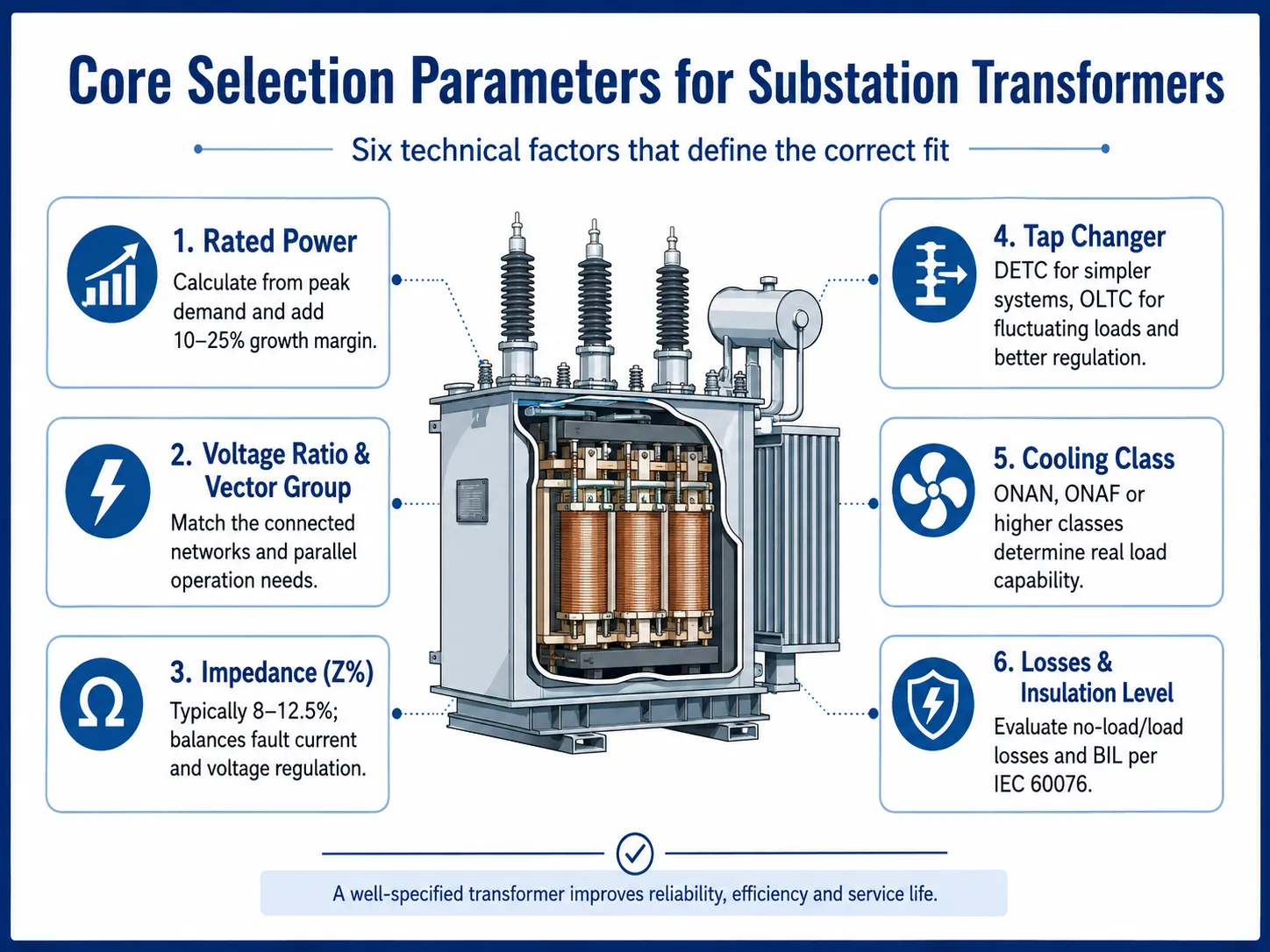
لماذا يعتبر محول المحطة الفرعية هو الأصل الحرج
على الرغم من أن المحطة الفرعية النموذجية تتكون من قواطع، وفواصل، ومرحلات حماية، وأجهزة قياس، وشرائط ناقلة، فإن الغرض الرئيسي من المحطة الفرعية يتحقق من خلال المحول. يوفر التحويل الضروري للجهد لربط شبكتين وعادة ما يكون العنصر الأكثر تكلفة في فاتورة المواد، حيث يمثل حوالي 20-40 في المئة من التكلفة الإجمالية للمعدات. تم تصميم هذه المعدات وتصنيعها حسب الطلب، لذا فإن تصنيعها يستغرق حوالي 3-9 أشهر، مما يجعلها المحدد لجدول البناء العام.
تشغيل المحول مهم بنفس القدر. يجب أن يدعم الحمل الكامل للمحطة الفرعية مع خسائر تجعل من الممكن تقليل تكاليف التشغيل، وضمان جهد مستقر ضمن الحدود التي تحددها مدونة الشبكة، وتحمل جميع تيارات العطل في النظام. عندما يقول المهندسون إن جودة المحطة الفرعية تعتمد على المحول، فإنهم يقصدون ذلك بجدية، حيث تعتمد كل إمكانية لزيادة موثوقية الشبكة بسبب استخدام أجهزة مختلفة، بدءًا من القواطع التلقائية وانتهاءً بالعدادات الذكية، على المحول فقط.
التكلفة الحقيقية لاختيار المحول الخاطئ
عندما يتم اختيار محول محطة فرعية بشكل غير صحيح، فإنه يتسبب في تكاليف في ثلاث مراحل. للبدء، في وقت التشغيل، يمكن أن يسخن المحول الذي يكون صغيرًا جدًا في الصيف ويتسبب في انقطاع الجهاز الحامي، مما يؤدي إلى الشراء الفوري لمحول طوارئ. على مدار عمره، يتسبب في تكلفة تشغيل محول يعاني من خسائر أعلى ويتطلب كهرباء إضافية تكلف شركات المرافق anywhere from $10,000 إلى $60,000 في شكل فقدان الكهرباء. علاوة على ذلك، خلال عطل، وفقًا للدراسات المقدمة من IEEE وCIGRÉ، فإن معدلات الفشل السنوية تصل إلى 0.5%–2% لمحوّلات التوزيع وأقل من ذلك لمحوّلات الطاقة الأكبر، بينما تتراوح تكلفة الانقطاعات من $50,000 إلى $2 مليون اعتمادًا على الوقت الذي يفشل فيه المحول وكمية الطاقة التي يتم تصنيفه لها.
تكلفة إضافية مرتبطة بالاختيار الخاطئ هي تكلفة السعة المخفية. في معظم الحالات، تصمم شركات الطاقة المحطات الفرعية لأفق زمني يتراوح بين 20-30 عامًا وتفترض زيادة سنوية في الحمل تتراوح بين 2%–5% في الشبكات الكهربائية الجديدة. يصبح المحول المصمم مع وضع الحمل الحالي في الاعتبار عنق زجاجة يتطلب استثمارات إضافية من أجل استخدام المحول بالكامل، في هذه الحالة على الأقل ضعف نفقات الشحنة الأولى، حيث يتطلب أيضًا استبدال مخطط القضبان الأساسية وأساس المحطة الفرعية.
معايير اختيار النواة لمحوّلات المحطات الفرعية
يبدأ اختيار المحول بنفس مجموعة المعايير. يجب عليك المرور بالعناصر التالية قبل أن تطلب عروض الأسعار:
القدرة المقدرة (kVA/MVA). يمكن حسابها بناءً على الطلب الذروي للمنطقة، بما في ذلك هامش 10–25%. عادةً ما تتطلب محطة فرعية 33/11 kV لـ 8,000 عميل محولًا بحوالي 10–20 MVA؛ قد تتطلب محطة نقل 100–300 MVA.
نسبة الجهد ومجموعة الاتجاه. يجب أن تكون مستويات الجهد الأولية والثانوية واتجاه التحول، أي ما إذا كانت Dyn11 أو YNd1، مناسبة للشبكات التي سيتم توصيلها.
المقاومة. بشكل عام، تساوي مقاومات المحولات 8–12.5%. تسمح المقاومة بالتحكم في تيار القصر وانخفاض الجهد؛ إذا كانت صغيرة جدًا، فقد تؤدي إلى تلف أجهزة التبديل؛ إذا كانت كبيرة جدًا، فقد تؤدي إلى تنظيم جهد ضعيف.
محول التغيير. عادةً ما تتطلب المحطات الفرعية للتوزيع استخدام نقاط تغيير خارج الدائرة حوالي ±2×2.5%، بينما تستهلك المحطات الفرعية للنقل عادةً محول تغيير الحمل (-8×1.25% أو ±9×1.78% وفقًا لـ IEC 60214)
فئة التبريد. ONAN للتصنيف السفلي، ONAF لزيادة السعة بنسبة 20–33% مع المراوح، ODAF/OFAF للوحدات الأكبر.
مستوى العزل (BIL). يجب أن يتناسب مستوى العزل مع التعرض المتوقع للصواعق وكذلك مع جهد النظام. على سبيل المثال، قد يتطلب المحول 33 kV مستوى عزل (BIL) حوالي 170–200 kV وفقًا لـ IEC 60076-3.
الخسائر. عادةً ما يتم حسابها من حيث خسائر عدم الحمل وخسائر الحمل.
أنواع المحولات الفرعية وتكويناتها
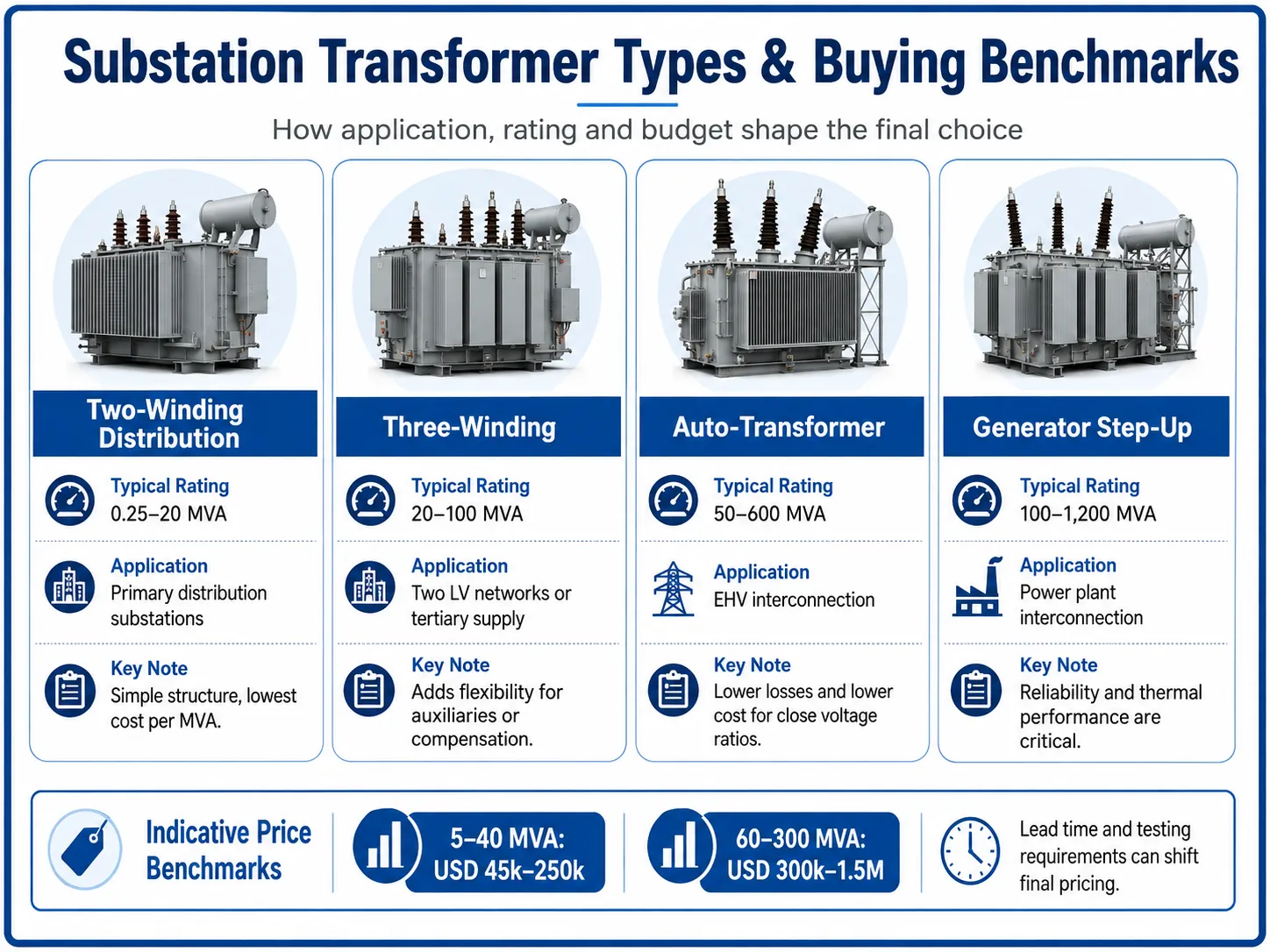
تأتي المحولات الفرعية بتكوينات تتناسب مع وظيفة الشبكة. الجدول أدناه يقارن الأنواع الرئيسية التي سيواجهها المشترون:
| النوع | التقييم النموذجي | التطبيق | ميزة مميزة |
|---|---|---|---|
| محول توزيع ذو ملفين | 25–20 MVA | المحطات الفرعية للتوزيع الأولي | بسيطة، أقل تكلفة لكل MVA |
| محول ذو ثلاثة ملفات | 20–100 م.ف.أ | تزويد شبكتين منخفضتي الجهد أو شبكة ثالثة | الملف الثالث للمساعدات/التعويض |
| محول أوتوماتيكي | 50–600 م.ف.أ | الربط بين شبكات الجهد العالي جداً (مثل 220/110 kV) | ملف واحد، خسائر وتكاليف أقل |
| محول تغيير الطور | مخصص | التحكم في التدفق في الشبكات المتشابكة | يتحكم OLTC في تدفق الطاقة النشطة |
| محول رفع الجهد للمولد | 100–1,200 MVA | الربط بين محطات الطاقة | أعلى موثوقية، غالباً ما يكون متصلًا على شكل دلتا مع جهد منخفض |
| محول التأريض (المحايد) | حتى 2 MVA | توفير محايد لشبكات الجهد المنخفض | لف زجزاج، واجب قصير المدة |
عادةً، يختار المشترون شراء إما محول ذو ملفين يحتوي على OLTC أو محول توزيع بسيط يحتوي على نقاط سحب خارج الدائرة. إذا كانت تقلبات الجهد في نظامك تساوي أو تتجاوز ±5 في المئة أو إذا كنت ستواجه تقلبات كبيرة في الحمل بين القمم والوديان، يجب أن تفكر في اختيار OLTC، الذي يكلف 20–40 في المئة أكثر من محول ثابت ذو نقاط سحب بنفس التصنيف.
قم بمطابقة التكوين مع تطبيقك الفعلي:
| التطبيق | التكوين الموصى به | التقييم النموذجي | المحرك الرئيسي للاختيار |
|---|---|---|---|
| التوزيع الريفي | ذو ملفين، ONAN، DETC | 5–5 MVA | أقل تكلفة أولى |
| التوزيع الحضري | ذو ملفين، ONAN/ONAF، OLTC | 10–40 م.ف.أ | تنظيم الجهد |
| Transmission interconnection | محول أوتوماتيكي | 50–300 MVA | Low losses at EHV |
| Renewable plant step-up | Two-winding, OLTC | 10–60 MVA | Variable generation profile |
| الربط بين محطات الطاقة | رفع جهد المولد | 100–1,200 MVA | Reliability above all |
Cooling Systems and Load Capability
The loading of substation transformers is determined by the cooling system in place, and the way the cooling system is designed determines the extent to which the rated capacity can be utilized. According to the cooling classes outlined in IEC 60076-2, O stands for mineral oil, N stands for natural convection, A for air, F represents forced and W denotes water.
| فئة التبريد | آلية | Typical Capacity Multiplier vs ONAN | When Used |
|---|---|---|---|
| أونان | Natural oil, natural air | 1.0 (base) | Most distribution substation transformers |
| أوناف | Natural oil, forced air (fans) | 1.2–1.33 | Peak-load substations with summer demand |
| أوفاف | Forced oil, forced air | 1.4–1.6 | Large power transformers with OLTC |
| ODAF / ODWF | Directed oil flow, air/water | 1.6–2.0 | Very large units, power plants |
The practical effect is that a transformer that has a capacity of 20 MVA and is rated ONAN/ONAF 20/27 MVA is capable of carrying loads of 27 MVA when fans are operational, but fan service requires additional maintenance and causes noise. Coupling the loading guidelines from IEC 60076-7 with this rating will allow for better planning of cyclic and emergency loading, so that there is no dependence on fans when it comes to base loads. Furthermore, the allowable temperature rise limits (65 K for oil and 78 K for OA class windings) must be checked against the ambient temperatures of the site to ensure that suitable margins are allowed.
Tap Changers and Voltage Regulation
The primary function of a transformer in a substation is voltage regulation. There are two types of technologies available and one must make the right choice, since tap changers have been identified as the main cause for transformer malfunctions in five years of operation.
Off-circuit tap changer (DETC): manually operated taps, typically ±2×2.5 percent or ±5×1.6 percent that can be operated only if the transformer is switched off. Low price, reliability and appropriateness where the line voltage remains stable.
On-load tap changer (OLTC): automatic taps, typically ±8×1.25 percent or ±9×1.78 percent per IEC 60214, that can be operated while the transformer is energized. Although it raises the price of the transformer by about 8 to 15 percent and requires oil maintenance, it is able to keep transformer output voltage regulated at ±2 to 3 percent under the changing load.
A good rule of thumb is to use OLTC if the line voltage changes more than 5 percent over a day or in case of variable industrial load served by the substation. OLTC maintenance involves oil filtration every 3–6 years, contacts inspection and actuator testing, so make sure to include it in your O&M plan.
Losses, Efficiency, and Life-Cycle Economics
Losses from substation transformers are a normal expense that must be paid for the entire operations of such devices. For a 20 MVA transformer with usual losses equal to 15-30 kW no-load losses and 90-150 kW load losses, the annual cost of losses at $0.10-0.14/kWh with 70-80% average loading will compose approximately $60,000 – $180,000. This sum is enough to cover the cost of the transformer in the first years after its purchase within its 30-year life span.
Therefore, utilities make their buying decisions based on total evaluated cost (TEC), applying capitalized loss factors. European and Asian utilities usually calculate their no-load loss at $2,500-$7,000/kW and load loss at $500-$1,500/kW. A 10 kW difference in no-load loss means that the associated cost for the buyer will be up to $25,000 – $70,000. Therefore, a buyer who determines price per MVA does not take losses into account gives its money away to utility for thirty years.
Specification Table for a Typical Substation Transformer
The table below is a representative specification envelope for a 10 MVA 33/11 kV distribution substation transformer. Use it as a starting point and adjust for your grid code and load.
| المعامل | Typical Specification |
|---|---|
| القدرة المقدرة | 10 MVA (ONAN), 12.5 MVA (ONAF optional) |
| نسبة الجهد | 33 ± 2×2.5% / 11 kV |
| مجموعة المتجهات | YNd11 or Dyn11, 50 Hz |
| جهد المقاومة | 9–10.5% at rated current |
| فئة التبريد | ONAN / ONAF |
| فقدان بدون تحميل | ≤ 12–20 kW |
| Load loss (75°C) | ≤ 75–110 kW |
| مستوى العزل | HV 170 kV BIL, LV 75 kV BIL |
| ارتفاع درجة الحرارة | 65 K oil / 78 K winding (OA) |
| مستوى الضوضاء | ≤ 70–75 dB(A) at 1 m |
| الملحقات | Conservator, Buchholz relay, silica-gel breather, OLTC or DETC |
| معيار | IEC 60076-1/-2/-3/-5 |
Brand Comparison and Price Benchmarks
The price of substation transformers is determined by rating, losses, tap changer and testing. The given ranges are typical for 10 MVA and 100 MVA units, FOB, and differ according to copper and oil markets, specification and negotiations.
| Brand / Manufacturer | الأصل | 10 م ف أ 33/11 ك ف | 100 MVA 220/110 kV | وقت التسليم | القوة |
|---|---|---|---|---|---|
| هيتاشي للطاقة | سويسرا/اليابان | $190,000–$340,000 | $1.2M–$2.0M | 28–44 weeks | EHV and HVDC expertise |
| ABB | سويسرا | $180,000–$320,000 | $1.1M–$1.9M | 26–40 weeks | Global service footprint |
| سيمنز للطاقة | ألمانيا | $200,000–$350,000 | $1.2M–$2.1M | 28–42 weeks | Digital monitoring solutions |
| شنايدر إلكتريك | فرنسا | $170,000–$310,000 | — | 24–38 weeks | MV/LV package competence |
| الشركات الكبرى الكورية (هيونداي، ILJIN) | كوريا الجنوبية | $150,000–$280,000 | $900K–$1.6M | 24–36 weeks | Strong test labs and export record |
| Chinese OEMs (TBEA, Baoding Tianwei) | الصين | $90,000–$180,000 | $600K–$1.1M | 16–28 weeks | Capacity, cost, IEC certified |
| المصدرون الصينيون من الطبقة المتوسطة (مثل Jiangsu Subian Electric Power) | الصين | $80,000–$150,000 | — | 14–24 weeks | Custom engineering, FAT support, shorter queues |
The appropriate brand depends on the importance of the asset. In case EHV transformers are concerned, the past experience and service organization of Hitachi Energy, ABB, or Siemens Energy are understandable given the high prices of these brands. Nevertheless, in the case of distribution transformers with the capacity from 5 to 40 MVA, the market is mostly presented by mid-market manufacturers, whose products fully comply with IEC 60076 standards and are offered at a 20-40% lower price and with supply terms shorter. An example of Chinese middle-range producer is شركة جيانغسو سوبين للطاقة الكهربائية; this company is a manufacturer of IEC 60076 compliant transformers operating in distribution and/or power transformer segment up to 110 kV; the company invites clients to observe tests conducted at its factory; the company is making exports to power companies and developers in Asia, Africa, the Middle East and Latin America. Regarding the substation project of 10MVA class, Jiangsu Subian is capable of providing an engineer with the reliable technical background and needed speed of delivery.
Procurement, Testing, and Delivery Considerations
Because substation transformers are original, the same process has to be applied while procuring them. By applying practical rules you can ensure your project is safe:
Us an RFQ with a full technical schedule specifying the IEC 60076-1/-2/-3/-5 and your grid code; also, request compliance statement.
Request type-test report for temperature rise, lightning impulse, and short-circuit withstand from accredited or witnessed testing program.
Agree the FAT protocol and witness the first unit; $2,000–$8,000 will be spent for this trip although it is cheap compared to a failed delivery.
Identify transportation risks. For units above approximately 30 tons, conduct route survey, create transport drawings, and install vibration monitoring.
State warranty terms for 24–60 months from commissioning and provide availability of spare parts for bushings, OLTC, and gaskets.
الأسئلة المتكررة
How is the size of a substation transformer determined?
The demand forecast for peak consumption governs the substation’s size. Utilities usually assess peak consumption first, then estimate how much peak consumption will grow at the rate of about 2 to 5 percent per annum over a 10- to 20-year period, allow additional peak consumption by adding a 10-25 percent allowance, and finally choose the most appropriate standard rating. For example, for a 33/11 kV primary substation, this would generally fall in the range of between 5 and 40 MVA depending on the density of the customer base.
What does a 10 MVA substation transformer cost?
The price of a 10 MVA 33/11 kV oil-immersed transformer which has an ONAN/ONAF cooling system with an on-load tap changer can cost between $90,000 and $280,000 FOB. The price of a similar transformer from Chinese suppliers is 在80,000 and $150,000, from Korean manufacturers is from$150,000 to $280,000, and from European brands is $180,000 to $350,000. Adding 5-15 percent logistic costs such as shipping and insurance, one should expect a lead time of 14 to 32 weeks.
Why is impedance voltage important in substation transformer selection?
Impedance voltage determines both the short-circuit current the substation switchgear must withstand and the voltage drop across the transformer at full load. Values of 8–12.5 percent are typical for power transformers. Matching impedance also allows transformers to share load correctly when operated in parallel.
How long does a well-maintained substation transformer last?
By properly maintaining equipment as far as oil management and DGA survey it is expected for a substation transformer to last 30-40 years, with many of them even functioning for over 50 years. Insulation aging follows the Arrhenius rule, meaning that for each 6 – 8 K in constant elevated hotspot temperature above the rated temperature the insulation life decreases by approximately half, which shows the importance of thermal design and loading regime.
Is an on-load tap changer worth the extra cost?
Typically for substations that receive uneven loads or weak grid connections. An OLTC adds 8–15 percent to the cost of a transformer but keeps the voltage within a range of ±2–3 percent automatically that helps to avoid voltage issues, motor failures, and failures of equipment downstream. For strong networks, an off-circuit tap changer with ±2×2.5 percent will work well and requires less maintenance.
المراجع
- IEC 60076-1: المحولات الكهربائية — عام — Governing standard for rating, voltages, and losses.
- IEC 60076-7: Loading Guide for Oil-Immersed Power Transformers — The authoritative reference for cyclic and emergency loading capability.
- IEC 60214: Tap-Changers — Defines on-load and off-circuit tap-changer requirements and duty.
- IEEE — Publishes C57 series standards and transformer reliability survey data used across the industry.
- CIGRÉ — Produces technical brochures on transformer failure statistics and asset management practices.
- NEMA — North American guidance on transformer application, efficiency, and safety.
- شركة جيانغسو سوبين للطاقة الكهربائية — IEC 60076-compliant transformer manufacturer serving substation projects worldwide.
الخاتمة
The transformer used in a substation determines the system’s capacity, reliability, and operating costs. In this case, it is important to make the right choice rather than just looking for a good price. First, it is necessary to establish the capacity according to the expected demand with a margin for growth. The next step includes choosing the impedance and vector type. Then, it is necessary to choose a type of tap changer and cooling classes according to the load profile.
The specified capacity should be calculated according to the demand with 10-25 percent of growth margin, and rounded to a standard capacity.
An OLTC should be chosen if the voltage at the feeder varies more than plus/minus 5 percent.
The cooling class and temperature rise limits should correspond to the climate of the selected site.
The losses should be estimated at the level of $2,500-7,000 per kW with no load and $500-1,500 with the load.
The type tests should be checked and the factory acceptance test should be agreed, also a warranty period should be set from 24 to 60 months in written form.
When you are ready to source, شركة جيانغسو سوبين للطاقة الكهربائية builds IEC 60076-certified substation transformers up to 110 kV with engineering support and short lead times. Share your load forecast and network data via subian-electric.com for a specification-matched quotation.