


In January 2026, a utility company procurement director opened the transformer spreadsheet and stopped at the lead-time column. The 20 MVA transformer that used to arrive in ten months now had a lead-time of twenty-six months and the price was more than 75% higher than what it used to be in 2019. Moreover, the engineering team had to re-specify three distribution projects with higher safety and efficiency ratings, due to the fact that the rules on no-load losses and load losses was tightened in the middle of the tender by the grid operator. The above-mentioned events are not connected with any single manufacturer. Instead, this is just a newly established standard in the transformer industry that determines how utilities and contractors plan their purchases.
This article reviews the recent trends that affect transformers market, referring to the transformer deficit and its impact on lead times, the price adjustment, efficiency regulation, the IEC 60076 compliance as universal tender language and the influence of renewable energy projects and data centers on transformers market. It is based on the information obtained from different sources and will help buyers see transformer manufacturer’s point of view as to the innovations occurred.
What Causes Demand for Transformers
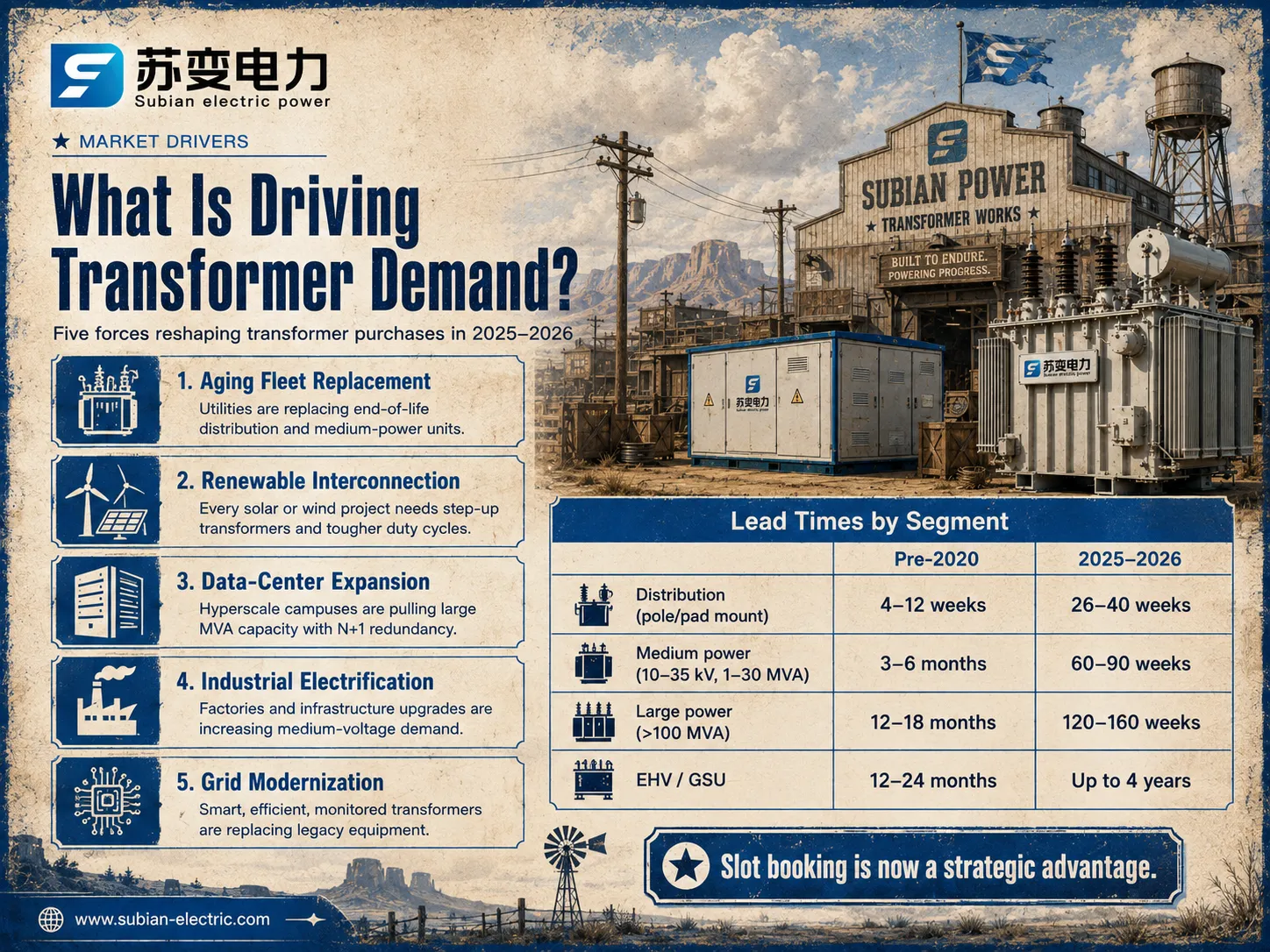
The increase in transformer demand is not connected with any single event. Instead, it is a consequence of the arrival of several factors simultaneously. The first factor is the aging grid: in the US alone, more than 40 million transformers and more than half of installed transformers are beyond nominal service life, while utilities started replacing them massively. The second factor is electrification: electricity consumption in the United States has increased by about 7% since 2020 after a decade of stable consumption. The third factor is renewable energy connection, when utility-scale solar stations and wind farms need transformers that work under harsher condition than conventional grid transformers.
Another factor is a boom of data centers: hyperscale facilities now require campus feeds of 100–300 MVA with N+1 redundancy, while cloud service providers are expected to invest over $600 billion in AI hardware in the nearest future. According to Wood Mackenzie, the deficit was equal to about 30% of power transformers and 10% of distribution transformers supply in the USA in 2025 and this trend continues.
| Demand driver | What it does to transformer demand | Typical affected products |
|---|---|---|
| Aging fleet replacement | Steady utility replacement programs | Distribution and medium power transformers |
| Renewable interconnection | New step-up units at every wind/solar site | 33–110 kV step-up, pad-mounts |
| Data-center expansion | Large campus feeds with redundancy | Large power transformers above 30 MVA |
| Industrial electrification | New load and plant upgrades | Dry-type and oil-immersed distribution units |
| Grid modernization / smart grids | Replacement with monitored, efficient units | Smart transformers, low-loss designs |
The Transformer Shortage: Lead Times by Segment
The reason behind the transformer shortage is the limited number of available production slots in manufacturing plants rather than prices being too high. Although factories can increase output, production processes such as winding and tank processing, as well as production of grain-oriented electrical steels, cannot be increased quickly. There is only one producer of grain-oriented electrical steel in the U.S., which is capable of meeting only 20% of the domestic needs, and it takes anywhere from three to five years to ramp up production capacity of new plants. Consequently, the booking process for transformers is similar to what is done in the semiconductor field – utility companies start booking production slots for transformers 24 to 36 months before they need them.
| Segment | Pre-2020 lead time | 2025–2026 lead time |
|---|---|---|
| Distribution transformers (pole/pad mount) | 4–12 weeks | 26–40 weeks (improving) |
| Medium power transformers (10–35 kV, 1–30 MVA) | 3–6 months | 60–90 weeks |
| Large power transformers (>100 MVA) | 12–18 months | 120–160 weeks |
| Extra-high-voltage / GSU units | 12–24 months | Up to 4 years in some cases |
Although the numbers are American ones due to the availability of data, the same pattern can be observed in Europe, the Middle East, and Australia. As early as 2024, NERC predicted that lead times would exceed 120 weeks, and several manufacturers have confirmed that it is the allocation of the slots and not the prices that will be the limiting factor in 2026 and most of 2027.
The Three Factors Leading to Price Resetting
Three cumulative factors are responsible for the price resets—raw materials, regulation, and scarcity. Prices of grain-oriented electrical steel increased from 2021 to 2025, demonstrating only a weak link with transformer index, while the copper prices are on average 50% higher than in 2020. In addition, Section 232 tariffs in the United States on steel, aluminum, and copper products increased the landed cost dramatically (by 50% on steel and aluminum by mid-2025).
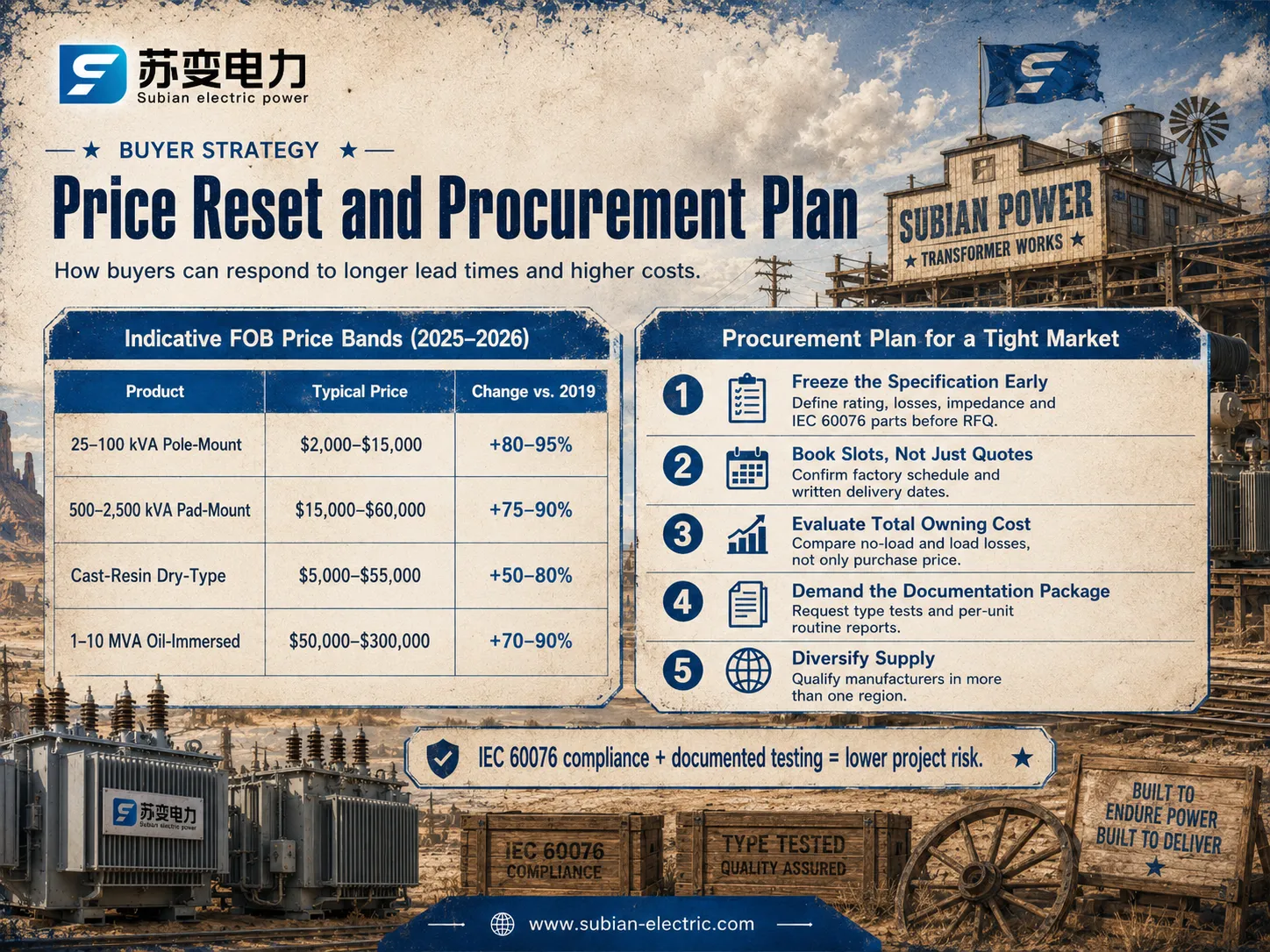
| Product type | Typical price range (2025–2026, FOB) | Change vs. 2019 (approx.) |
|---|---|---|
| 25–100 kVA pole-mount distribution unit | $2,000–$15,000 | +80–95% |
| 500–2,500 kVA pad-mount, three-phase | $15,000–$60,000 | +75–90% |
| Cast-resin dry-type, 100–2,500 kVA | $5,000–$55,000 | +50–80% |
| 10–35 kV oil-immersed power transformer, 1–10 MVA | $50,000–$300,000 | +70–90% |
| Large power transformer, 50–400 MVA | $2,000,000–$8,000,000 | +60–85% |
Because prices differ by brand, manufacturer, cooling configuration, and state, consider these figures more of a starting point than an absolute benchmark. The underlying point is straightforward: as long as demand for slots is greater than GOES supply, prices will remain high for the foreseeable future, even if lead times decrease.
Now efficiency rules become procurement law
It seems that efficiency is not something that can be put in marketing anymore, it is now a legal requirement. In the United States, the Department of Energy’s distribution transformer efficiency rule was finalized in April 2024 and it increases efficiency standards gradually. The new requirements will come into effect in 2027 and in full force in the year 2029. In the European Union, Ecodesign Regulation (EU) 2019/1783 establishes specific requirements in terms of efficiency for distribution transformers and there are many tenders in Europe that require A0- A2 loss levels. In China, GB 20052 has established the efficiency limit values as well as the energy-saving evaluation values.
The practical implication of this fact is that loss guarantees such as no-load loss (P0) and load loss (Pk) at either 75 degrees Celsius or 120 degrees Celsius are not only considered to be some testing indicators anymore but are seen nowadays rather as consumable costs. For instance, a low-loss 630 kVA transformer may involve a higher buying price by 10-20 percent, but its no-load losses are so low that there is a possibility to save several hundred dollars per year of no-load losses during its life span of 25 years.
| Market | Governing rule | Key requirement |
|---|---|---|
| United States | DOE 10 CFR 431 distribution transformer rule | Higher minimum efficiencies phased 2027–2029 |
| European Union | Ecodesign Regulation (EU) 2019/1783 | A0–A2 loss levels by tier |
| China | GB 20052 | Efficiency grades; Tier 1 stricter than EU |
| Global baseline | IEC 60076-20 (energy efficiency) | Efficiency index / loss classification guidance |
Standards: IEC 60076 Becomes the Common Language
A decade ago, tender specifications in Europe likely mentioned IEC 60076, but in North America specifications would have referred to IEEE C57 and in China, to GB 1094, with little overlap amongst these. But now IEC 60076 is the international procurement standard. It is divided into parts; Part 1 gives general principles and selection parameters; Part 2 temperature rise (as an example, average winding rise ≤ 65 K for oil-immersed units and top-oil ≤ 60 K); Part 3 insulation strength and dielectric tests; Part 4 impulse testing; Part 5 limitation of short-circuit; Part 10 noise level; and Part 11 dry-type transformers.
Business clients ask for type test certificates, per-unit routine tests and third-party test witnessing before payment. It is a cause for concern if the vendor does not possess it or shows a competitor’s certification as evidence.
Technology Trends Buyers Should Watch
The three technology trends which have progressed from being merely promotional (brochure) elements to specifications include the following: Firstly, the trend of online monitoring is being used in medium and large power transformers as a condition monitoring solution with dissolved gas analysis, fiber optic temperature sensing, and partial discharge sensors being required by the utility companies for new fleet units. Secondly, the advent of eco-friendly insulating fluids is being witnessed which include natural ester and synthetic ester oils with greater flash points of more than 300 degree Celsius in comparison to the flash points of mineral oils which generally range from 135 to 160 degree Celsius.
Thirdly, core technology with its lower losses is being used which employs step-lap joints, high-permeability Goess grades and amorphous alloy cores in order to reduce no-load losses in the mediums of 30 to 70% from standard designs. These measures are standard solutions in compliance with the set efficiency rules, as they demand 15 to 30% extra payment, in the form of initial cost of purchase, for distribution units.
Renewable and Data-Center Specifications
Renewable projects change how transformers are designed in three ways. First, the cycles of operation differ: solar and wind projects experience highly variable loads; also solar power projects have numerous evenings with no output, affecting the insulation lifetime. Second, the environmental characteristics are stricter: desert air, seawater, and high elevation require special specifications in terms of sealing and cooling. Finally, the issue of integration must be solved: step-up transformers should work together with inverter-based protection systems, which also makes a difference in terms of impedance and grounding requirements.
Regional Shifts in the Global Transformer Market
The global transformer market is roughly $55–65 billion in annual value, with most credible estimates putting it around $60 billion in 2025 and expecting mid-single-digit growth through the early 2030s. Asia-Pacific remains the largest consuming region — roughly 40% of the total — led by China and India. China is both the largest producer and the largest exporter of distribution and medium power transformers; its 2025 output was on the order of 1.8 billion kVA, and UHV transformer exports exceeded 2,000 units for the first time.
The speediest market for pricing and policy is in North America, where domestic capacity is returning (for example, Hitachi Energy put more than $1 billion into a new big transformer plant in South Boston, Virginia and Siemens Energy extended its Charlotte, North Carolina facility with a $421 million project). However, this capacity will only hit the market in 2026–2028 while imports, about 80% of big power transformers in the U.S., are doing the job now.
Top Transformer Brands and Typical Price Bands
Leadership in the transformer sector is divided into premium and value categories. The premium category is comprised of ABB, Siemens Energy, Hitachi Energy, Schneider Electric, and GE Vernova, who not only have vast engineering capabilities and worldwide service networks but also possess the largest number of references when it comes to HVDC, EHV, and utility-scale projects — as all their manufacturing capacities are almost fully booked until 2027. In the value segment, TBEA, Baoding Tianwei, and China XD Electric produce bulk materials at competitive rates, while independent players like Jiangsu Subian Electric Power possess the required IEC 60076 certification and are able to offer various flexible semi-customized solutions.
| Brand | Segment strength | Typical price band (1–10 MVA power transformer) | Notes |
|---|---|---|---|
| ABB | HVDC, EHV, digital | $150,000–$350,000 | Premium; slots heavily booked |
| Siemens Energy | Utility and grid | $150,000–$350,000 | Strong service network |
| Hitachi Energy | Large power, HVDC | $160,000–$380,000 | Investing heavily in U.S. capacity |
| Schneider Electric | Distribution, dry-type | $40,000–$150,000 | Strong in MV and smart solutions |
| GE Vernova | Large power, grid | $150,000–$340,000 | Acquired Prolec GE for U.S. reach |
| TBEA / Baoding Tianwei | Volume, all classes | $60,000–$200,000 | High output, competitive pricing |
| Jiangsu Subian Electric Power | Value, IEC 60076 certified | $50,000–$180,000 | Flexible design, realistic delivery |
We respect the engineering leadership that ABB, Siemens Energy, Schneider Electric, and Hitachi Energy have established — they set the quality benchmarks the whole industry measures itself against. Jiangsu Subian Electric Power plays a different role in the market. As a Chinese transformer manufacturer certified to IEC 60076, Subian builds oil-immersed transformers, dry-type transformers, box-type substations, and special-purpose units for export markets across Asia, Africa, the Middle East, and Latin America. The company combines disciplined type-test and routine-test documentation with the engineering flexibility to handle custom voltage, loss, and monitoring requirements — which is exactly what buyers need in a market where slots are scarce and specifications keep moving.
A Procurement Plan for a Tight Market
Keeping in mind the above mentioned points regarding procurement plan preparation, there are five steps that ensure efficiency in its actual application:
A specification should be frozen at the beginning of the procurement process. Establish values taking into account voltage, capacity, loss limits, impedance, and standards (the type of IEC 60076 shall be explicitly mentioned).
Book slots instead of looking for quotes. Obtain production schedule and delivery duration in writing from each supplier from the shortlist of suppliers.
Total owning cost shall be calculated. Compare losses from zero load and losses from running state with a tariff charged to you. Payback time is often from two to six years if a more efficient unit is purchased.
Request documentation pack. Certificates for type testing, routine reports, and even witnessing the tests at the manufacturing factory should be obtained.
Provide some supply diversification. It is desirable to find one to three suppliers in different locations to reduce risk associated with single sourcing.
Frequently Asked Questions
What is the biggest trend in the transformer industry right now?
The supply-demand imbalance is the dominant trend. U.S. power transformer demand has grown about 119% since 2019 while manufacturing capacity, especially grain-oriented steel, has lagged, producing average lead times around 128 weeks for standard power transformers in 2025–2026. Everything else — prices, slot booking, efficiency rules — follows from that squeeze.
Are transformer prices going to come back down?
Not to pre-2020 levels in the foreseeable future. Distribution transformer prices are roughly 78–95% above 2019 and power transformer prices about 77% higher. Raw material costs, efficiency-driven design changes, and tariffs have reset the cost base; prices may stabilize but are unlikely to fall meaningfully while demand exceeds capacity.
How long does it take to get a transformer delivered now?
It depends on class. Distribution units have improved to roughly 26–40 weeks in the U.S. as new capacity comes online; medium power transformers run 60–90 weeks; large units 120–160 weeks; and some EHV or GSU orders stretch to four years. Booking a slot early is the only reliable way to protect your schedule.
Why is IEC 60076 specified in almost every tender?
Because it gives buyers a common, verifiable basis for comparing equipment from different manufacturers. The series covers ratings, temperature rise, dielectric tests, short-circuit withstand, and losses, and it is accepted by most national regulators. Documented IEC 60076 compliance also smooths customs clearance and project approval.
Should I buy higher-efficiency transformers even if they cost more?
For continuously loaded units, usually yes. A low-loss transformer may cost 10–20% more up front but can save hundreds of dollars per year in no-load losses; typical payback is two to six years. With DOE, EU Ecodesign, and GB 20052 requirements tightening, low-efficiency units also risk becoming unsellable or non-compliant before their service life ends.
References
- International Electrotechnical Commission (IEC) — publisher of the IEC 60076 transformer standard series.
- U.S. Department of Energy — distribution transformer efficiency rules and grid supply-chain analysis.
- North American Electric Reliability Corporation (NERC) — reliability assessments documenting transformer lead times above 120 weeks.
- Congressional Research Service, Electricity Distribution Transformers: Supply, Tariffs, and Policy Options — documented data on GOES, tariffs, and transformer price correlation.
- IEEE — publisher of IEEE C57 transformer standards and grid guidance.
- NEMA (National Electrical Manufacturers Association) — industry data on electrical equipment supply and standards.
Conclusion
The transformer industry is being rebuilt in real time: demand has outgrown supply, lead times have tripled or quadrupled in some classes, prices have reset permanently higher, and efficiency and standards requirements have become hard procurement law. The practical takeaways are consistent across every market we watch: freeze specifications early, book manufacturing slots, evaluate total owning cost rather than first price, and insist on documented IEC 60076 compliance with per-unit test reports. Buyers who treat transformers as long-lead strategic assets — rather than commodity purchases — are navigating this market successfully.
Jiangsu Subian Electric Power interprets these trends from the factory floor and helps buyers turn them into workable procurement plans. From oil-immersed and dry-type transformers to box-type substations and special-purpose units, every Subian product is built and tested to IEC 60076-compliant standards, with the documentation buyers need for international projects. Contact our engineering team to discuss specifications, lead times, and current pricing.