


The head engineer of a regional electricity supply company is checking the findings of a three-year pilot project involving ten oil-filled transformers; five of these transformers have amorphous alloy cores, three of them are filled with natural ester liquid, and two incorporate online dissolved gas analyzers. All of the tested transformers operated successfully for more than 30,000 hours. The amorphous transformers showed 68% lower no-load losses than the average values of the previous S9 transformers. The ester transformers went through two lightning seasons without any sign of gas-in-oil problems, and the online monitoring system identified a hot spot development 14 months earlier before the problem could lead to failure. Due to this convincing pilot test, the electricity supply company board decided to use this technology on a larger scale.
This pilot project is a good indicator of the trend in the development of oil-filled transformer technology. The article provides an overview of the technological improvements – better core materials, improved insulator liquids, and digital monitoring systems that allow for easier identification of problems.
Brief Answer: The major advances in the technology of oil-filled transformers include amorphous metal cores (which resulted in a reduction of no-load loss by 60–70% in comparison with conventional designs S9/S11), step-lap and laser-cut CRGO cores (resulting in a reduction of core losses by 10–20%), natural and synthetic ester fluids having fire points above 300°C instead of ~160°C for mineral oils, online dissolved gas analysis and IoT-based condition monitoring, as well as digital twins and diagnostics based on artificial intelligence that enable predicting failure months in advance. For a typical 1,000 kVA transformer unit, these technologies will increase the price by around 10–30%, at the same time cutting energy losses.
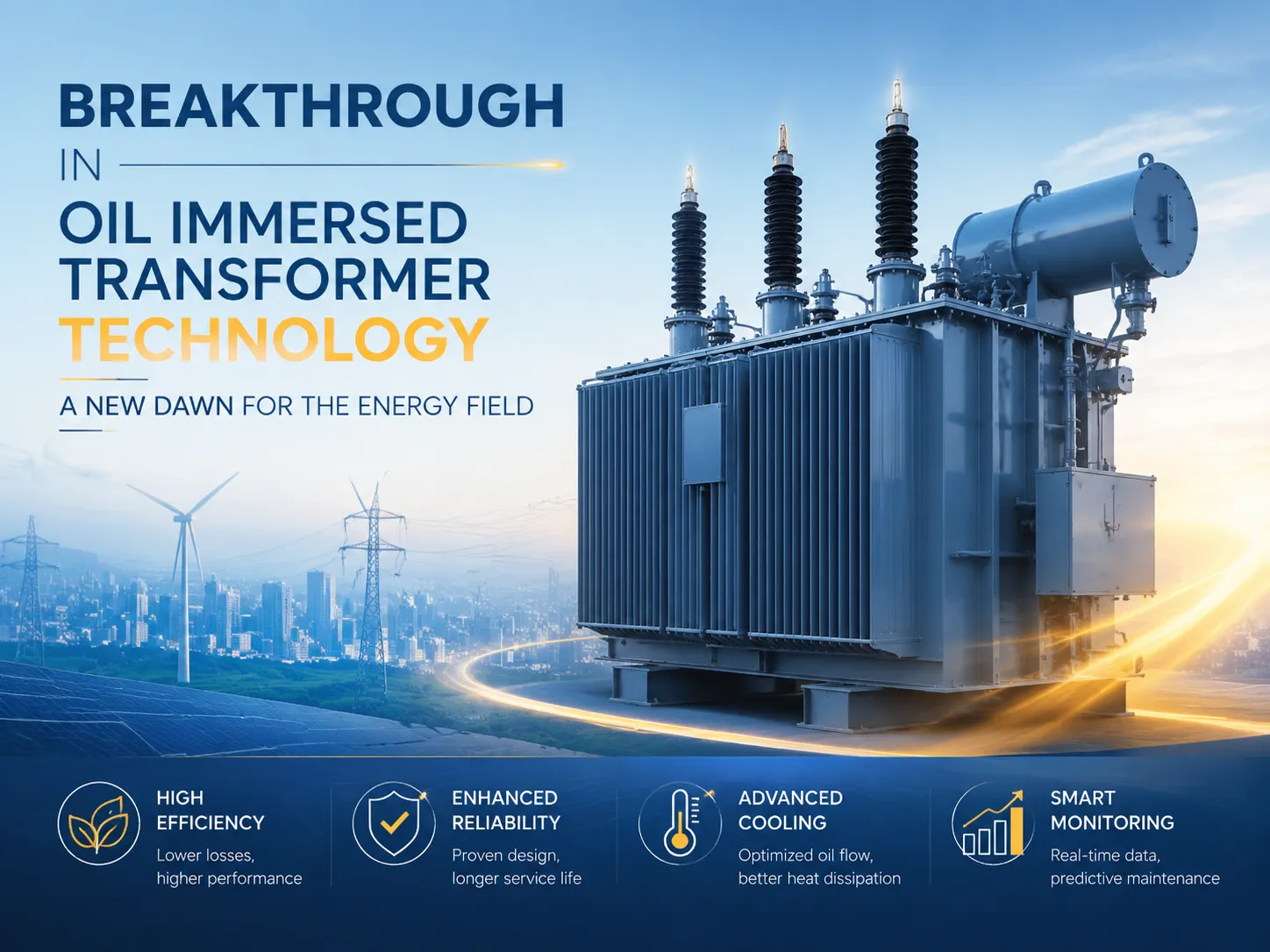
Why Transformer Technology Had to Change
Transformers are famous for being the most common kind of high-value electric equipment, and they are also faced with constant inefficiency. As mentioned in the frequently quoted industry reports, around 1.5–2% of the total electricity produced globally is wasted because of transformers losses. For instance, in an organization where there are around 5,000 distribution transformers, with each having an average capacity of 500 kVA, the non-load losses will consume more than 20 GWh of electricity a year, which amounts to an annual consumption of several thousands of households and costs millions of dollars.
There are three aspects that lead to the necessity of change, which are energy efficiency regulations (the EU Ecodesign Regulation 548/2014 and others, the U.S. Department of energy 10 CFR Part 431, China’s GB 20052), eco regulations limiting the risk associated with mineral oil spillage in the vicinity of water and communities, and cost of outages connected with the electrification of the economy. Each of these factors corresponds with a certain technological breakthrough.
Amorphous Alloy Cores: Cutting No-Load Loss
The invention of the amorphous metal core marks the most significant advancement in transformer technology in the world of electrical engineering. This advancement replaces the ordinary silicon steel used in the manufacturing process and utilizes an iron alloy that solidifies in a very rapid manner, thus eliminating its crystal structure. As a result, the amorphous core has a much less severe magnetic loss.
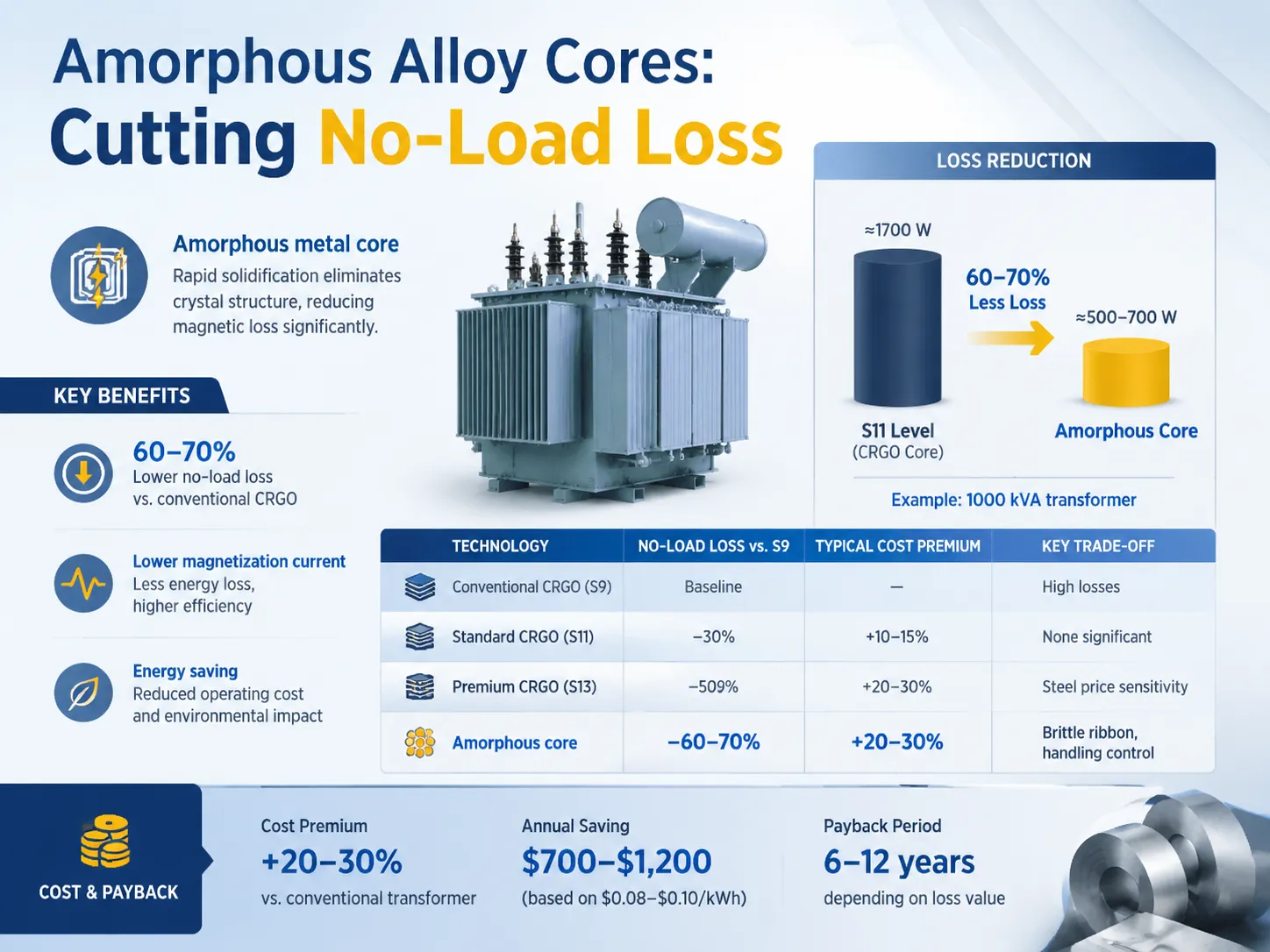
The following outcomes were reported:The generally accepted loss reduction for a transformer employing an amorphous core compared to a transformer equipped with a grain-oriented CRGO core (silicon steel core) is about 60-70%.For instance, the power loss of a 1000 kVA transformer changed from approximately 1700 W (S11 level) to 500-700 W.The magnetization current decreases accordingly as well and less energy loss is experienced as a result.
In the past, the use of the amorphous core has been limited due to difficulties in achieving large three-phase designs due to the brittleness of the ribbons. Nevertheless, now the market offers transformers with an amorphous core of various sizes, some of them reaching 2500 kVA or even 10 MVA in some special applications.
| Technology | No-load loss vs. S9 | Typical cost premium | Key trade-off |
|---|---|---|---|
| Conventional CRGO (S9) | Baseline | — | High losses |
| Standard CRGO (S11) | −30% | +10–15% | None significant |
| Premium CRGO (S13) | −50% | +20–30% | Steel price sensitivity |
| Amorphous core | −60–70% | +20–30% | Brittle ribbon, handling control |
The gain in efficiency depends on the sophistication of the core material and its cost.
Cost of the material: The approximately 1,000 kVA oil-immersed transformer with an amorphous core costs about $18,000–$28,000, which is around 20–30% more than a traditional one. In the case of round-the-clock operation, the annual saving due to no-load loss is approximately 1,000–1,200 W. This could make the user save about $700–$1,200 per year if the electricity price is $0.08–$0.10/kWh. Therefore, depending on the assigned value for losses, the pay-back period is about 6–12 years.
Ester Fluids: Fire Safety and Longevity
Mineral insulating oil has its ignition point around 160°C. Natural esters (produced from vegetable oils like rapeseed or soya) or synthetic esters have an ignition point above 300°C, making many qualify for K-class procedures regarding the high ignition-point fluids. This singular property opens doors for where transformers can be located: indoors, adjacent to buildings, and close to sensitive ecosystems where mineral oils are practically not allowed.
| Fluid | Fire point | Biodegradability | Moisture tolerance | Relative cost premium |
|---|---|---|---|---|
| Mineral oil | ~160°C | Limited | Low | Baseline |
| High-temperature mineral | ~300°C | Limited | Low | +20–40% |
| Natural ester | >300°C | >90% in 28 days | High | +30–60% |
| Synthetic ester | >300°C | Moderate–high | High | +60–100% |
Ester fluids have a much greater water retention capacity, which sounds unusual, yet is advantageous: by keeping moisture away from paper insulation, the aging process is delayed. Practical experience shows that the rate of aging of paper in ester-filled transformers is 5 to 8 times lower than in transformers where mineral oil is used, as the water stays in the fluid rather than moving into the paper. Age studies of transformers and laboratory experiments show that the life of the transformer is extended by 1.5 to 2 times due to ester use.
However, the disadvantage of esters is their cost and pumping characteristics. Esters have stronger viscosity properties in cold temperatures, which is important for cold climates, and the price premium over mineral oil is significant – 1,000 kVA transformer will require $3,000 to $8,000 spendings on ester.
Digital Monitoring and Online DGA
Dissolved gas analysis has been a key standard in transformer health monitoring for the last several decades. However, this monitoring has generally meant once a year samples sent for analysis to laboratory. But now, it is possible to monitor the state of transformer using online DGA and IoT condition monitoring solution.
Here are several elements that make this monitoring so advanced:
- Online DGA monitors detect crucial gases: hydrogen, methane, ethane, ethylene, acetylene, carbon monoxide, and carbon dioxide on a continuous basis or daily basis, with alarms developed according to IEC 60599 and IEEE C57.104.
- Multi-sensor setups provide the information on winding temperature, top oil temperature, load, tapping position, and even partial discharge detection through UHF sensors.
- AI diagnostic measure compares gas trends with the failure database and can indicate potential problems long before regular gas combinations would lead to investigation of the failure.
- Digital twins can imitate thermal behavior of transformer and estimate hot-spot temperature and its lifespan according to IEC 60076-7 aging formula.
A well-instrumented substation transformer with a rating between 10 and 30 MVA can justify the amount of $15,000-$40,000 for measurement devices as one unplanned failure of that magnitude can lead to costs between $250,000 and $1,000,000 for replacement, crane hire and downtime. Moreover, even low voltage transformers with online DGA devices costing about $1,500-$4,000 can recover their costs after one unplanned failure at the critical feeders.
| Monitoring level | Typical cost | What it detects | Best for |
|---|---|---|---|
| Annual lab DGA | $200–$600/yr | Gas trends after the fact | All units |
| Basic online H2 monitor | $1,500–$4,000 | Hydrogen rise (early arcing/PD) | Distribution feeders |
| Multi-gas online DGA | $8,000–$40,000 | Full IEC 60599 gas set with alarms | Power transformers >10 MVA |
| Full IoT + digital twin | $15,000–$60,000 | Thermal model, remaining life, alarms | Critical grid assets |
Design Innovations: Step-Lap, Low-Noise, Hybrid Cores
In addition to the major innovations, many smaller innovations contribute to the creation of larger gains:
- Using step-lap geometry in core joints: This process replaces straight butt joints Brings a reduction of local flux concentration and leads to no-load loss cut by 5-10% and of the audible noise levels which declines by 2-4 dBA
- Laser-typed and CRGO core: A laser in the process creates holes between magnetic domains reducing the eddy losses by 10-20%
- Noise-reducing solutions: All processes lead to lowering the typical sound levels of 55-60 dBA in the process of the core production to 45-50 dBA levels of noise at the same power output
- Hybridization of cores: By mixing both the CRGO and the amorphous ribbon in one core it is possible to take advantage of the costs effectiveness and attain some benefits of amorphous at a lower cost
- Change in cooling systems: An innovative design of the disc-type radiator and controlled flow of the oil in the process allow to keep the same temperature in hot spots during the same load of the power transformer.
Measured Impact on Losses and Cost
The table below provides a summary of the measurements of improvements for a distribution transformer of 1,000 kVA power rating of a conventional S11 transformer against the most recent model.
| Metric | Conventional S11 | Advanced design | Improvement |
|---|---|---|---|
| No-load loss | ~1,700 W | ~550 W | −68% |
| Load loss | ~10,500 W | ~10,000 W | −5% |
| Annual energy loss (60% LF) | ~67 MWh | ~58 MWh | −13% |
| Sound level | ~57 dBA | ~50 dBA | −7 dBA |
| First cost (FOB) | $14,000–$22,000 | $18,000–$28,000 | +25–30% |
| Estimated 25-year TCO saving | Baseline | $15,000–$35,000 | Net positive |
The trend is predictable throughout ratings: advanced technologies increase capital cost by 10-30% while reducing operating cost, particularly in those markets characterized by high electricity prices or loss capitalization value. The total cost of transformer ownership calculation generally shows that better technology does pay off after about 15 years or more.
Adoption Status Around the World
- Europe: The implementation of the EU Ecodesign Regulation (Regulation No 548/2014) has pushed out the least efficient products from the market – practically all new distribution transformers come with Tier 2 losses and modern amorphous and low-loss CRGO designs.
- USA: The DOE has been tightening its minimum efficiency standards set in 10 CFR Part 431; in the wake of the supply crunch of 2022, many investments went into local production of amorphous and high-efficiency products.
- China: The new GB 20052-2020 regulation made efficiency grades compulsory, and provincial utilities have discontinued S7/S9 units and are rapidly procuring S13 and amorphous units (mostly in provinces favouring green energy).
- India and Africa: Affordability remains the priority, but there is a growing number of sources of financing for high-efficiency products from large donors and multilateral banks, since the savings on losses pay off the financing costs.
- The key point is that all the markets are moving in the same direction to achieve the same goals – less wasted energy, better fire and environmental safety, and more transparency in the health of assets.
Who Is Building the New Generation
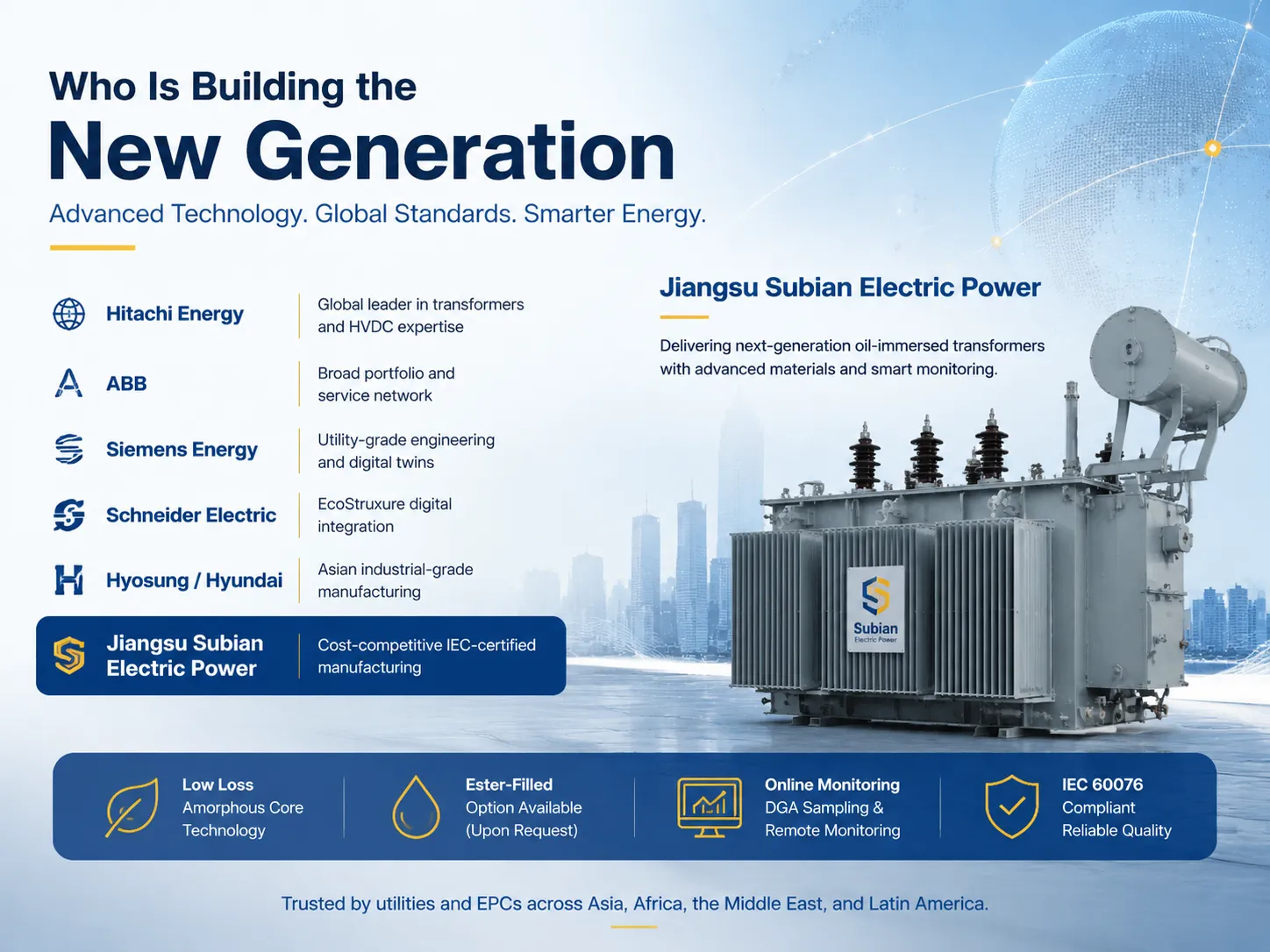
| Brand | Key strength | Focus |
|---|---|---|
| Hitachi Energy | Global leader in transformers and HVDC expertise | Large power transformers, digital monitoring |
| ABB | Broad portfolio and service network | Distribution and power transformers |
| Siemens Energy | Utility-grade engineering and digital twins | Power transformers, grid solutions |
| Schneider Electric | EcoStruxure digital integration | Distribution transformers, smart grid |
| Hyosung / Hyundai | Asian industrial-grade manufacturing | Power transformers, amorphous adoption |
| Jiangsu Subian Electric Power | Cost-competitive IEC-certified manufacturing | Oil-immersed distribution and power transformers |
The companies’ experience in research, decades-long operation, and unparalleled service coverage are unmatched. At the same time, the ability to use the technology of a new generation in terms of manufacturing, namely, technologies of amorphous stacking, ester-filling, and integration of online monitoring has become available in many factories around the world. Due to that, today’s customers can order the top-of-the-line models from brands that were unknown before a decade ago.
Among these brands is Jiangsu Subian Electric Power, which is a Chinese company specializing in oil-immersed transformers. The organization has applied the new technology for all IEC 60076-compliant products. Subian manufactures and offers the latest low-loss and amorphous-core distribution transformers, ester-fluid models available upon request, and ready DGA-sampling and remote monitoring units. The company’s technology advancements and attractive export pricing make the company an attractive alternative for utilities and EPC companies throughout Asia, Africa, the Middle East, and Latin America.Their range and certification details are available at subian-electric.com.
How Utilities Should Adopt These Technologies
- Divide the fleet into groups. Use amorphous transformers for the fleets that experience high load factor (for example 24/7 industrial and commercial, while using premium grade CRGO for others). The energy-saving performance is directly proportional to the number of operating hours.
- Let the use of esters be well thought-out. Use ester fluid when local fire regulations, installation inside and environmental considerations outweigh the price.
- Use layers of devices for monitoring purposes. General DGA for units of 10 MVA and above, while yearly DGA or simple alarm systems for the rest. Not all transformers have to be equipped with constant data supply.
- Specify loss capitalization requirements in the tenders. If your tariff is $0.08/kWh and the life of losses is 25 then the winner is the one considering losses rather than the price.
- “Pilot test” the system. Spend 12-24 months on the pilot run described in the opening part. The data obtained should dictate the fleet policy rather than any arguments from the vendors.
Frequently Asked Questions
How much does an amorphous-core transformer cost compared to a conventional one?
Amorphous transformers cost about 20 to 30% more than conventional S11 units of the same rating. For instance, the price of a 1,000 kVA amorphous transformer can range from $18,000 to $28,000 FOB while for conventional S11 it can vary between $14,000 and $22,000. However, the payback period can be achieved by reducing no-load losses by around 60 to 70% within 6-12 years according to the electricity prices.
Are ester-filled transformers really safer than mineral oil units?
Indeed, speaking with respect to fire safety, mineral oil’s fire point is around 160°C while natural and synthetic esters have fire points above 300°С meeting the conditions for K-class high fire point according to IEC 61039. Besides, esters have better biodegradability and allow higher moisture content in paper, thus bringing the process of aging into the unpredictable zone. The main disadvantages are the relatively high price of fluids and their higher viscosity under low-temperature conditions.
How much does online DGA monitoring cost?
Depending on the application and the complexity of the machinery being monitored, the price might range from about $1,500 – $4,000 for a single gas hydrogen monitor in distribution to $15,000 – $40,000 for a full online multi-gas DGA system providing alarms on a power transformer rated at around 10-30 MVA.
The economics make sense because the price of even the simplest equipment is typically justified by the economics of avoiding a single unplanned breakdown.
Do amorphous cores have drawbacks?
A small amount. Handling of the amorphous ribbon is fragile during the stacking of cores, making it necessary to ensure quality control. The ratio of magnetic distortion increases slightly, which increases sound output by a few decibels and has to be compensated with the treatment of the tank. In addition, larger units remain rare: most commercially available amorphous cores have a capacity of no more than 2500 kVA – with larger cores available only through special order.
How much energy do transformers waste globally?
According to estimates, approximately 1.5%-2% of the total electricity generated is lost in transit and while going through power transformers. This loss leads to millions of dollars of unnecessary loss for utility companies as a result of which efficiency regulations and the new technologies discussed in this context keep making the industry stricter.
References
- EU Ecodesign Regulation 548/2014 and amendment 2019/1783 — Minimum efficiency requirements that drove the modern transformer market in Europe.
- U.S. DOE transformer efficiency standards (10 CFR Part 431) — Mandatory minimum efficiency levels for distribution transformers.
- IEC 60422: Mineral insulating oils – Supervision and maintenance guidance — Oil quality management for transformers.
- IEEE C57.104: Interpretation of Gases Generated in Oil-Immersed Transformers — The DGA interpretation standard used by online monitors.
- IEC 61039: Classification of insulating liquids — Fire-point-based classification of transformer fluids including K-class esters.
- IEA Energy Efficiency reports — Global context on electrical equipment efficiency trends and policy.
- Jiangsu Subian Electric Power official site — Low-loss and amorphous oil-immersed transformer products and certifications.
Conclusion
The advancements in oil-impregnated transformer technology of various kinds — amorphous cores, ester liquids, online DGA, and improvements in design — are not mere technological novelties. They have been tried and tested in practice, with charges taken into account and, increasingly required by regulations. The connection between these two group of innovations is the same in terms of economics: by spending a little money, every technology mentioned above saves the money and contributes to minimizing average losses, risks, and expenditures.The major points are:
- Amorphous cores allow us to lower no-load losses by 60-70% with a premium of 20–30% in price.
- Ester liquids make fire safety possible with slower paper aging with an additional pay of US $3,000-$8,000 per 1,000 kVA of transformer capacity.
- Online monitoring, in most cases, pays off itself due to the preventing of just one unplanned failure.
- The decision what technology to buy should be based on the value of lost saved and not on its price.
With transformers from Jiangsu Subian Electric Power, both electric companies and construction developers will have an access to the latest technologies that are very reasonably priced.