


In Lagos, an electrical contractor placed an order of twelve dry-type transformers of capacity 1000 kVA per unit at a very attractive price. However, during the commissioning stage, it was revealed that the units were shipped with mismatch of impedance by 5 percent, absence of partial discharge certificate, and nameplate which did not match with the factory test report. As a result, the whole project was delayed for three months, and the client lost confidence in the supplier chain. It is the story that repeats in every market where customers judge the price per kVA as the main criterion for choosing the supplier.
This buyer’s guide will help you understand how to go about the process of purchasing dry-type transformers. Thus, you will be guided through every stage of the process starting from determining your voltage, load, environment and continuing with reading quotations, checking compliance with IEC 60076-11 guide, carrying out inspection, and computing total cost of ownership.
The dry-type transformer is an air-cooled transformer with a capacity ranging from 25 kVA to 12,500 kVA. It is insulated with cast epoxy resin or class-H varnish, and not with oil, and is used in principle according to IEC 60076-11 (and IEEE C57.12.01 / NEMA TP-1 in North America). The core buying process includes: establishing the voltage and short-circuitity of the system, determining losses and efficiency class, choosing between cast resin and VPI, checking the K-factor in case of non-linear loads, getting the test certificates, and adding 10-15% to the cost of the transformer for shipping, customs, and commissioning.
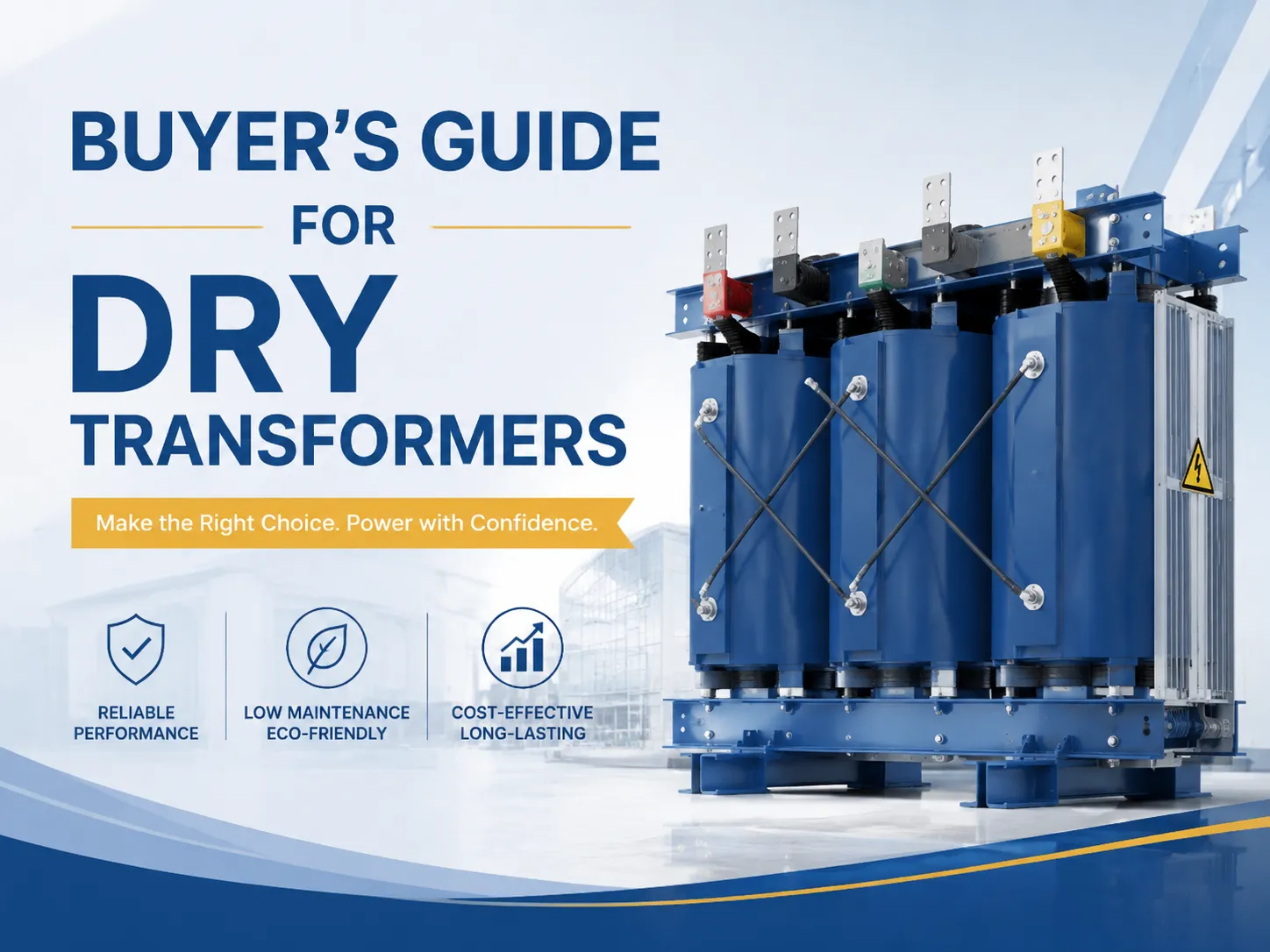
What Is a Dry-Type Transformer?
A dry-type transformer is one that transmits electricity using magnetic induction and no liquid insulation. Instead, the conductors are insulated using mild materials like epoxy resin or Class H varnish while the core is made up of a series of silicon-steel laminations. This type of transformer is used in any places where oil cannot be used, including buildings, tunnels, ships, and towers.
The maximum voltage levels allowed under the IEC regulations can reach 36 kV and the most common power of transformers ranges from 50 kVA to 12,500 kVA. Losses, impedance, and temperature rise are values that have to be confirmed based on the data included in the routine test report, which should be provided by the manufacturer with every delivery.
How It Works
The magnetization of the laminated steel core occurs due to the flow of alternating current. As such, a magnetic field is created that induces a current in the secondary winding through electromagnetic induction as prescribed by Faraday’s law. In transformers, the voltage and primary to secondary turns ratios are equivalent: hence, a transformer with 100 primary windings and 10 secondary windings will reduce the voltage by a factor of ten while at the same time increasing the current by the same factor.
Heat limits the operation of transformers; copper losses increase with the square of load; core losses remain constant during operation. In this respect, dry-type insulation systems are limited to temperature classes F (155°C) and H (180°C), with rise in temperature equal to 100 K and 125 K above an ambient level of 40°C. If these limits are exceeded, insulation may be damaged permanently after a few hours of operation.
Types and Construction
| Construction | Insulation System | Rating Range | Key Characteristics |
|---|---|---|---|
| Cast-resin (encapsulated) | Epoxy resin, vacuum cast | 100–12,500 kVA | Moisture-resistant, self-extinguishing, low PD, quiet |
| VPI (vacuum pressure impregnated) | Class H varnish | 25–3,000 kVA | Lower cost, good performance in clean indoor air |
| Open ventilated dry type (OVDT) | Aramid paper + varnish | 500–3,000 kVA | Utility-style open coils, high thermal endurance |
| Amorphous metal core | Cast resin or VPI | 50–2,500 kVA | 70–80% lower no-load losses, higher first cost |
For most commercial clients, the choice is usually between cast-resin and VPI. Cast-resin is more expensive, about 15% to 30% more expensive than VPI, but it copes better with humidity, partial discharge stress and repeated energization. As a result, the data center and process industries prefer cast-resin.
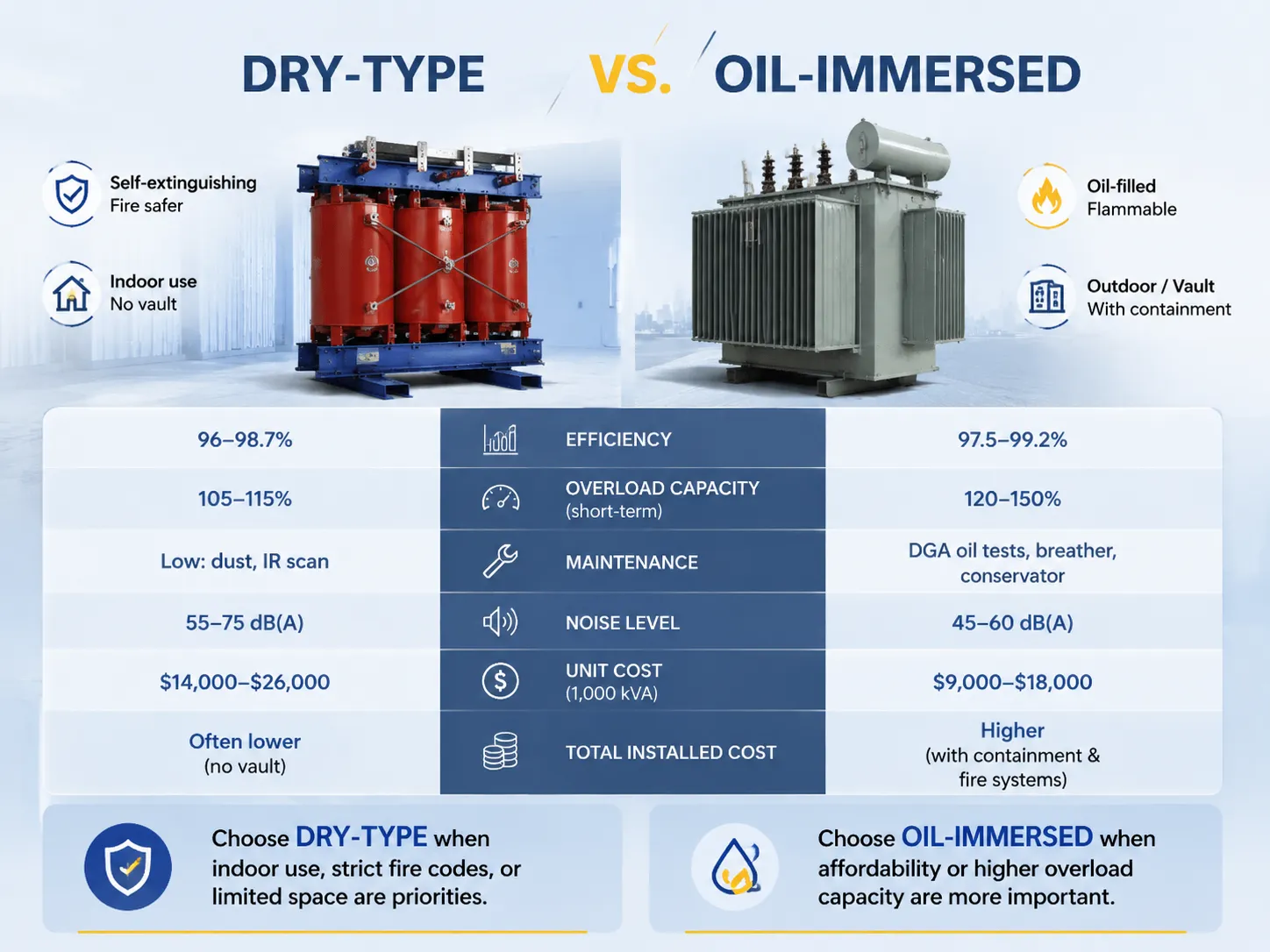
Dry-Type vs. Oil-Immersed
| Criterion | Dry-Type | Oil-Immersed |
|---|---|---|
| Safety / fire | Self-extinguishing materials | Flammable oil, containment needed |
| Installation | Indoor, no vault | Outdoor or vault with bund/pit |
| Efficiency | 96–98.7% typical | 97.5–99.2% typical |
| Overload | 105–115% short-term | 120–150% short-term |
| Maintenance | Low: dust, IR scan | DGA oil tests, breather, conservator |
| Noise | 55–75 dB(A) | 45–60 dB(A) |
| Unit cost, 1,000 kVA | $14,000–$26,000 | $9,000–$18,000 |
| Total installed cost | Often lower (no vault) | Higher once containment and fire systems count |
Select dry-type units when indoor use is required or when compliance with strict fire codes or having a constricted floor space is more significant. Select oil-filled units when affordability or having a higher overload headroom is more relevant than the idea of installing indoors.
Specifications You Must Verify
| Parameter | What to Ask For | Typical Value |
|---|---|---|
| Rated power | Continuous kVA at stated ambient | 100–2,500 kVA (distribution) |
| Primary/secondary voltage | Both, with tap range | 11 kV / 0.4 kV; 33 kV / 11 kV, ±2×2.5% |
| Impedance (uk) | Short-circuit voltage at rated current | 4–8%, tolerance ±7.5% |
| Losses | No-load and load loss at 120°C | See efficiency table below |
| Temperature rise | Winding rise class | 100 K (F) or 125 K (H) |
| Insulation level | Lightning impulse (LI) and power frequency (AC) | e.g. 75/28 kV for 11 kV system |
| Noise level | Sound pressure at 1 m | 55–75 dB(A) |
| Cooling method | AN, AF or ANAF | AN standard; AF adds 15–20% capacity |
| Standards | Governed standard and test certificate | IEC 60076-1/-11, IEEE C57.12.01 |
Efficiency Classes and Loss Values
| Rating (kVA) | No-Load Loss (W) | Load Loss @120°C (W) | Efficiency @100% |
|---|---|---|---|
| 250 | 500–700 | 2,600–3,800 | 98.1–98.6% |
| 630 | 1,000–1,400 | 6,000–8,500 | 98.2–98.8% |
| 1,000 | 1,500–2,100 | 8,900–12,500 | 98.3–98.9% |
| 1,600 | 2,100–3,000 | 13,000–18,000 | 98.5–99.0% |
| 2,500 | 3,000–4,200 | 19,000–26,000 | 98.7–99.1% |
High-efficiency transformers (often made of amorphous metal core or a better grade of silicon steel) have lower no-load losses, saving about 30-60% compared to the conventional designs. If the machine is energized all day through the year and powered by light loads, the cost of savings would cover the additional costs of 10-25% of the original investment over the period of three to six years. The calculations of the investment payback must be done assuming the loss costs of $3,000 to $6,000 for every kW of the loss.
Applications Across Industries
- Office buildings and skyscrapers: basement electrical rooms with distribution approach of 11/0.4 kV, without use of oil.
- Data centers: dry-type transformers with rating of 750–3,000 kVA, used for the feeds of 480/277 V and 208/120 V panelboards.
- Renewable sources: wind turbine transformers with rating from 1 to 5 MVA inside the tower and solar plants which provide auxiliary supply.
- Railway transport: traction auxiliary transformers which can work under vibrations and humidity inside tunnels.
- Marine area: cast-resin small transformers which maintain their work under salty sprays and condensation.
- Industrial sector: isolation and step-down transformers for the purposes of motor controls and drives.
Top Brands and Price Ranges
| Brand | Country | 1,000 kVA Price | 2,500 kVA Price | Strength |
|---|---|---|---|---|
| ABB | Switzerland | $22,000–$36,000 | $40,000–$62,000 | Global network, digital monitoring |
| Siemens | Germany | $21,000–$35,000 | $38,000–$58,000 | GEAFOL cast-resin reference |
| Schneider Electric | France | $22,000–$37,000 | $39,000–$60,000 | Eco-design portfolio |
| Hitachi Energy | Switzerland/Japan | $23,000–$38,000 | $41,000–$65,000 | High-power cast resin |
| Eaton | Ireland/US | $15,000–$26,000 | $28,000–$45,000 | UL/NEMA line, fast stock in Americas |
| CG Power | India | $16,000–$28,000 | $29,000–$47,000 | Value pricing, EMEA reach |
| Jiangsu Subian Electric Power | China | $12,000–$22,000 | $22,000–$38,000 | Direct factory, OEM/ODM, IEC 60076 tested |
Well-known brands such as ABB, Siemens, Schneider Electric, and Hitachi Energy charge high prices for local connections, technical assistance, and many years of proving technology. However, construction is obsolete as grain-oriented steel cores, resinification, and ordinary IEC testing remain the same everywhere. For example, manufacturers like Jiangsu Subian Electric Power supply transformers that comply with IEC 60076 standards at a price that is 30% to 50% less than official European prices while shipping their products to over 60 locations. One cannot choose anything other than two manufacturers and two local suppliers to compare costs, including delivery and inspection fees.
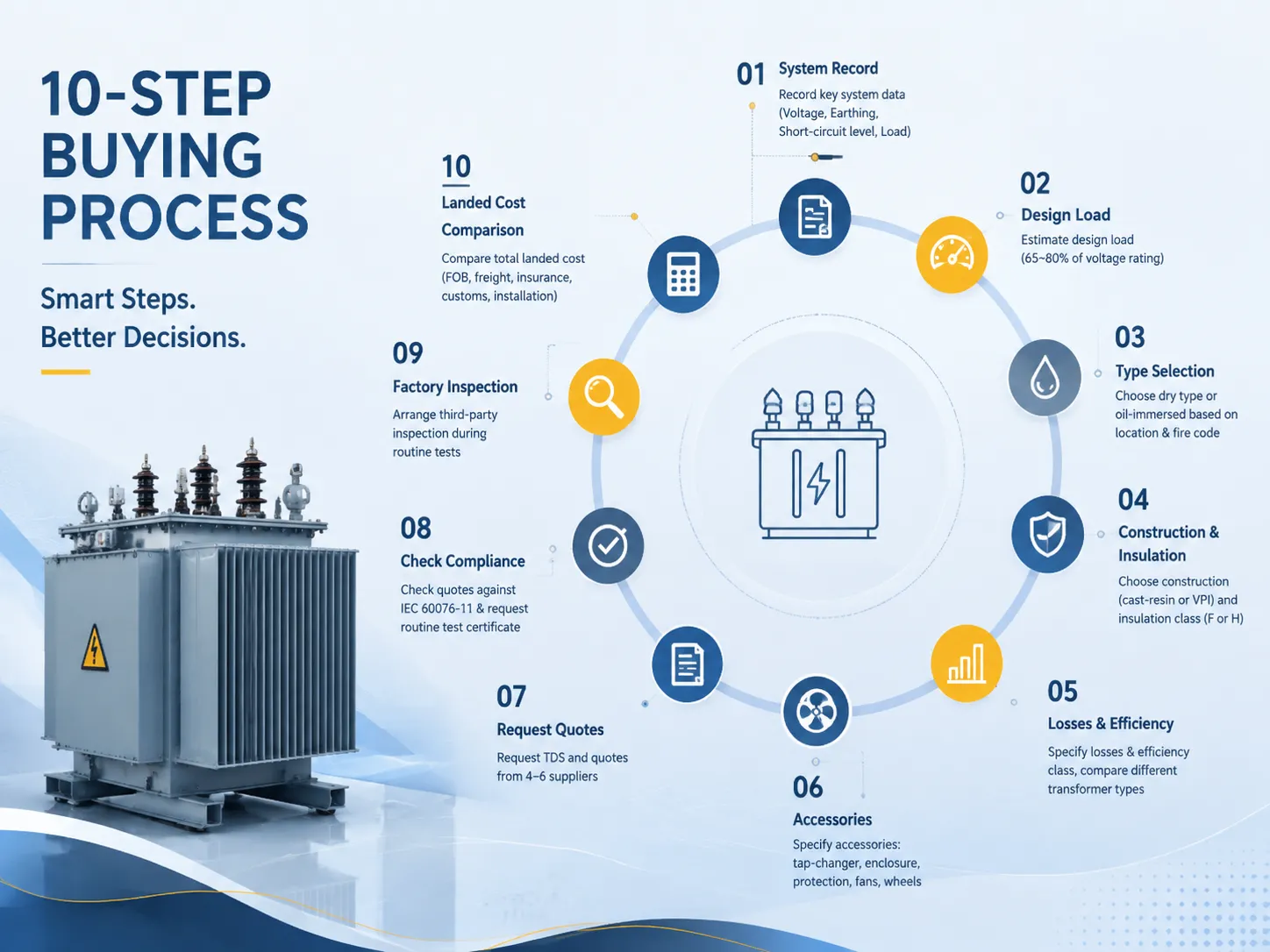
The 10-Step Buying Process
- It is necessary to record all aspects of the system being used in terms of specification: nominal voltage, earthing arrangement, short-circuit level and load in kVA and load profile.
- Use a calculating method to estimate design load of 65~80% of the voltage rating, thus achieving maximum efficiency.
- Choose dry type or oil-immersed transformer based on location, fire code and installation cost.
- Choose construction method (cast-resin or VPI) and insulation class (F or H).
- Specify losses and efficiency class. Tally losses with efficiency of different type of transformers.
- Determine the type of accessories, such as tap-changer, enclosure, thermistor/PTC protection, fans and wheels.
- Order a technical data sheet and quotes from four to six suppliers.
- Check quotes against IEC 60076-11 and ask for routine test certificate for the reference unit.
- If possible, arrange third-party inspection at the factory during the routine tests (it will cost 1-3% of the unit price).
- By using landed cost comparison formula (which includes not only FOB price, but also freight charges, insurance, customs and, of course, installation expenditure) for comparing contacts.
Reading Quotations and Avoiding Traps
- Losses classified as either guaranteed or measured: only guaranteed losses that can be tested will be accepted – a 10% variance results in loss valuation in the range of $1,500–$4,000 for every machine unit.
- Impedance tolerance: standard is ±7.5% according to IEC 60076-1; and a higher tolerance can result in the breakdown of protection coordination.
- Ambient base: it must be ensured that the design ambient is specified (typically is 40°C); if quotation is done at 30°C, that isn’t of direct comparability.
- Enclosure and cooling: confirm if IP23, fans, and the presence of sensors are taken into account in pricing or stated separately, which is quite frequent and increases pricing by 8-15%.
- Incoterms: ascertain whether prices are expressed as EXW, FOB, or CIF; quotations being expressed as EXW can be misleading since they appear to be really cheap but afterward turn out to be double the price as freight and insurance must be considered.
- Documentation: make sure that various types test certificates, routine test report, drawings, and warranty for one year with stated conditions will be provided.
Factory Inspection and Testing
- Observe regular examinations following IEC 60076-1/60076-11: turns ratio, resistance, no-load and load losses, IR assessment, elevated voltage examination, and partial discharge (for cast resin).
- Compare the nameplate data to the order details: power rating, voltage, impedance, losses, criteria, date of any manufacturing.
- Photographical observations of the condition of the cast resin coils, tracing any cracks, bubbles, or discoloration from previous curing processes.
- Check the hardness of the core clamps as well as that the ground lugs are available.
- Take pictures of the serial numbers, test arrangement, as well as the packaging.
Delivery, Installation and Maintenance
- Lifting should only be done with rated lifting lugs and not by using slings on bushings, coils and fan shields.
- Store indoors, and if the storage period is longer than 6 months an IR test should be performed and an energization should be done for 4-6 hours under no load condition beforehand.
- Place on a flat base which is at least 600-700 mm in height at the front with 200-300 mm clearance at the back for air flows.
- Measure IR before the energizing operation; if less than 100 MΩ at 500 V is measured, dry it out.
- Carry out infrared scanning for the first time in 30 days after commissioning and then quarterly; tighten the loose connections with more than 20 K temperature difference.
- Perform cleaning of the radiator ducts and fins once a year using a small degree of vacuum cleaning.
Frequently Asked Questions
How much does a dry-type transformer cost per kVA?
The cost of cast-resin transformers ranges from approximately $14 to $26 per kVA for units with power ratings ranging from 630 to 2000 kVA, and price ranges for VPI transformers vary from $9 to $18 per kVA when factory-bound. A typical cast-resin transformer with a power rating of 1000 kVA will cost between $14,000 and $26,000, excluding taxes ranging from 10 to 15% for shipping, customs clearance charges, and installation expenses. Prices vary according to brand, specifications, and geographical differences.
What is the difference between cast-resin and VPI dry-type transformers?
Winding and epoxy materials can be found in cast-resin transformers. This unique type of transformer offers an extremely high degree of protection against moisture without compromising performance in operations since it provides low partial discharge of less than 10 pC. It is definitely recommended for installations in humid or fire-prone areas.
Can a dry-type transformer be installed outdoors?
Yes, as long as the unit has proper enclosures (normally IP54 or IP55 weatherproof), it can have heating strips to control condensation and a sun roof. Units rated for indoor use, like IP23, installed outdoors will deteriorate insulation and cause insulation tracking failure. Dry-type outdoor-rated units cost about 10 to 20 percent more than indoor units of similar design.
How long do dry-type transformers last?
When used under the appropriate temperature conditions and maintained clean, cast-resin type transformers usually last more than 25–30 years in service life. Insulation life decreases by about two times for every increase in temperature exceeding standard values by 8–10°C. Hence, to preserve your equipment, it is recommended to keep the temperature of the windings within the limits given in the specification.
Why are dry-type transformers more expensive than oil-filled ones?
The price of materials required for dry type transformers is higher due to epoxy resin and class H insulation in place of bulk transformer oil, and dry types need more substantial conductors as air cooling is less efficient than oil cooling. At the same time, once making adjustments to the vault, oil containment, and extending fire-suppression systems, the overall cost of the dry system tends to be lower even in indoor locations.
References
- IEC 60076-11: Power Transformers – Dry-Type Transformers — core standard for ratings, losses, temperature rise and testing of dry-type units.
- IEC 60076-1: General Requirements — covers rated values, tolerances, and general test procedures for power transformers.
- IEEE C57.12.01: Dry-Type Distribution and Power Transformers — North American requirements and test methods.
- NEMA TP-1: Guide for Determining Energy Efficiency of Distribution Transformers — the efficiency benchmark used across North American tenders.
- U.S. DOE Distribution Transformer Efficiency — explains minimum efficiency regulations and loss evaluation.
- NFPA 70 (NEC) — installation and clearance requirements for transformer locations.
- Jiangsu Subian Electric Power — IEC 60076-compliant dry-type transformer manufacturer offering cast-resin and VPI lines with OEM support.
Conclusion
A successful purchase of a dry-type transformer depends on the type of specification you provide, the completeness of your quotations, and the quality of factory inspection. Dry-type transformers are proven technology; you differentiate a favorable purchase from an expensive purchase based on verifications of losses, impedance, temperature rise class, and conformity to standards instead of relying on a technical specification sheet.
- Articulate the IEC 60076-11 conformity, losses level, and test submissions in writing.
- Do a comparison of the total cost of ownership with landed price, and include a loss estimation of $3,000-$6,000 per kW.
- Also, be ready to pay an additional 10-15% on top of the price for logistics.
Irrespective of whether you are buying from market leaders like ABB and Siemens, or directly from Jiangsu Subian Electric Power, the contract should specify the standards used, the necessary tests, and warranty provisions.